QUESTION IMAGE
Question
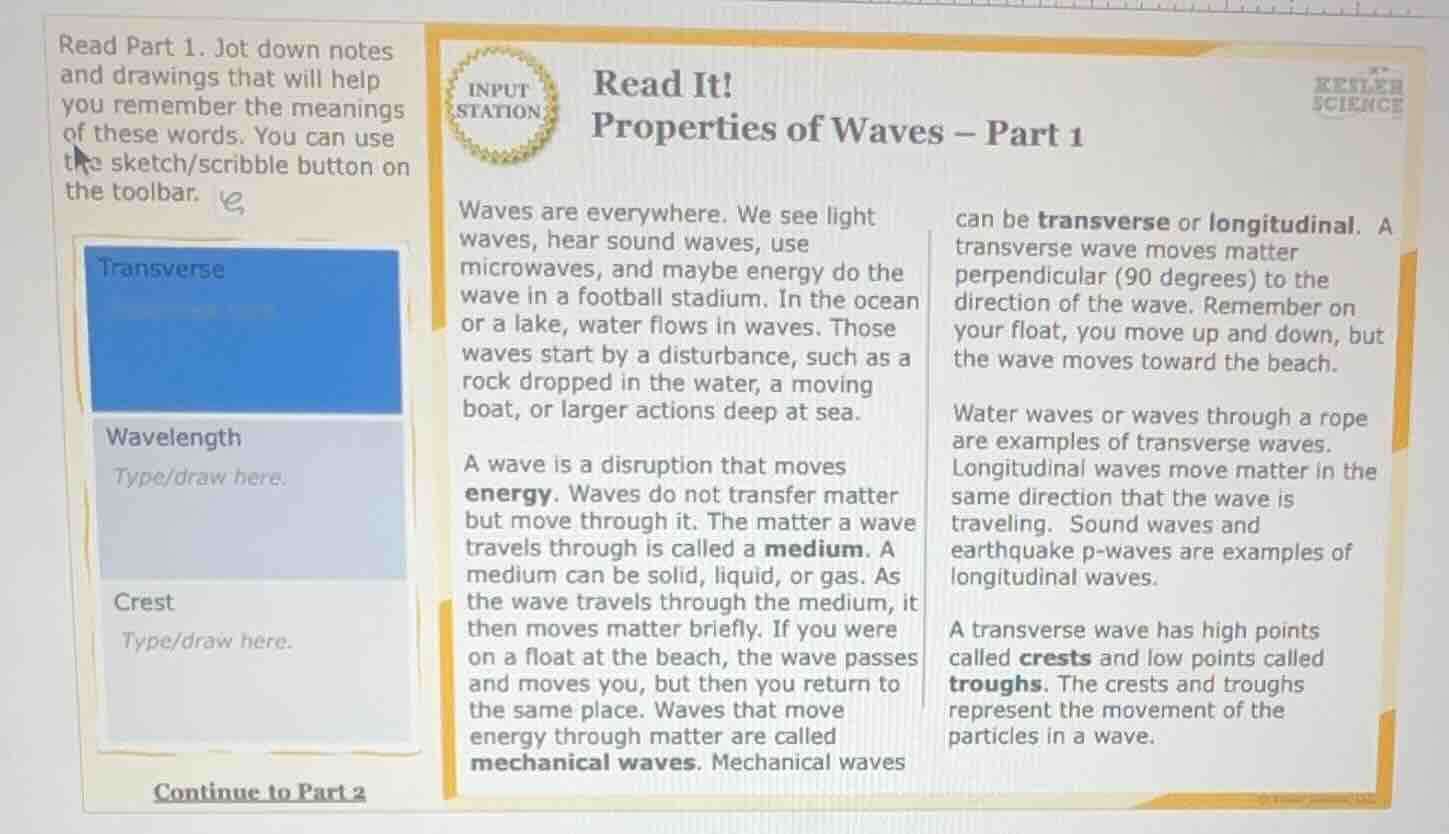
read part 1. jot down notes and drawings that will help you remember the meanings of these words. you can use the sketch/scribble button on the toolbar.
transverse
type/draw here.
wavelength
type/draw here.
crest
type/draw here.
continue to part 2
input station
read it!
properties of waves – part 1
waves are everywhere. we see light waves, hear sound waves, use microwaves, and maybe energy do the wave in a football stadium. in the ocean or a lake, water flows in waves. those waves start by a disturbance, such as a rock dropped in the water, a moving boat, or larger actions deep at sea.
a wave is a disruption that moves energy. waves do not transfer matter but move through it. the matter a wave travels through is called a medium. a medium can be solid, liquid, or gas. as the wave travels through the medium, it then moves matter briefly. if you were on a float at the beach, the wave passes and moves you, but then you return to the same place. waves that move energy through matter are called mechanical waves. mechanical waves can be transverse or longitudinal. a transverse wave moves matter perpendicular (90 degrees) to the direction of the wave. remember on your float, you move up and down, but the wave moves toward the beach.
water waves or waves through a rope are examples of transverse waves. longitudinal waves move matter in the same direction that the wave is traveling. sound waves and earthquake p - waves are examples of longitudinal waves.
a transverse wave has high points called crests and low points called troughs. the crests and troughs represent the movement of the particles in a wave.
To answer questions about the "Properties of Waves - Part 1" text, here are brief explanations and answers for potential questions (assuming a common question about wave types or definitions):
Example Question 1: What are the two types of mechanical waves?
The text states mechanical waves (waves moving energy through matter) can be transverse or longitudinal. Transverse waves move matter perpendicular to the wave’s direction (e.g., water waves), while longitudinal waves move matter parallel to the wave’s direction (e.g., sound waves).
The text says the matter a wave travels through is called a medium, and it can be solid, liquid, or gas.
The text lists water waves (or waves through a rope) as examples of transverse waves, where matter moves perpendicular to the wave’s direction.

Snap & solve any problem in the app
Get step-by-step solutions on Sovi AI
Photo-based solutions with guided steps
Explore more problems and detailed explanations
Transverse and longitudinal