QUESTION IMAGE
Question
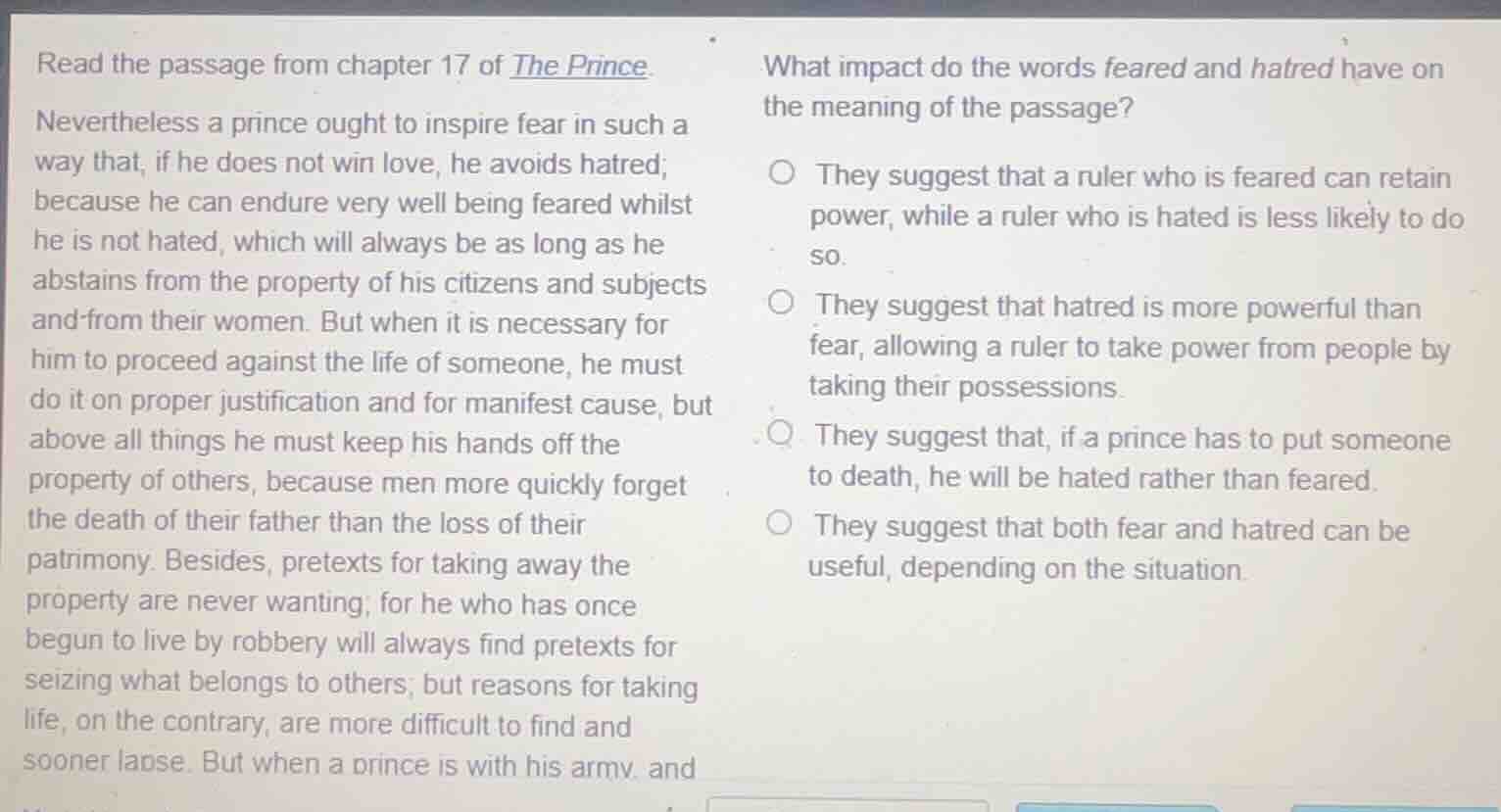
read the passage from chapter 17 of the prince. nevertheless a prince ought to inspire fear in such a way that, if he does not win love, he avoids hatred; because he can endure very well being feared whilst he is not hated, which will always be as long as he abstains from the property of his citizens and subjects and from their women. but when it is necessary for him to proceed against the life of someone, he must do it on proper justification and for manifest cause, but above all things he must keep his hands off the property of others, because men more quickly forget the death of their father than the loss of their patrimony. besides, pretexts for taking away the property are never wanting, for he who has once begun to live by robbery will always find pretexts for seizing what belongs to others; but reasons for taking life, on the contrary, are more difficult to find and sooner lapse. but when a prince is with his army, and what impact do the words feared and hatred have on the meaning of the passage? \bigcirc they suggest that a ruler who is feared can retain power, while a ruler who is hated is less likely to do so. \bigcirc they suggest that hatred is more powerful than fear, allowing a ruler to take power from people by taking their possessions. \bigcirc they suggest that, if a prince has to put someone to death, he will be hated rather than feared. \bigcirc they suggest that both fear and hatred can be useful, depending on the situation.
The passage states a prince can be feared without being hated if he avoids seizing citizens' property/women; being feared (without hatred) lets him keep power, but hatred (from taking property) undermines his rule. The first option aligns with this core distinction between the two terms' impacts on retaining power. The other options misinterpret the text: the passage does not say hatred is more powerful, that killing leads to hatred over fear, or that both are useful.

Snap & solve any problem in the app
Get step-by-step solutions on Sovi AI
Photo-based solutions with guided steps
Explore more problems and detailed explanations
They suggest that a ruler who is feared can retain power, while a ruler who is hated is less likely to do so.