QUESTION IMAGE
Question
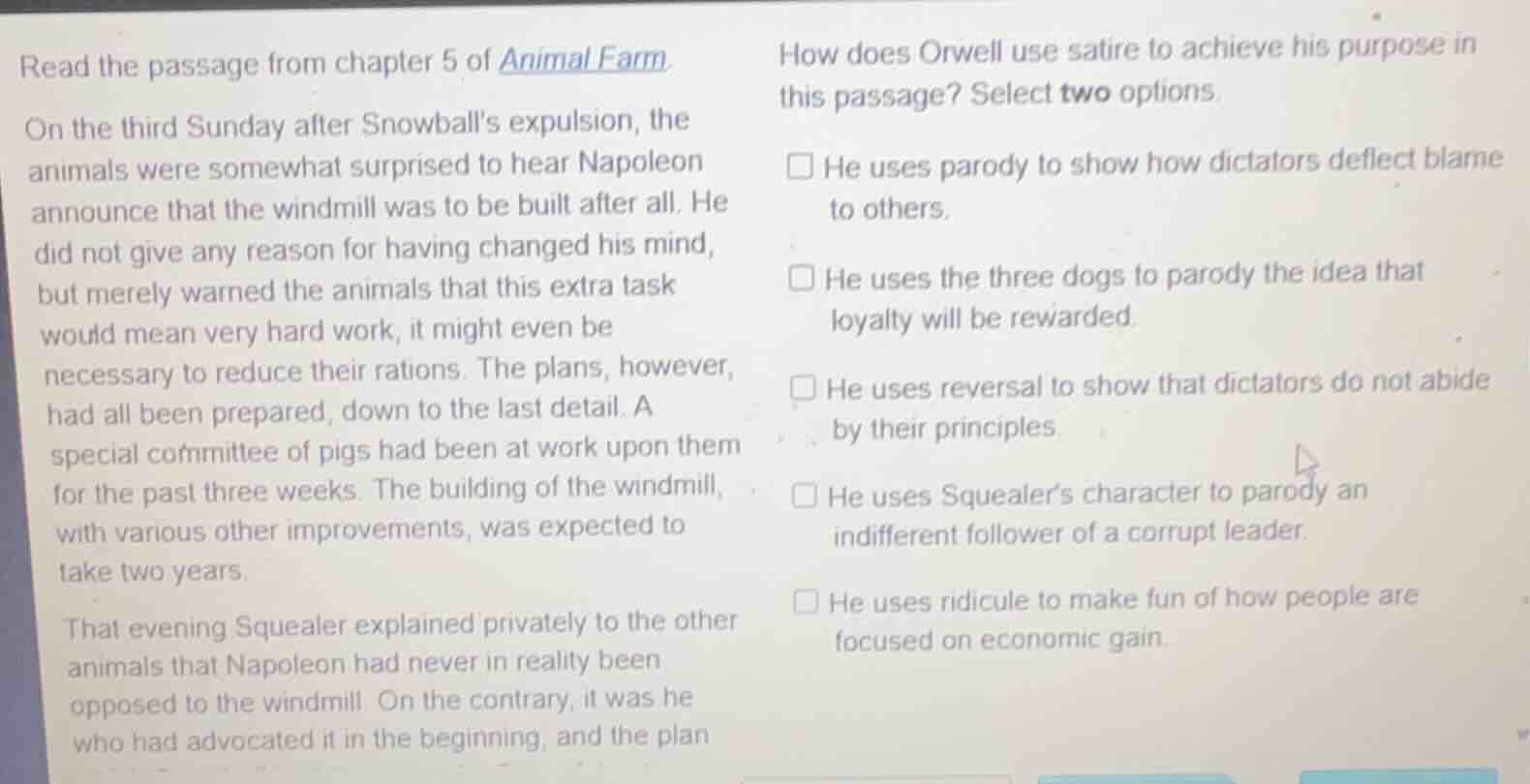
read the passage from chapter 5 of animal farm.
on the third sunday after snowballs expulsion, the animals were somewhat surprised to hear napoleon announce that the windmill was to be built after all. he did not give any reason for having changed his mind, but merely warned the animals that this extra task would mean very hard work, it might even be necessary to reduce their rations. the plans, however, had all been prepared, down to the last detail. a special committee of pigs had been at work upon them for the past three weeks. the building of the windmill, with various other improvements, was expected to take two years.
that evening squealer explained privately to the other animals that napoleon had never in reality been opposed to the windmill. on the contrary, it was he who had advocated it in the beginning, and the plan
how does orwell use satire to achieve his purpose in this passage? select two options.
□ he uses parody to show how dictators deflect blame to others.
□ he uses the three dogs to parody the idea that loyalty will be rewarded.
□ he uses reversal to show that dictators do not abide by their principles.
□ he uses squealer’s character to parody an indifferent follower of a corrupt leader.
□ he uses ridicule to make fun of how people are focused on economic gain.
- For the first correct option: Orwell uses reversal (Napoleon was against the windmill, then supports it) to show dictators don't follow their principles. This matches the "reversal" option.
- For the second correct option: The "parody to show how dictators deflect blame" fits as Napoleon changes his stance and gives no real reason, deflecting responsibility, using parody (a satire technique) to critique dictators. The other options are incorrect: the three dogs option misinterprets their role; Squealer is not an indifferent follower but a propagandist; the ridicule about economic gain is not the focus here.

Snap & solve any problem in the app
Get step-by-step solutions on Sovi AI
Photo-based solutions with guided steps
Explore more problems and detailed explanations
A. He uses parody to show how dictators deflect blame to others.
C. He uses reversal to show that dictators do not abide by their principles.