QUESTION IMAGE
Question
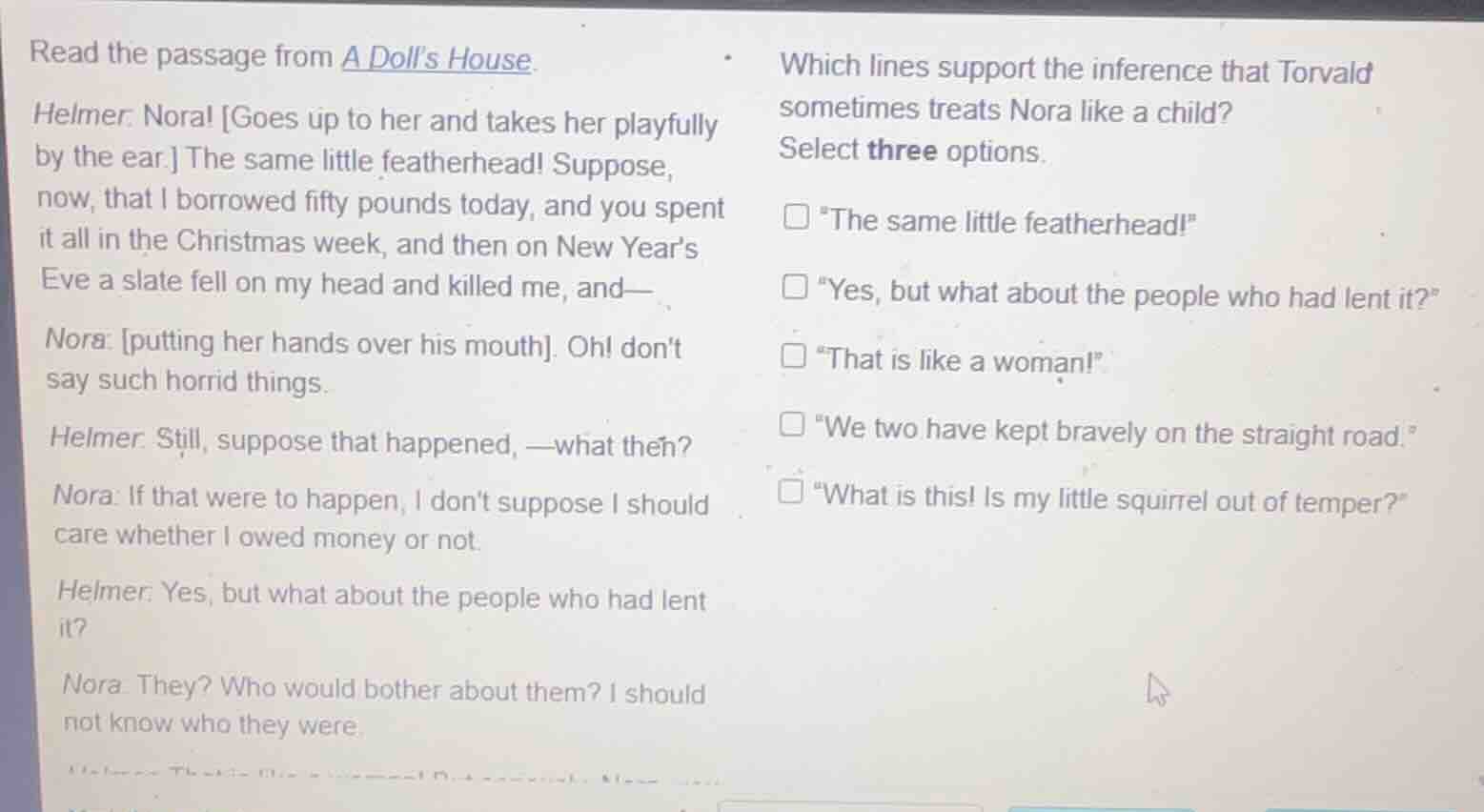
read the passage from a doll’s house.
helmer: nora! goes up to her and takes her playfully by the ear. the same little featherhead! suppose, now, that i borrowed fifty pounds today, and you spent it all in the christmas week, and then on new year’s eve a slate fell on my head and killed me, and—
nora: putting her hands over his mouth. oh! don’t say such horrid things.
helmer: still, suppose that happened, —what then?
nora: if that were to happen, i don’t suppose i should care whether i owed money or not.
helmer: yes, but what about the people who had lent it?
nora: they? who would bother about them? i should not know who they were.
which lines support the inference that torvald sometimes treats nora like a child?
select three options.
□ “the same little featherhead!”
□ “yes, but what about the people who had lent it?”
□ “that is like a woman!”
□ “we two have kept bravely on the straight road.”
□ “what is this! is my little squirrel out of temper?”
- "The same little featherhead!" uses a childish, dismissive nickname ("little featherhead") to refer to Nora, framing her as immature.
- "That is like a woman!" is a patronizing generalization that dismisses Nora's perspective in a condescending, paternalistic way, treating her as a naive, irrational child-like figure.
- "What is this! Is my little squirrel out of temper?" uses a cutesy, diminutive pet name ("little squirrel") and a tone that treats Nora like a small, moody animal/child.
The other lines focus on practical concerns or shared responsibility, not childlike treatment.

Snap & solve any problem in the app
Get step-by-step solutions on Sovi AI
Photo-based solutions with guided steps
Explore more problems and detailed explanations
- "The same little featherhead!"
- "That is like a woman!"
- "What is this! Is my little squirrel out of temper?"