QUESTION IMAGE
Question
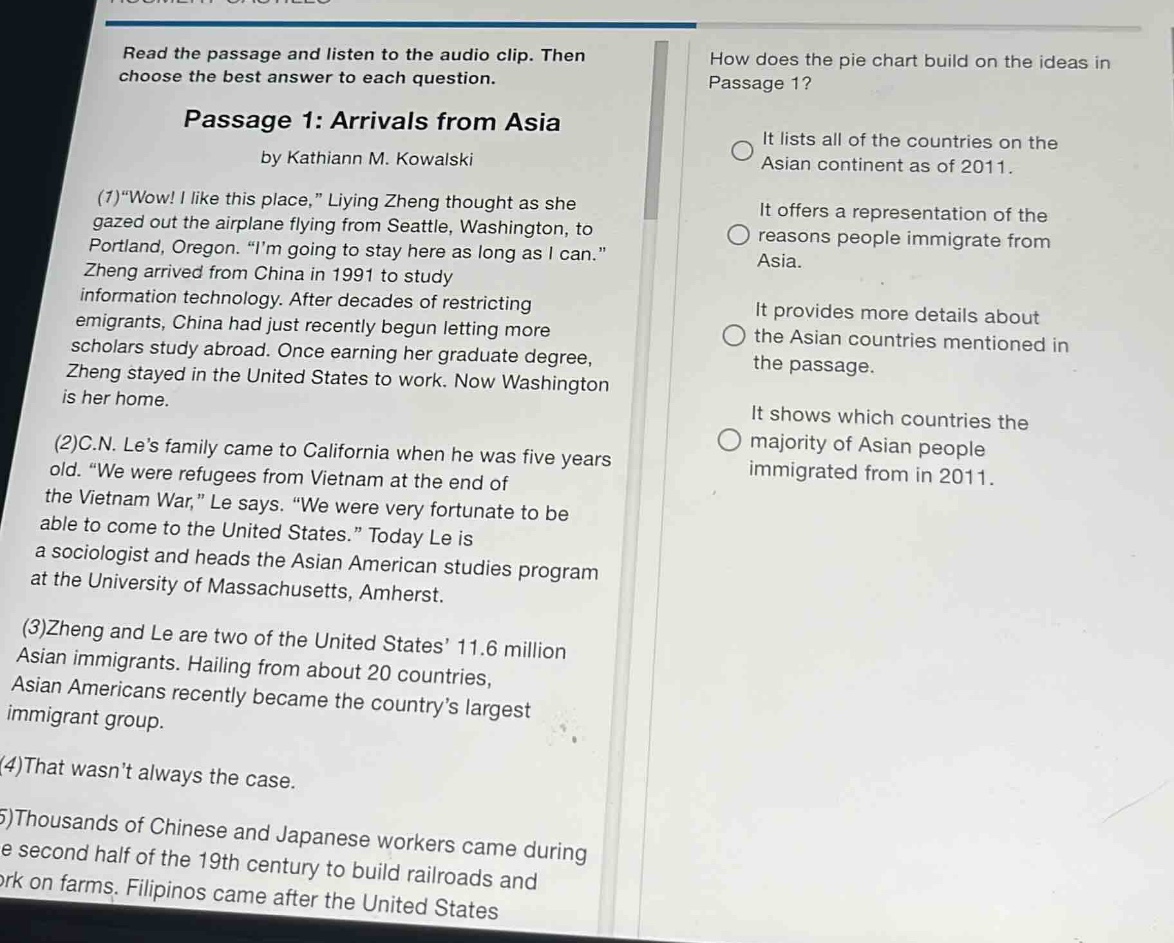
read the passage and listen to the audio clip. then choose the best answer to each question. passage 1: arrivals from asia by kathiann m. kowalski (1)\wow! i like this place,\ liying zheng thought as she gazed out the airplane flying from seattle, washington, to portland, oregon. \im going to stay here as long as i can.\ zheng arrived from china in 1991 to study information technology. after decades of restricting emigrants, china had just recently begun letting more scholars study abroad. once earning her graduate degree, zheng stayed in the united states to work. now washington is her home. (2)c.n. les family came to california when he was five years old. \we were refugees from vietnam at the end of the vietnam war,\ le says. \we were very fortunate to be able to come to the united states.\ today le is a sociologist and heads the asian american studies program at the university of massachusetts, amherst. (3)zheng and le are two of the united states 11.6 million asian immigrants. hailing from about 20 countries, asian americans recently became the countrys largest immigrant group. (4)that wasnt always the case. (5)thousands of chinese and japanese workers came during e second half of the 19th century to build railroads and ork on farms. filipinos came after the united states how does the pie chart build on the ideas in passage 1? it lists all of the countries on the asian continent as of 2011. it offers a representation of the reasons people immigrate from asia. it provides more details about the asian countries mentioned in the passage. it shows which countries the majority of asian people immigrated from in 2011.
The passage states there are 11.6 million Asian immigrants from ~20 countries, who are the largest U.S. immigrant group. A pie chart would visualize the proportional breakdown of immigrants by their home Asian countries, showing which ones make up the majority of this immigrant population in 2011, which builds on the passage's general data about Asian immigrants. The other options are incorrect: the passage does not focus on all Asian countries, reasons for immigration, or deep details about the specific countries named (China, Vietnam) beyond individual stories.

Snap & solve any problem in the app
Get step-by-step solutions on Sovi AI
Photo-based solutions with guided steps
Explore more problems and detailed explanations
D. It shows which countries the majority of Asian people immigrated from in 2011.