QUESTION IMAGE
Question
read the passage. there are several questions about this passage.
(from astronomy: heavenly creatures)
1
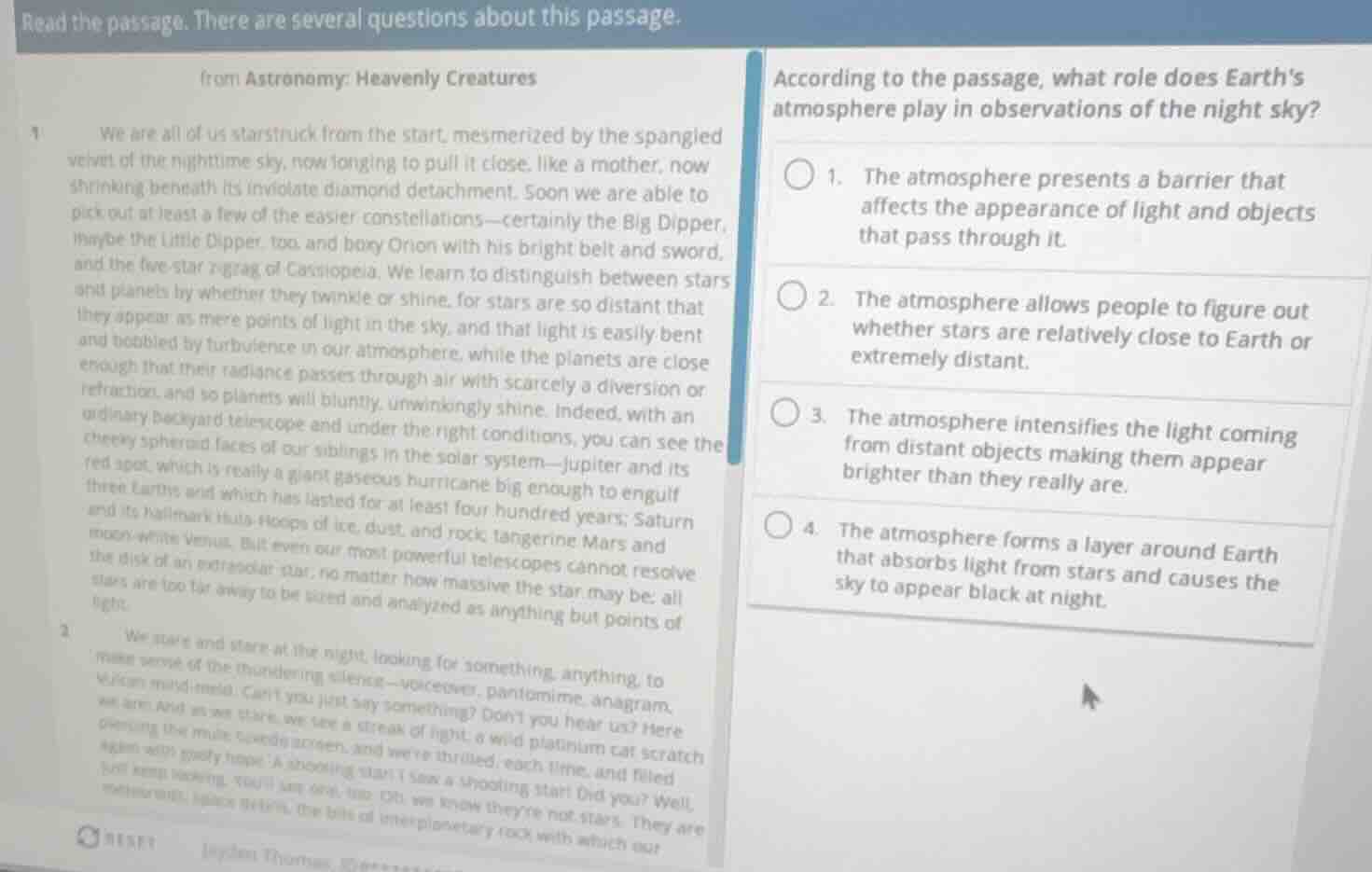
we are all of us starstruck from the start, mesmerized by the spangled velvet of the nighttime sky, now longing to pull it close, like a mother, now shrinking beneath its inviolate diamond detachment. soon we are able to pick out at least a few of the easier constellations—certainly the big dipper, maybe the little dipper, too, and bony orion with his bright belt and sword, and the five - star zigzag of cassiopeia. we learn to distinguish between stars and planets by whether they twinkle or shine, for stars are so distant that they appear as mere points of light in the sky, and that light is easily bent and bobbled by turbulence in our atmosphere, while the planets are close enough that their radiance passes through air with scarcely a diversion or refraction, and so planets will bluntly, unwinkingly shine. indeed, with an ordinary backyard telescope and under the right conditions, you can see the cheeky spherical faces of our siblings in the solar system—jupiter and its red spot, which is really a giant gaseous hurricane big enough to engulf three earths and which has lasted for at least four hundred years; saturn and its hallmark rings of ice, dust, and rock; tangerine mars and moon - white venus. but even our most powerful telescopes cannot resolve the disk of an extrastellar star, no matter how massive the star may be: all stars are too far away to be sized and analyzed as anything but points of light.
2
we stare and stare at the night, looking for something, anything, to make sense of the thundering silence—voicemail, pantomime, anagram, kalam cosmological. cant you just say something? dont you hear us? here we are. and as we stare, we see a streak of light: a wild platinum cat scratch gracing the mute dark, a weed - green smear, and were thrilled, each time, and filled again with goofy hope: a shooting star! i saw a shooting star! did you? well, keep looking. youll see one, too. (do we know theyre not stars? they are meteors: space debris, the bits of interplanetary rock with which our...
according to the passage, what role does earths atmosphere play in observations of the night sky?
○ 1. the atmosphere presents a barrier that affects the appearance of light and objects that pass through it.
○ 2. the atmosphere allows people to figure out whether stars are relatively close to earth or extremely distant.
○ 3. the atmosphere intensifies the light coming from distant objects making them appear brighter than they really are.
○ 4. the atmosphere forms a layer around earth that absorbs light from stars and causes the sky to appear black at night.
To solve this, we analyze each option by matching with the passage:
- Option 1: The passage says "stars are so distant... light is easily bent and bobbled by turbulence in our atmosphere" and planets' light "passes through air with scarcely a diversion or refraction". This shows the atmosphere acts as a barrier affecting light/objects passing through, matching Option 1.
- Option 2: The passage distinguishes stars and planets by twinkling (due to atmosphere for stars) but doesn't say it helps figure out star distance. Eliminate.
- Option 3: The passage says stars' light is bent/bobbled (not intensified) and planets shine "unwinkingly", so atmosphere doesn't make distant objects brighter. Eliminate.
- Option 4: The passage doesn't mention atmosphere absorbing light to make sky black; it's about light bending. Eliminate.

Snap & solve any problem in the app
Get step-by-step solutions on Sovi AI
Photo-based solutions with guided steps
Explore more problems and detailed explanations
- The atmosphere presents a barrier that affects the appearance of light and objects that pass through it.