QUESTION IMAGE
Question
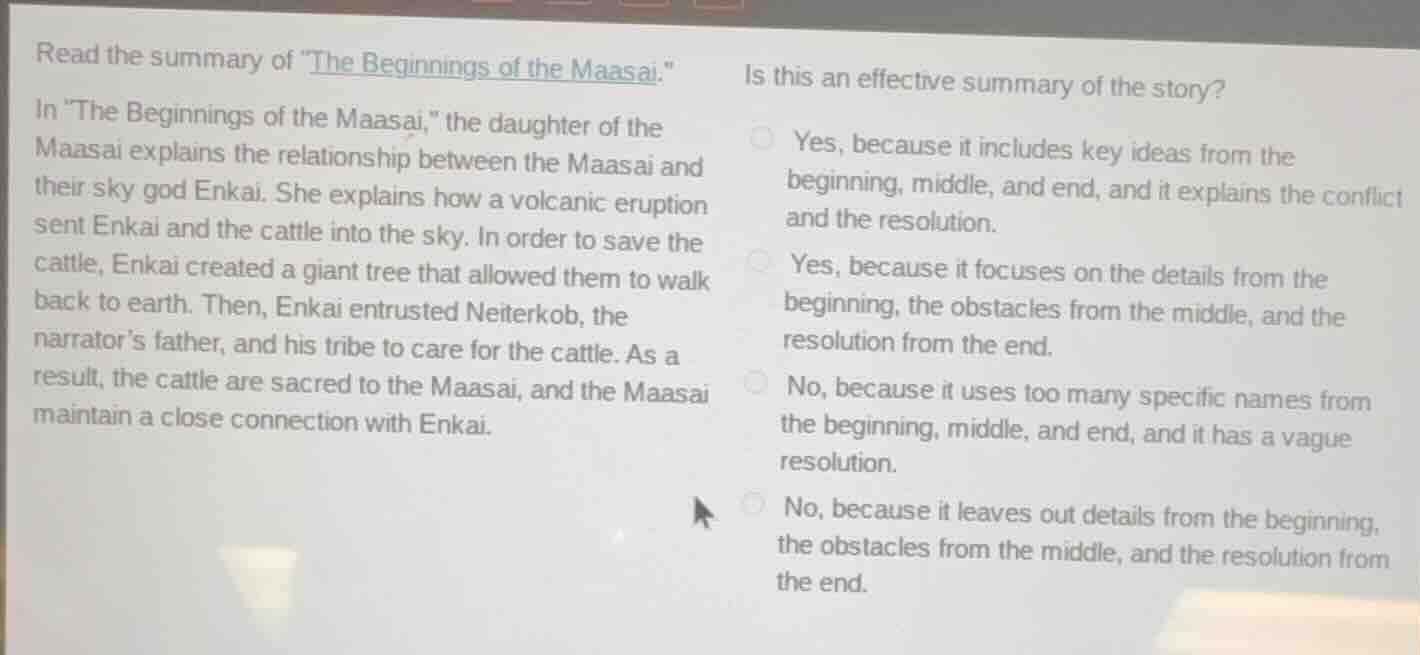
read the summary of \the beginnings of the maasai.\ in \the beginnings of the maasai,\ the daughter of the maasai explains the relationship between the maasai and their sky god enkai. she explains how a volcanic eruption sent enkai and the cattle into the sky. in order to save the cattle, enkai created a giant tree that allowed them to walk back to earth. then, enkai entrusted neiterkob, the narrator’s father, and his tribe to care for the cattle. as a result, the cattle are sacred to the maasai, and the maasai maintain a close connection with enkai. is this an effective summary of the story? yes, because it includes key ideas from the beginning, middle, and end, and it explains the conflict and the resolution. yes, because it focuses on the details from the beginning, the obstacles from the middle, and the resolution from the end. no, because it uses too many specific names from the beginning, middle, and end, and it has a vague resolution. no, because it leaves out details from the beginning, the obstacles from the middle, and the resolution from the end.
To determine if the summary is effective, we analyze its content. An effective summary should include key elements (beginning, middle, end, conflict, resolution). The summary mentions the relationship (beginning), the volcanic eruption and tree (middle - conflict and solution to save cattle), and the entrusted care and sacred cattle/connection (end - resolution). The first option correctly states it includes key ideas from all parts and explains conflict/resolution. Other options are incorrect: the second focuses on details (summaries should be concise, not detailed), third claims too many names (names are relevant) and vague resolution (resolution is clear), fourth claims it leaves out details (it doesn't).

Snap & solve any problem in the app
Get step-by-step solutions on Sovi AI
Photo-based solutions with guided steps
Explore more problems and detailed explanations
A. Yes, because it includes key ideas from the beginning, middle, and end, and it explains the conflict and the resolution.