QUESTION IMAGE
Question
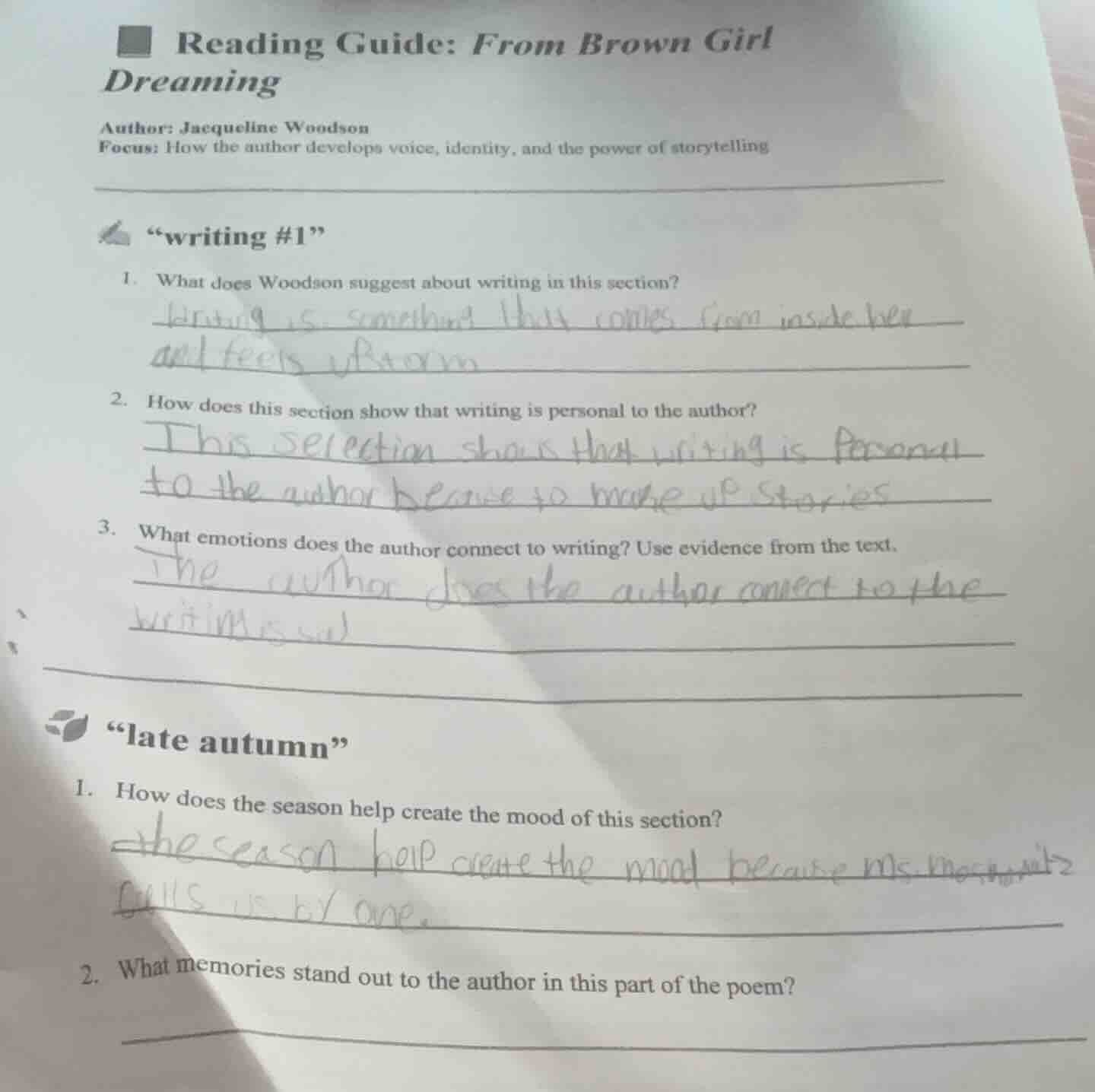
reading guide: from brown girl dreaming
author: jacqueline woodson
focus: how the author develops voice, identity, and the power of storytelling
“writing #1”
- what does woodson suggest about writing in this section?
- how does this section show that writing is personal to the author?
- what emotions does the author connect to writing? use evidence from the text.
“late autumn”
- how does the season help create the mood of this section?
- what memories stand out to the author in this part of the poem?
To answer these questions, we analyze the text "From Brown Girl Dreaming" by Jacqueline Woodson:
“writing #1”
- What does Woodson suggest about writing?
Woodson suggests writing comes from within (personal, emotional, instinctual). She implies it’s a natural, internal drive—like a force or feeling that rises up, not just a task.
- How is writing personal to the author?
The section shows writing is personal by tying it to her inner self: she writes from her experiences, feelings, and imagination (e.g., making up stories that reflect her perspective). The tone and details feel intimate, rooted in her identity.
- Emotions connected to writing?
Woodson connects writing to passion, urgency, and comfort. Evidence: Phrases like “feels upstorm” (intense, internal energy) or personal investment (writing as a part of her, not just an activity) show excitement, introspection, or emotional depth.
“late autumn”
- How does the season create mood?
Late autumn (cool, fading light, falling leaves) creates a nostalgic, reflective mood. The season’s transition (end of fall) mirrors themes of change or memory, setting a somber or contemplative tone for the author’s reflections.
- Standout memories?
Memories like interactions with Ms. Moses (e.g., being called one by one) or moments of childhood in autumn—small, personal moments that highlight her youth, relationships, or school experiences.
These answers interpret Woodson’s voice, identity, and storytelling (the focus of the reading guide) by analyzing her writing style and content.

Snap & solve any problem in the app
Get step-by-step solutions on Sovi AI
Photo-based solutions with guided steps
Explore more problems and detailed explanations
To answer these questions, we analyze the text "From Brown Girl Dreaming" by Jacqueline Woodson:
“writing #1”
- What does Woodson suggest about writing?
Woodson suggests writing comes from within (personal, emotional, instinctual). She implies it’s a natural, internal drive—like a force or feeling that rises up, not just a task.
- How is writing personal to the author?
The section shows writing is personal by tying it to her inner self: she writes from her experiences, feelings, and imagination (e.g., making up stories that reflect her perspective). The tone and details feel intimate, rooted in her identity.
- Emotions connected to writing?
Woodson connects writing to passion, urgency, and comfort. Evidence: Phrases like “feels upstorm” (intense, internal energy) or personal investment (writing as a part of her, not just an activity) show excitement, introspection, or emotional depth.
“late autumn”
- How does the season create mood?
Late autumn (cool, fading light, falling leaves) creates a nostalgic, reflective mood. The season’s transition (end of fall) mirrors themes of change or memory, setting a somber or contemplative tone for the author’s reflections.
- Standout memories?
Memories like interactions with Ms. Moses (e.g., being called one by one) or moments of childhood in autumn—small, personal moments that highlight her youth, relationships, or school experiences.
These answers interpret Woodson’s voice, identity, and storytelling (the focus of the reading guide) by analyzing her writing style and content.