QUESTION IMAGE
Question
reading quiz
question 3
instructions
read the question carefully and select the best answer.
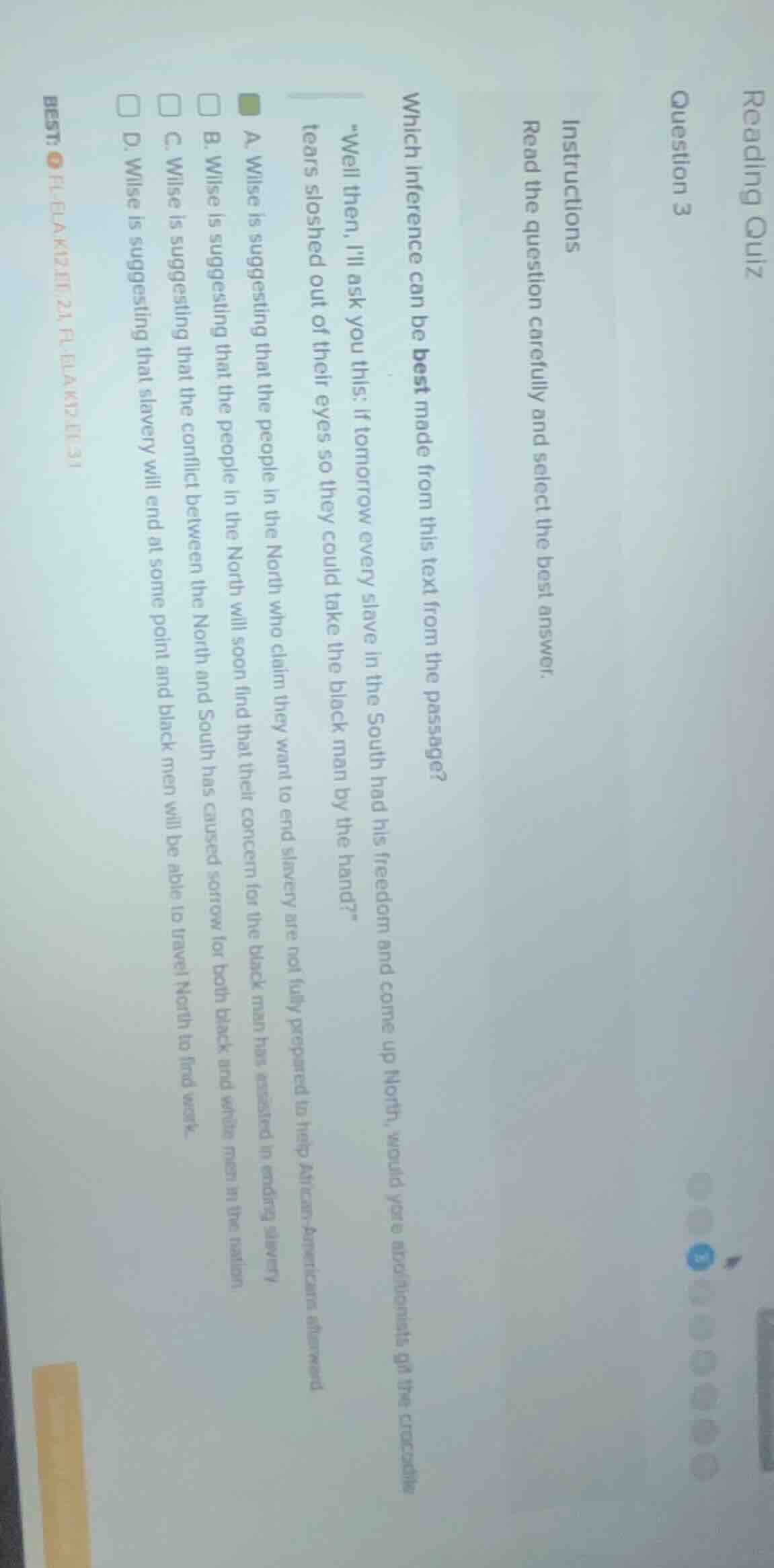
which inference can be best made from this text from the passage?
\well then, ill ask you this: if tomorrow every slave in the south had his freedom and come up north, would you abolitionists git the crocodile tears sloshed out of their eyes so they could take the black man by the hand?\
a. wise is suggesting that the people in the north who claim they want to end slavery are not fully prepared to help african - americans afterward
b. wise is suggesting that the people in the north will soon find that their concern for the black man has existed in ending slavery
c. wise is suggesting that the conflict between the north and south has caused sorrow for both black and white men in the nation
d. wise is suggesting that slavery will end at some point and black men will be able to travel north to find work
To determine the best inference, we analyze each option:
- Option A: The quote's context (asking if abolitionists would "take the black man by the hand" after freed slaves come North) implies that Northerners who claim to want to end slavery may not be fully ready to help African - Americans (shown by the "crocodile tears" metaphor, suggesting insincere sorrow). This matches the idea that they aren't fully prepared to help.
- Option B: The quote doesn't focus on Northerners' concern for black men's existence in ending slavery, but rather their readiness to help.
- Option C: The quote is about the readiness to help, not the sorrow caused by North - South conflict.
- Option D: The quote isn't about black men traveling North for work, but about the support from Northern abolitionists.

Snap & solve any problem in the app
Get step-by-step solutions on Sovi AI
Photo-based solutions with guided steps
Explore more problems and detailed explanations
A. Wise is suggesting that the people in the North who claim they want to end slavery are not fully prepared to help African - Americans (shown by the “crocodile tears” metaphor, implying insincere sorrow and lack of true readiness to assist freed slaves from the South).