QUESTION IMAGE
Question
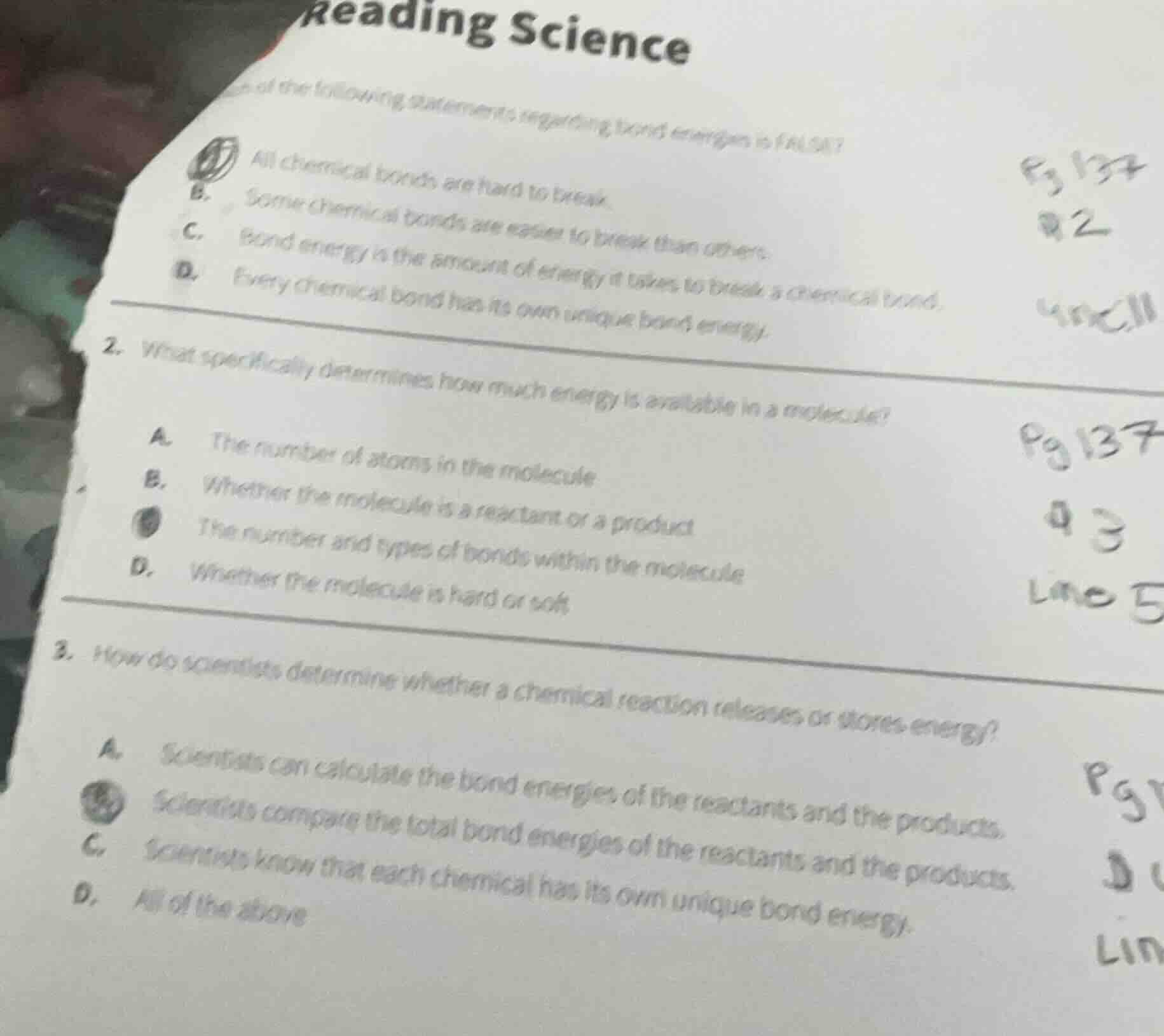
reading science of the following statements regarding bond energy is false? a. all chemical bonds are hard to break. b. some chemical bonds are easier to break than others. c. bond energy is the amount of energy it takes to break a chemical bond. d. every chemical bond has its own unique bond energy. 2. what specifically determines how much energy is available in a molecule? a. the number of atoms in the molecule b. whether the molecule is a reactant or a product c. the number and types of bonds within the molecule d. whether the molecule is hard or soft. 3. how do scientists determine whether a chemical reaction releases or stores energy? a. scientists can calculate the bond energies of the reactants and the products. b. scientists compare the total bond energies of the reactants and the products. c. scientists know that each chemical has its own unique bond energy. d. all of the above
- For question 1: Bond energies vary; some bonds are easy to break (e.g., weak bonds like hydrogen bonds in some contexts), so the claim all are hard to break is false.
- For question 2: The energy in a molecule comes from the bonds—different bond types have different energies, and the count of bonds also affects total available energy.
- For question 3: To find if a reaction releases/stores energy, scientists calculate total bond energy of reactants (energy to break bonds) and products (energy released forming bonds), then compare the two values.

Snap & solve any problem in the app
Get step-by-step solutions on Sovi AI
Photo-based solutions with guided steps
Explore more problems and detailed explanations
- A. All chemical bonds are hard to break.
- C. The number and types of bonds within the molecule
- B. Scientists compare the total bond energies of the reactants and the products.