QUESTION IMAGE
Question
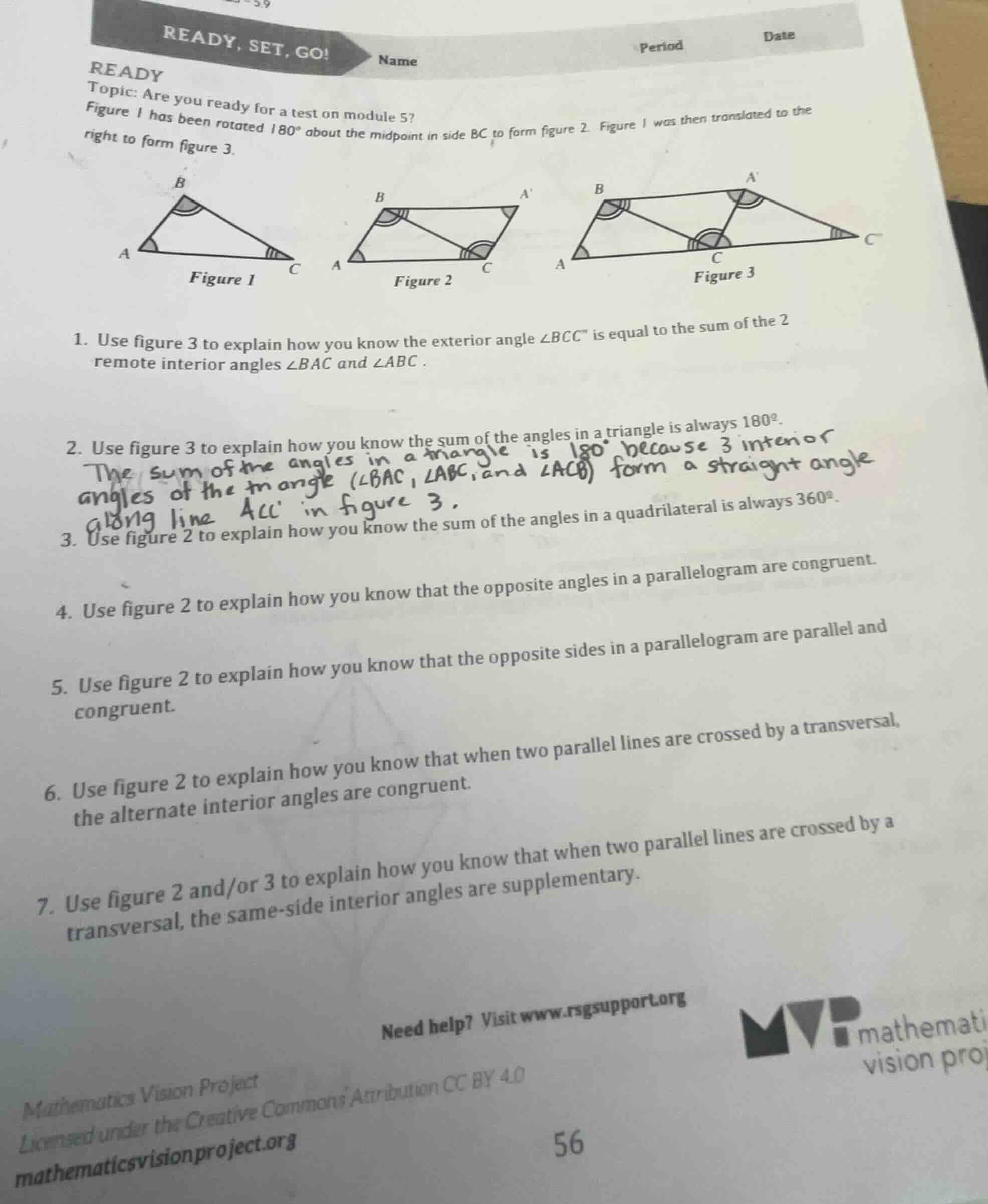
ready, set, go! name period date ready topic: are you ready for a test on module 5? figure 1 has been rotated 180° about the midpoint in side bc to form figure 2. figure 1 was then translated to the right to form figure 3. 1. use figure 3 to explain how you know the exterior angle ∠bcc is equal to the sum of the 2 remote interior angles ∠bac and ∠abc. 2. use figure 3 to explain how you know the sum of the angles in a triangle is always 180°. 3. use figure 2 to explain how you know the sum of the angles in a quadrilateral is always 360°. 4. use figure 2 to explain how you know that the opposite angles in a parallelogram are congruent. 5. use figure 2 to explain how you know that the opposite sides in a parallelogram are parallel and congruent. 6. use figure 2 to explain how you know that when two parallel lines are crossed by a transversal, the alternate interior angles are congruent. 7. use figure 2 and/or 3 to explain how you know that when two parallel lines are crossed by a transversal, the same - side interior angles are supplementary. need help? visit www.rsgsupport.org mathematics vision project licensed under the creative commons attribution cc by 4.0 mathematicsvisionproject.org 56 mvp mathemati vision proj
Question 1
Step1: Recall Transformations
Figure 1 is rotated \(180^\circ\) about midpoint of \(BC\) to get Figure 2, then translated right to get Figure 3. So, \(\angle BAC \cong \angle A'\) and \(\angle ABC \cong \angle A'BC\) (due to rotation and translation preserving angles).
Step2: Analyze Parallel Lines
In Figure 3, \(AB \parallel A'C\) (from translation, so corresponding sides are parallel). Thus, \(\angle BAC=\angle A'CC\) (alternate interior angles) and \(\angle ABC = \angle A'BC\) (rotation, and \(A'B \parallel BC\)? Wait, better: The exterior angle \(\angle BCC'\) is formed. Since Figure 3 is translation, \(AC \parallel A'C'\)? Wait, no. Wait, the three angles \(\angle BAC\), \(\angle ABC\), and \(\angle ACB\) sum to \(180^\circ\) (triangle angle sum). But \(\angle BCC'\) is supplementary to \(\angle ACB\) (linear pair), so \(\angle BCC' = 180^\circ - \angle ACB\). But also, \(\angle BAC + \angle ABC=180^\circ - \angle ACB\) (triangle angle sum). Thus, \(\angle BCC'=\angle BAC + \angle ABC\). Alternatively, using the translated triangle: The angle \(\angle BAC\) is equal to the angle between \(A'C\) and \(CC'\) (alternate interior angles, since \(AC \parallel A'C\) from translation), and \(\angle ABC\) is equal to the angle between \(A'B\) and \(BC\) (rotation, so \(A'B \parallel AC\)? Wait, maybe simpler: In Figure 3, the angle \(\angle BCC'\) is composed of the angles equal to \(\angle BAC\) and \(\angle ABC\) due to the translation and rotation, so their sum equals the exterior angle.
Step1: Identify Angles on a Line
In Figure 3, the three interior angles of the triangle (\(\angle BAC\), \(\angle ABC\), \(\angle ACB\)) lie along the straight line \(ACC'\) (since Figure 3 is a translation, the base \(AC\) is translated to \(A'C'\), so the angles at \(C\) form a linear pair? Wait, no. The three angles \(\angle BAC\), \(\angle ABC\), and \(\angle ACB\) are arranged such that when you translate the triangle, the angles \(\angle BAC\) and \(\angle ABC\) along with \(\angle ACB\) form a straight angle (180°). Because the translated triangle's angle \(\angle BAC\) and \(\angle ABC\) align with the angles adjacent to \(\angle ACB\) to form a straight line. So \(\angle BAC + \angle ABC + \angle ACB = 180^\circ\), proving the sum of angles in a triangle is \(180^\circ\).
Step1: Figure 2 is a Parallelogram
Figure 2 is formed by rotating Figure 1 \(180^\circ\) about the midpoint of \(BC\), so \(AB \parallel A'C\) and \(AC \parallel A'B\) (since rotation by \(180^\circ\) makes opposite sides parallel and congruent, forming a parallelogram \(ABCA'\)).
Step2: Sum of Angles in Parallelogram
In a parallelogram, consecutive angles are supplementary (e.g., \(\angle A + \angle B = 180^\circ\), \(\angle B + \angle C = 180^\circ\), etc.). The sum of all four angles: \((\angle A + \angle B)+(\angle C + \angle D)=180^\circ + 180^\circ = 360^\circ\) (since opposite angles in parallelogram are congruent, \(\angle A=\angle C\), \(\angle B=\angle D\)). Alternatively, divide the parallelogram into two triangles (e.g., diagonal \(BC\) divides Figure 2 into two congruent triangles, each with angle sum \(180^\circ\), so total \(180^\circ \times 2 = 360^\circ\)).

Snap & solve any problem in the app
Get step-by-step solutions on Sovi AI
Photo-based solutions with guided steps
Explore more problems and detailed explanations
By the transformations (rotation and translation) that form Figure 3, the angles \(\angle BAC\) and \(\angle ABC\) correspond to angles that, when combined, equal \(\angle BCC'\). Specifically, since translation preserves parallelism (so \(AB \parallel A'C\)), \(\angle BAC=\angle A'CC\) (alternate interior angles) and \(\angle ABC = \angle A'BC\) (rotation). Then, \(\angle BCC'=\angle A'BC+\angle A'CC=\angle ABC + \angle BAC\) (by angle addition), showing the exterior angle equals the sum of the two remote interior angles.