QUESTION IMAGE
Question
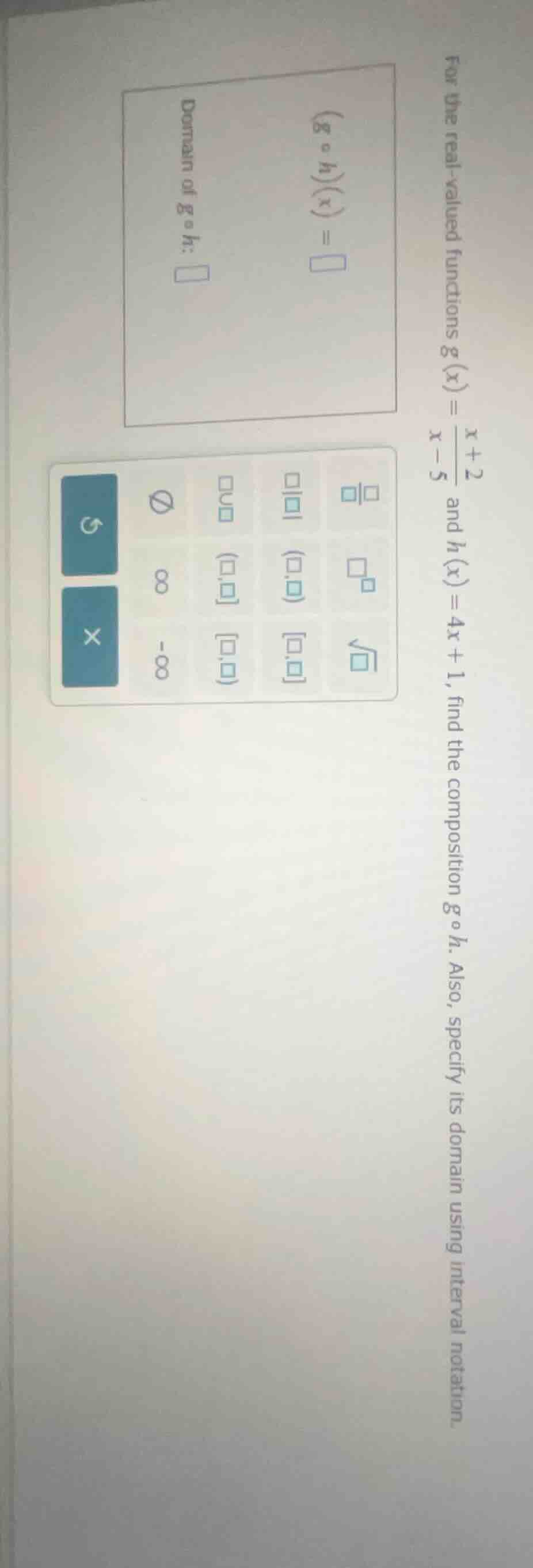
for the real-valued functions $g(x)=\frac{x+2}{x-5}$ and $h(x)=4x+1$, find the composition $g \circ h$. also, specify its domain using interval notation.
$(g \circ h)(x) = \square$
domain of $g \circ h$: $\square$
Step1: Define composite function
$(g\circ h)(x) = g(h(x))$
Step2: Substitute $h(x)$ into $g$
Substitute $h(x)=4x+1$ into $g(t)=\frac{t+2}{t-5}$:
$$(g\circ h)(x) = \frac{(4x+1)+2}{(4x+1)-5}$$
Step3: Simplify numerator and denominator
Simplify terms in numerator and denominator:
$$(g\circ h)(x) = \frac{4x+3}{4x-4} = \frac{4x+3}{4(x-1)}$$
Step4: Find domain restrictions
- Denominator of $g\circ h$ cannot be 0:
$4(x-1)
eq 0 \implies x
eq 1$
- $h(x)$ must be in domain of $g$: domain of $g$ is $t
eq 5$, so $4x+1
eq 5 \implies 4x
eq 4 \implies x
eq 1$ (same restriction as above)
- $h(x)$ is defined for all real $x$.
Combine restrictions: $x
eq 1$
Step5: Write domain in interval notation
Domain is $(-\infty,1) \cup (1,\infty)$

Snap & solve any problem in the app
Get step-by-step solutions on Sovi AI
Photo-based solutions with guided steps
Explore more problems and detailed explanations
$(g\circ h)(x) = \frac{4x+3}{4x-4}$
Domain of $g\circ h$: $(-\infty,1) \cup (1,\infty)$