QUESTION IMAGE
Question
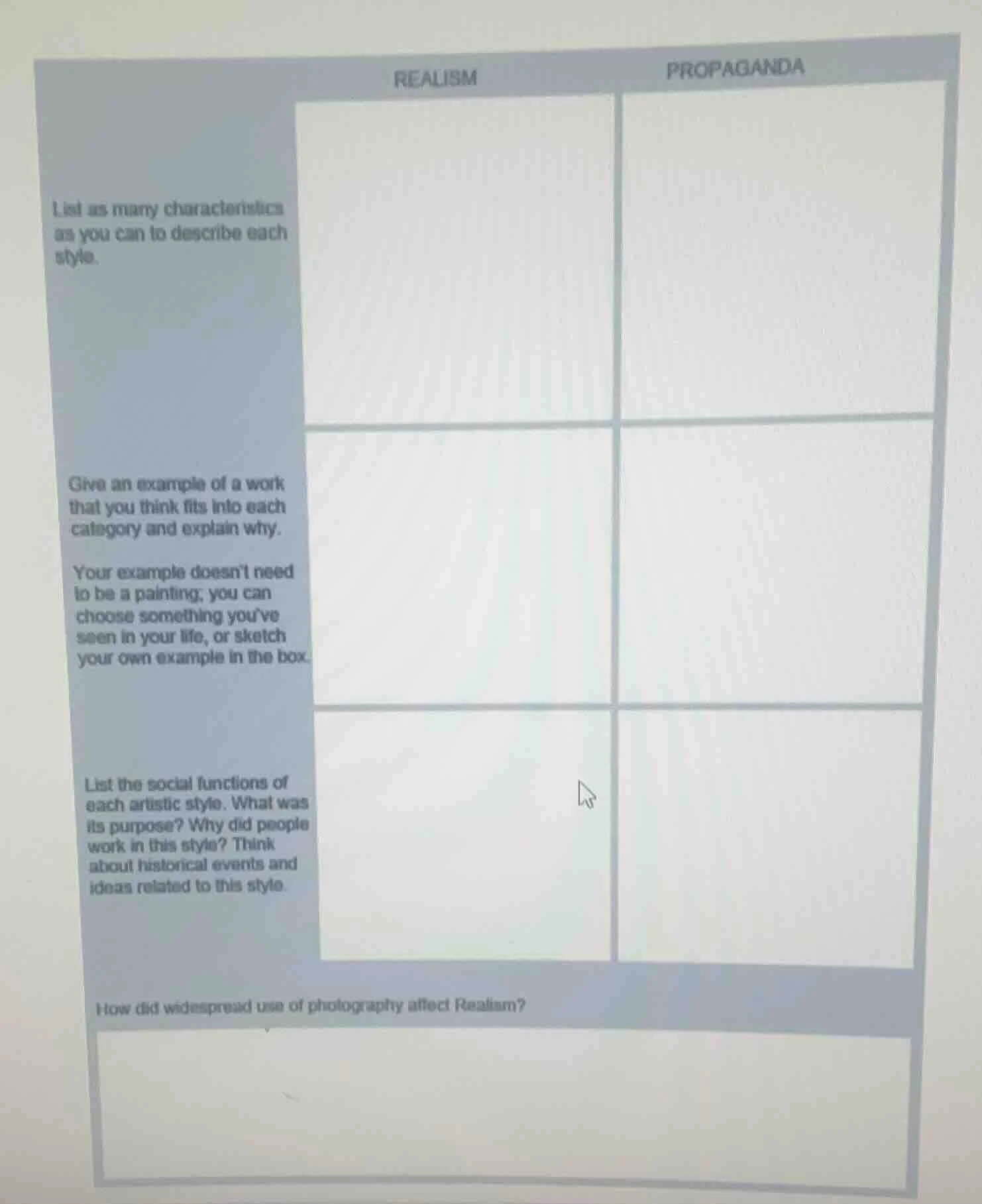
realismpropagandalist as many characteristicsas you can to describe eachstyle.give an example of a workthat you think fits into eachcategory and explain why.your example doesnt needto be a painting; you canchoose something youveseen in your life, or sketchyour own example in the box.list the social functions ofeach artistic style. what wasits purpose? why did peoplework in this style? thinkabout historical events andideas related to this style.how did widespread use of photography affect realism?
1. Characteristics of Each Style
- Realism: Focuses on accurate, unidealized depictions of everyday life, working-class experiences, and mundane scenes; uses detailed, lifelike representation; avoids romantic or dramatic embellishment.
- Propaganda: Designed to persuade audiences to adopt a specific ideology or action; uses emotional, biased messaging; simplifies complex ideas; often exaggerates or omits facts to shape opinion.
2. Examples and Explanations
- Realism Example: The Gleaners by Jean-François Millet. This painting depicts poor rural women gathering leftover grain after a harvest, using unglamorous, detailed imagery to show the harsh, ordinary realities of working-class rural life, a core focus of Realism.
- Propaganda Example: World War I "Uncle Sam Wants You" poster. This poster uses a commanding, patriotic image and direct messaging to persuade U.S. citizens to enlist in the military, prioritizing persuasion and ideological alignment over objective representation.
3. Social Functions/Purposes
- Realism: Emerged in the 19th century alongside industrialization; aimed to draw attention to social inequalities and the lives of marginalized groups; sought to document everyday truth and challenge romanticized views of society.
- Propaganda: Used by governments, political groups, or organizations to mobilize support, unify populations, or demonize opponents; often tied to wartime efforts, political campaigns, or ideological movements to shape public behavior and belief.
4. Photography's Impact on Realism
Widespread photography in the 19th century provided artists with a new, precise reference for capturing lifelike details of people, scenes, and objects. It reinforced Realism's focus on accurate, unidealized representation, as artists could study photographic depictions of everyday life to create more authentic, true-to-life works. Photography also pushed Realist artists to focus on subjects and details that felt even more grounded in tangible reality, as the medium set a new standard for visual accuracy.

Snap & solve any problem in the app
Get step-by-step solutions on Sovi AI
Photo-based solutions with guided steps
Explore more problems and detailed explanations
| Category | Content |
|---|---|
| Examples & Explanations | <ul><li>Realism: The Gleaners (Millet) – depicts unglamorous rural working life, aligns with Realism's focus on ordinary truth</li><li>Propaganda: "Uncle Sam Wants You" poster – uses patriotic imagery to persuade military enlistment, prioritizes ideological persuasion</li></ul> |
| Social Functions | <ul><li>Realism: Highlighted 19th-century social inequality, documented everyday truth, challenged romanticized societal views</li><li>Propaganda: Mobilized support for causes, shaped public opinion, unified/galvanized target groups (e.g., wartime recruitment)</li></ul> |
| Photography's Impact on Realism | Provided precise, lifelike references for artists, reinforced the focus on unidealized, accurate representation, set a new standard for tangible, true-to-life visual depictions of everyday life |