QUESTION IMAGE
Question
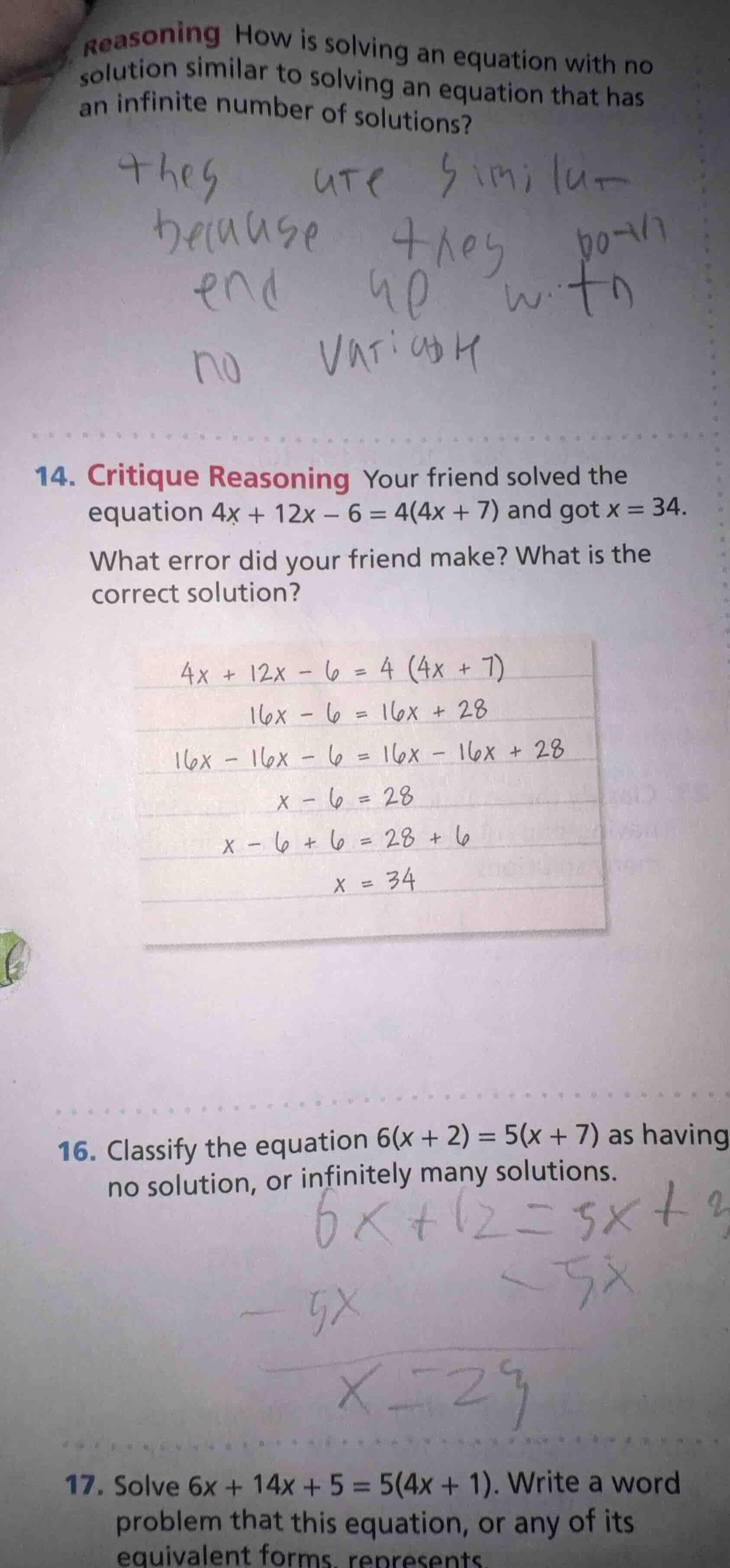
reasoning how is solving an equation with no solution similar to solving an equation that has an infinite number of solutions?14. critique reasoning your friend solved the equation $4x + 12x - 6 = 4(4x + 7)$ and got $x = 34$. what error did your friend make? what is the correct solution?$4x + 12x - 6 = 4(4x + 7)$$16x - 6 = 16x + 28$$16x - 16x - 6 = 16x - 16x + 28$$x - 6 = 28$$x - 6 + 6 = 28 + 6$$x = 34$16. classify the equation $6(x + 2) = 5(x + 7)$ as having no solution, or infinitely many solutions.17. solve $6x + 14x + 5 = 5(4x + 1)$. write a word problem that this equation, or any of its equivalent forms represents.
Step1: Analyze friend's error
When simplifying $16x - 16x - 6 = 16x - 16x + 28$, the friend incorrectly wrote $x - 6 = 28$ instead of $-6 = 28$. $16x-16x=0$, not $x$.
Step2: Correctly simplify the equation
Start with the original equation:
$4x + 12x - 6 = 4(4x + 7)$
Combine like terms and distribute:
$16x - 6 = 16x + 28$
Subtract $16x$ from both sides:
$16x - 16x - 6 = 16x - 16x + 28$
$-6 = 28$
Step3: Interpret the result
$-6 = 28$ is a false statement, so there is no value of $x$ that satisfies the equation.
Step1: Distribute to expand the equation
$6(x + 2) = 5(x + 7)$
$6x + 12 = 5x + 35$
Step2: Isolate the variable $x$
Subtract $5x$ from both sides:
$6x - 5x + 12 = 5x - 5x + 35$
$x + 12 = 35$
Subtract 12 from both sides:
$x + 12 - 12 = 35 - 12$
$x = 23$
Step3: Classify the solution type
The equation has exactly one unique solution, so it is neither "no solution" nor "infinitely many solutions".
Step1: Simplify both sides of the equation
Start with $6x + 14x + 5 = 5(4x + 1)$
Combine like terms and distribute:
$20x + 5 = 20x + 5$
Step2: Analyze the simplified equation
Subtract $20x$ from both sides:
$20x - 20x + 5 = 20x - 20x + 5$
$5 = 5$
Step3: Interpret the result
$5=5$ is a true statement, so all real numbers are solutions.
Step4: Create a word problem
Example: A café sells two combo meals. Combo A costs $6 per sandwich plus $14 per drink, plus a $5 service fee for any order. Combo B costs $5 for a set that includes a sandwich and a drink, where each set is priced as if it's $4 for the sandwich and $1 for the drink. How many meal sets (one sandwich + one drink) can you buy such that the total cost of Combo A equals Combo B?

Snap & solve any problem in the app
Get step-by-step solutions on Sovi AI
Photo-based solutions with guided steps
Explore more problems and detailed explanations
The friend incorrectly simplified $16x - 16x$ as $x$ instead of $0$. The equation has no solution.
---