QUESTION IMAGE
Question
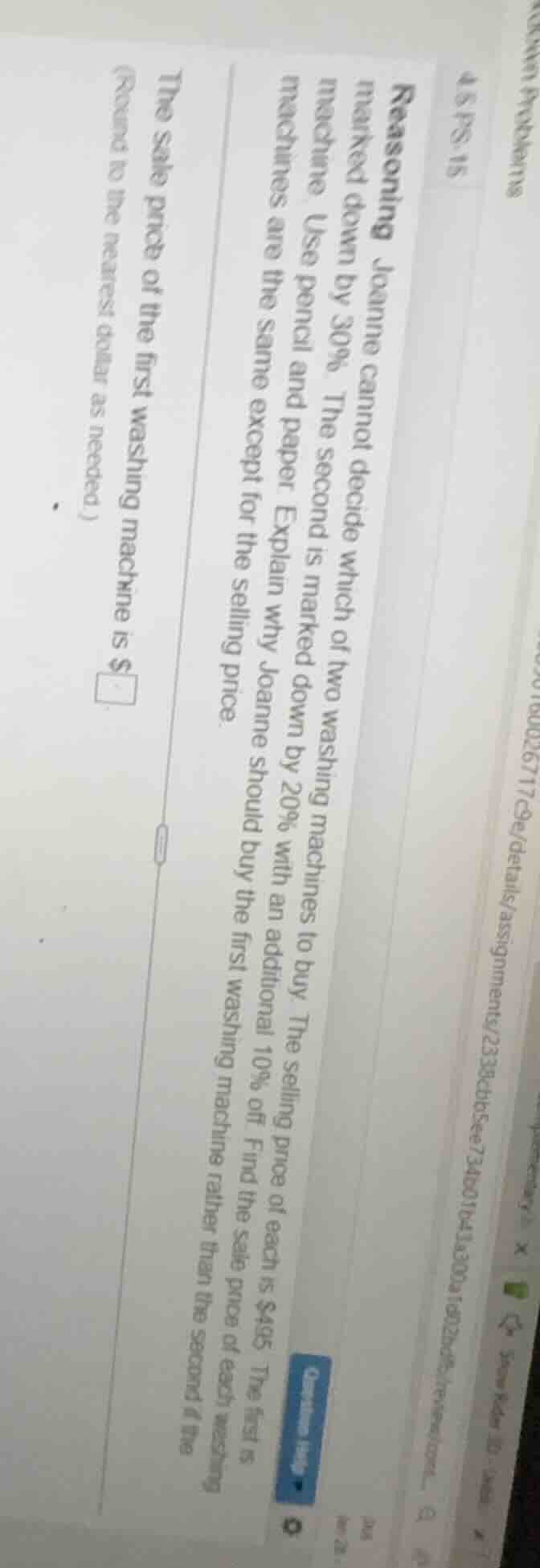
reasoning joanne cannot decide which of two washing machines to buy. the first is marked down by 30%. the second is marked down by 20% with an additional 10% off. find the sale price of each washing machine. use pencil and paper. explain why joanne should buy the first washing machine rather than the second if the selling price of each is the same except for the selling price. the sale price of the first washing machine is $\square$. (round to the nearest dollar as needed.)
Step1: Calculate first machine's sale price
First, find 30% of $495, then subtract it from the original price.
Sale price = $495 - (30\% \times 495) = 495 - (0.30 \times 495) = 495 \times (1-0.30) = 495 \times 0.70$
$= 346.5$
Step2: Calculate second machine's first discount
Find 20% off $495 first.
Price after 20% off = $495 - (20\% \times 495) = 495 \times (1-0.20) = 495 \times 0.80 = 396$
Step3: Calculate second machine's final price
Apply an additional 10% off the already discounted price.
Final sale price = $396 - (10\% \times 396) = 396 \times (1-0.10) = 396 \times 0.90 = 356.4$
Step4: Compare the two sale prices
$346.5 < 356.4$, so the first machine is cheaper.

Snap & solve any problem in the app
Get step-by-step solutions on Sovi AI
Photo-based solutions with guided steps
Explore more problems and detailed explanations
The sale price of the first washing machine is $\$347$ (rounded to nearest dollar).
The sale price of the second washing machine is $\$356$ (rounded to nearest dollar).
Joanne should buy the first machine because its final sale price ($\$347$) is lower than the second machine's final sale price ($\$356$).