QUESTION IMAGE
Question
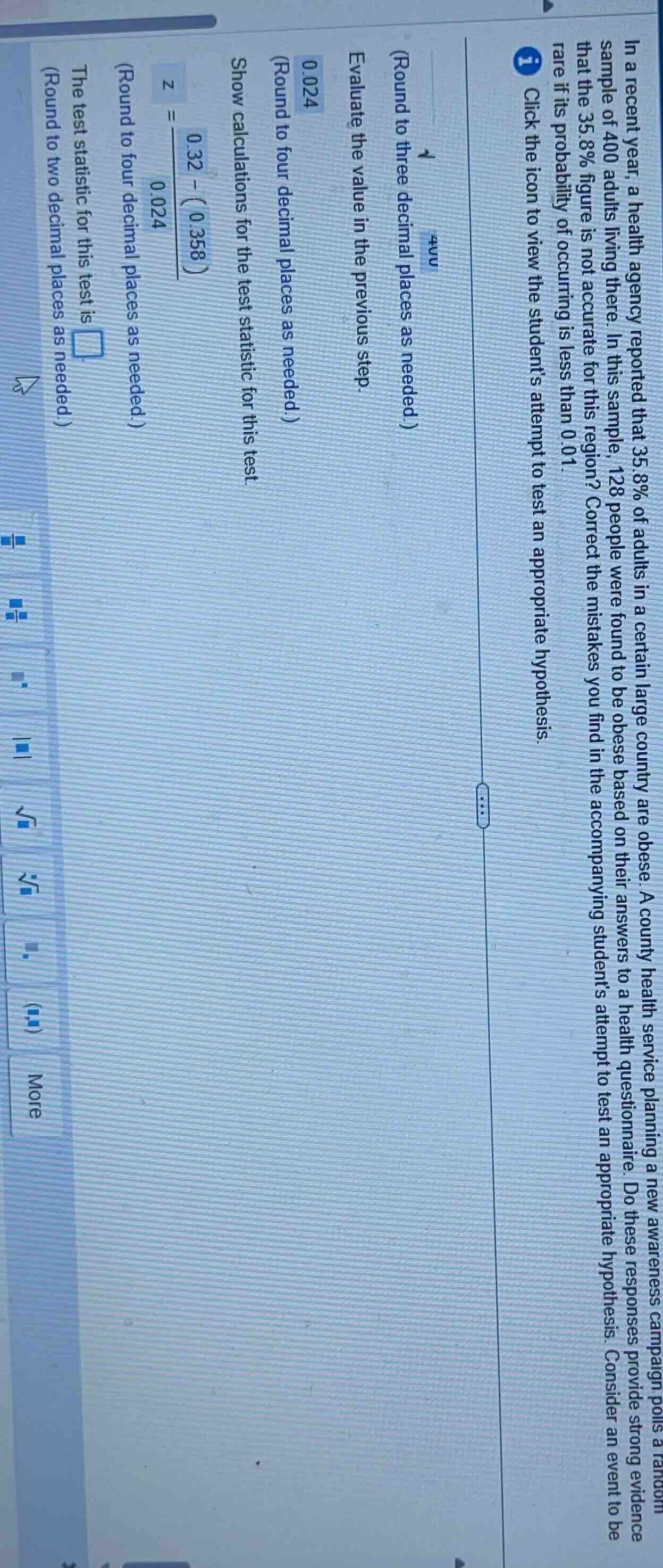
in a recent year, a health agency reported that 35.8% of adults in a certain large county are obese. a county health service planning a new awareness campaign polls a random sample of 400 adults living there. in this sample, 128 people were found to be obese based on their answers to a health questionnaire. do these responses provide strong evidence that the 35.8% figure is not accurate for this region? correct the mistakes you find in the accompanying student’s attempt to test an appropriate hypothesis. consider an event to be rare if its probability of occurring is less than 0.01. click the icon to view the student’s attempt to test an appropriate hypothesis. 400 (round to three decimal places as needed.) evaluate the value in the previous step. 0.024 (round to four decimal places as needed.) show calculations for the test statistic for this test. z = \frac{0.32 - (0.358)}{0.024} (round to four decimal places as needed.) the test statistic for this test is \square (round to two decimal places as needed.)
Step1: Calculate sample proportion
$\hat{p} = \frac{128}{400} = 0.32$
Step2: Compute standard error
$SE = \sqrt{\frac{0.358(1-0.358)}{400}} = \sqrt{\frac{0.358 \times 0.642}{400}} \approx 0.0239$
Step3: Calculate z-test statistic
$z = \frac{\hat{p} - p_0}{SE} = \frac{0.32 - 0.358}{0.0239} \approx -1.590$
Step4: Find p-value (two-tailed)
For $z=-1.590$, the one-tailed p-value is $\approx 0.0559$, so two-tailed p-value is $2 \times 0.0559 = 0.1118$

Snap & solve any problem in the app
Get step-by-step solutions on Sovi AI
Photo-based solutions with guided steps
Explore more problems and detailed explanations
First, correct the student's mistake: the standard error was incorrectly used as 0.024 (the correct standard error is ~0.0239). The correct z-test statistic is $\boldsymbol{-1.59}$ (rounded to two decimal places).
Since the p-value (0.1118) is greater than 0.01, there is not strong evidence that the 35.8% figure is inaccurate for this region.