QUESTION IMAGE
Question
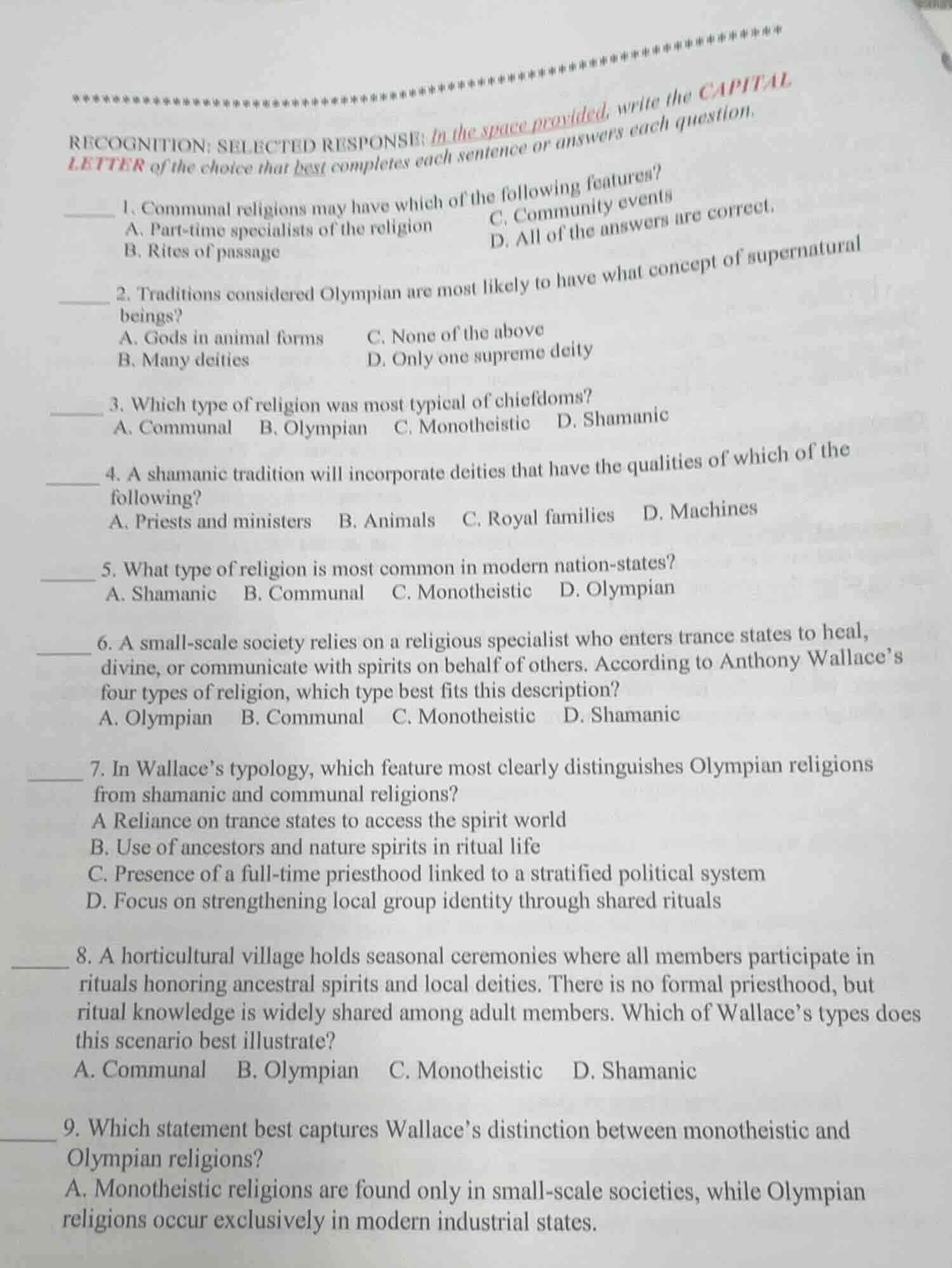
recognition: selected response: in the space provided, write the capital letter of the choice that best completes each sentence or answers each question.
- communal religions may have which of the following features?
a. part-time specialists of the religion
b. rites of passage
c. community events
d. all of the answers are correct.
- traditions considered olympian are most likely to have what concept of supernatural beings?
a. gods in animal forms
b. many deities
c. none of the above
d. only one supreme deity
- which type of religion was most typical of chiefdoms?
a. communal b. olympian c. monotheistic d. shamanic
- a shamanic tradition will incorporate deities that have the qualities of which of the following?
a. priests and ministers b. animals c. royal families d. machines
- what type of religion is most common in modern nation-states?
a. shamanic b. communal c. monotheistic d. olympian
- a small-scale society relies on a religious specialist who enters trance states to heal, divine, or communicate with spirits on behalf of others. according to anthony wallaces four types of religion, which type best fits this description?
a. olympian b. communal c. monotheistic d. shamanic
- in wallaces typology, which feature most clearly distinguishes olympian religions from shamanic and communal religions?
a. reliance on trance states to access the spirit world
b. use of ancestors and nature spirits in ritual life
c. presence of a full-time priesthood linked to a stratified political system
d. focus on strengthening local group identity through shared rituals
- a horticultural village holds seasonal ceremonies where all members participate in rituals honoring ancestral spirits and local deities. there is no formal priesthood, but ritual knowledge is widely shared among adult members. which of wallaces types does this scenario best illustrate?
a. communal b. olympian c. monotheistic d. shamanic
- which statement best captures wallaces distinction between monotheistic and olympian religions?
a. monotheistic religions are found only in small-scale societies, while olympian religions occur exclusively in modern industrial states.
- Communal religions emphasize group participation, include rites of passage, part-time religious specialists, and community events, so all options apply.
- Olympian traditions (like ancient Greek religion) are polytheistic, meaning they have many deities.
- Chiefdoms typically have Olympian religions, which link to stratified political structures with specialized religious roles.
- Shamanic traditions often feature deities or spirits with animal qualities, as shamans often connect with animal spirits.
- Modern nation-states are most commonly home to monotheistic religions (e.g., Christianity, Islam, Judaism).
- Shamanic religions center on specialists (shamans) who enter trances to interact with spirits for healing/guidance.
- A key feature of Olympian religions is a full-time priesthood tied to a stratified political system, unlike the more communal or individual shamanic traditions.
- Communal religions involve shared, group-wide rituals with no formal priesthood, matching the village scenario described.
- (Note: The options for question 9 are cut off, but based on Wallace's typology, the core distinction is that monotheistic religions focus on a single supreme deity, while Olympian religions have multiple distinct deities with specific domains.)

Snap & solve any problem in the app
Get step-by-step solutions on Sovi AI
Photo-based solutions with guided steps
Explore more problems and detailed explanations
- D. All of the answers are correct.
- B. Many deities
- B. Olympian
- B. Animals
- C. Monotheistic
- D. Shamanic
- C. Presence of a full-time priesthood linked to a stratified political system
- A. Communal
- (No complete options provided to select a final answer)