QUESTION IMAGE
Question
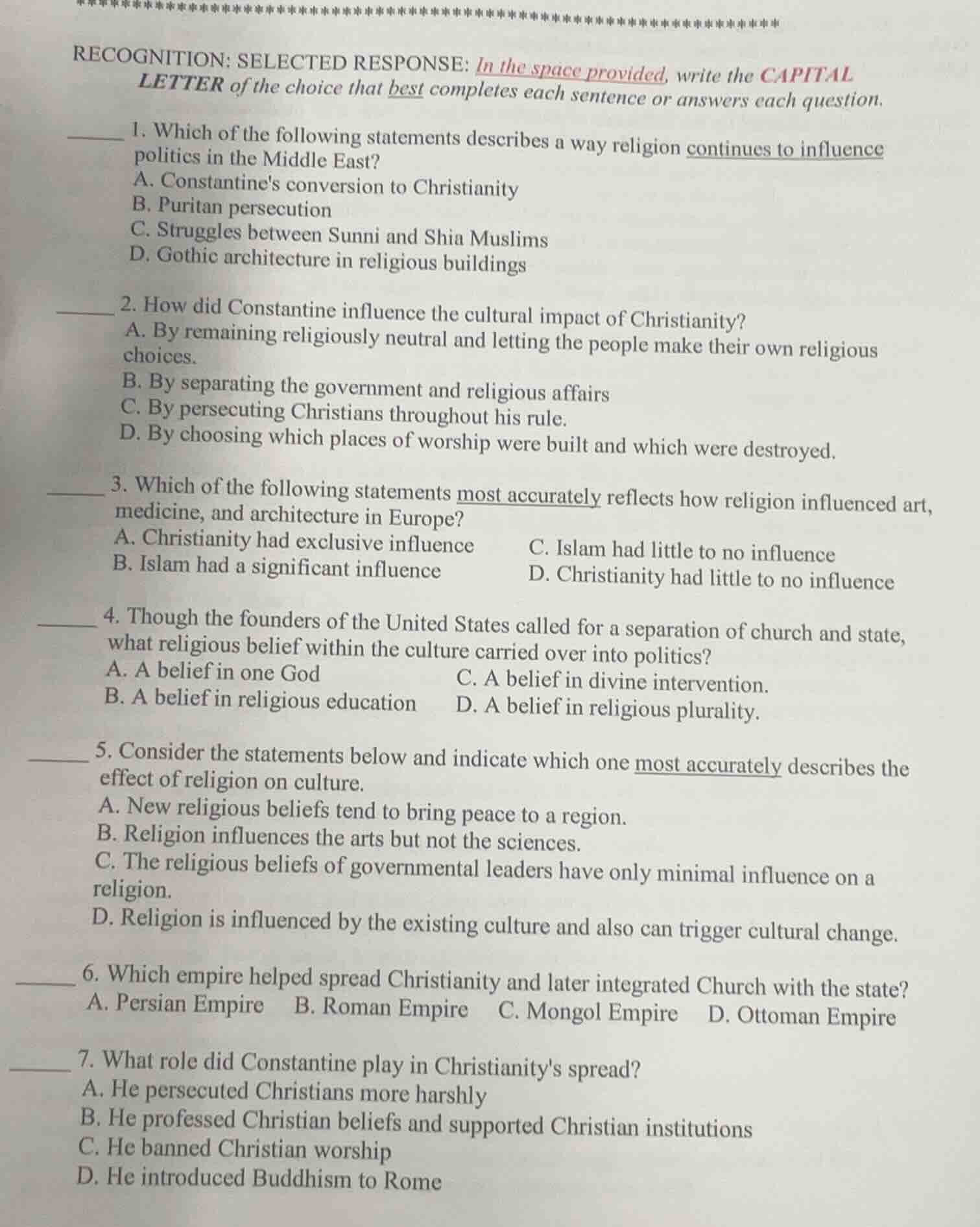
recognition: selected response: in the space provided, write the capital letter of the choice that best completes each sentence or answers each question.
- which of the following statements describes a way religion continues to influence politics in the middle east?
a. constantines conversion to christianity
b. puritan persecution
c. struggles between sunni and shia muslims
d. gothic architecture in religious buildings
- how did constantine influence the cultural impact of christianity?
a. by remaining religiously neutral and letting the people make their own religious choices.
b. by separating the government and religious affairs
c. by persecuting christians throughout his rule.
d. by choosing which places of worship were built and which were destroyed.
- which of the following statements most accurately reflects how religion influenced art, medicine, and architecture in europe?
a. christianity had exclusive influence
c. islam had little to no influence
b. islam had a significant influence
d. christianity had little to no influence
- though the founders of the united states called for a separation of church and state, what religious belief within the culture carried over into politics?
a. a belief in one god
c. a belief in divine intervention.
b. a belief in religious education
d. a belief in religious plurality.
- consider the statements below and indicate which one most accurately describes the effect of religion on culture.
a. new religious beliefs tend to bring peace to a region.
b. religion influences the arts but not the sciences.
c. the religious beliefs of governmental leaders have only minimal influence on a religion.
d. religion is influenced by the existing culture and also can trigger cultural change.
- which empire helped spread christianity and later integrated church with the state?
a. persian empire b. roman empire c. mongol empire d. ottoman empire
- what role did constantine play in christianitys spread?
a. he persecuted christians more harshly
b. he professed christian beliefs and supported christian institutions
c. he banned christian worship
d. he introduced buddhism to rome
- For question 1: Options A and B relate to European/Christian history, D is about architecture, while Sunni-Shia tensions are a key religious-political dynamic in the Middle East.
- For question 2: Constantine promoted Christianity, he did not stay neutral, separate church and state, or persecute Christians; he controlled religious building projects to shape Christianity's cultural presence.
- For question 3: Christianity was the dominant religious influence on European art, medicine, and architecture during medieval and early modern periods, while Islam's influence in these areas in Europe was limited.
- For question 4: The founding culture of the US was rooted in monotheism, which carried over into political discourse, unlike the other options which do not align with the core carried-over belief.
- For question 5: Religion and culture have a reciprocal relationship: culture shapes religious practice, and religious ideas can drive cultural shifts, which matches option D.
- For question 6: The Roman Empire, under leaders like Constantine, spread Christianity and later merged church and state institutions, unlike the other empires listed.
- For question 7: Constantine converted to Christianity, supported the church financially and institutionally, which aided its spread, contradicting the other negative or unrelated options.

Snap & solve any problem in the app
Get step-by-step solutions on Sovi AI
Photo-based solutions with guided steps
Explore more problems and detailed explanations
- C. Struggles between Sunni and Shia Muslims
- D. By choosing which places of worship were built and which were destroyed.
- A. Christianity had exclusive influence
- A. A belief in one God
- D. Religion is influenced by the existing culture and also can trigger cultural change.
- B. Roman Empire
- B. He professed Christian beliefs and supported Christian institutions