QUESTION IMAGE
Question
recognizing graphs of proportional relationships (continued)
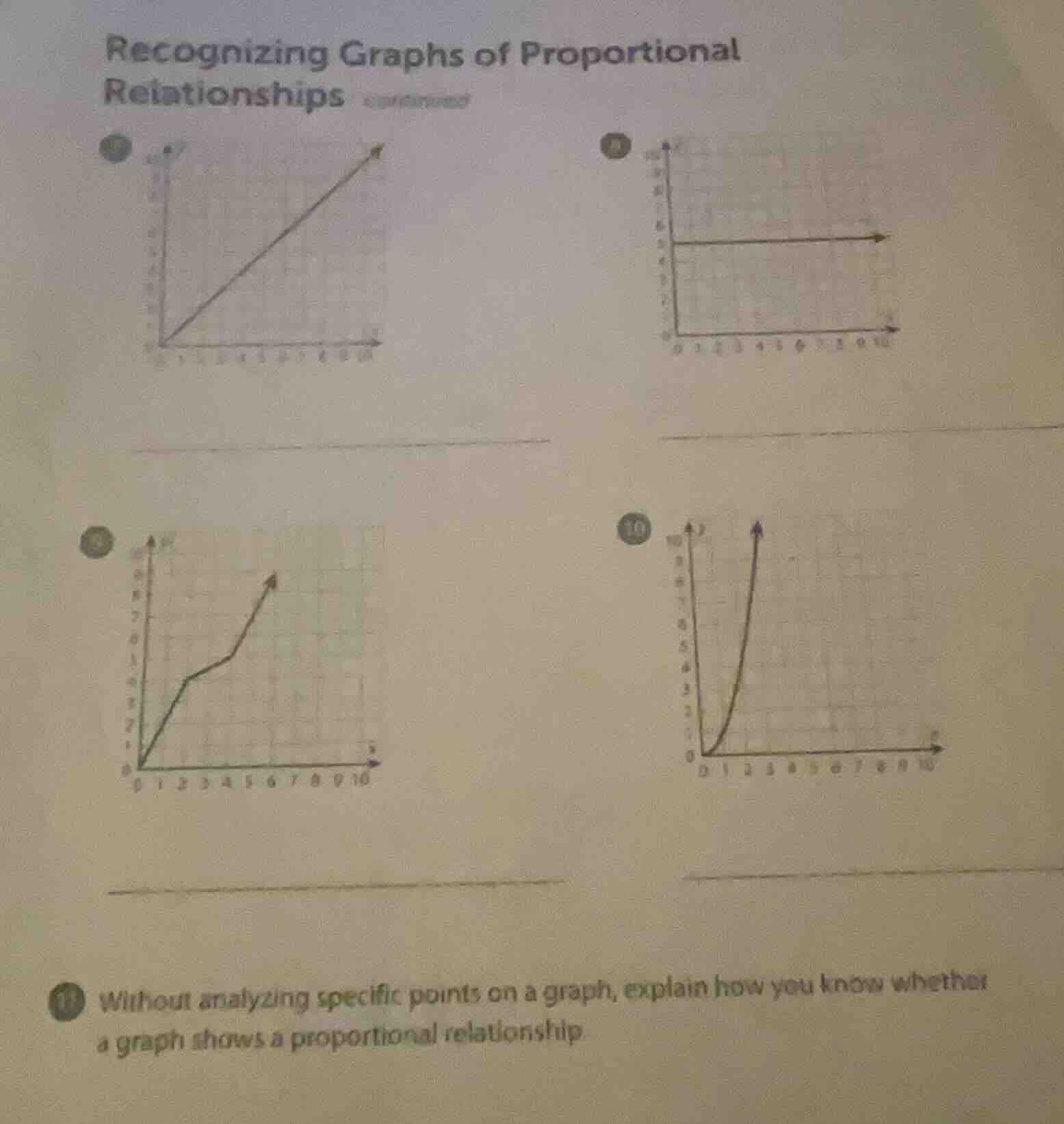
(7) graph 1
(8) graph 2
(9) graph 3
(10) graph 4
(11) without analyzing specific points on a graph, explain how you know whether a graph shows a proportional relationship.
For the graphs (assuming we need to determine which show proportional relationships):
Graph 8:
Step1: Recall proportional relationship graph properties
A proportional relationship graph is a straight line passing through the origin \((0,0)\) (since \(y = kx\) where \(k\) is constant, so when \(x = 0\), \(y = 0\)) and has a constant slope (constant rate of change).
Step2: Analyze Graph 8
Graph 8 is a straight line starting at \((0,0)\) and going upwards with a constant slope. So it satisfies the properties of a proportional relationship graph.
Graph 9:
Step1: Recall proportional relationship graph properties
A proportional relationship graph is a straight line through the origin with constant slope.
Step2: Analyze Graph 9
Graph 9 is a horizontal line (slope \(= 0\)) but it does not pass through the origin (it is at \(y = 5\) or similar, not \((0,0)\) as \(x = 0\) gives \(y
eq0\)). Also, it is a horizontal line, but since it does not pass through the origin, it is not a proportional relationship (proportional relationship requires \(y = kx\), so when \(x = 0\), \(y = 0\)).
Graph 10:
Step1: Recall proportional relationship graph properties
A proportional relationship graph is a straight line through the origin with constant slope.
Step2: Analyze Graph 10
Graph 10 is a curve (not a straight line), so its slope is not constant. Thus, it does not represent a proportional relationship.
Graph 11 (the curved one):

Snap & solve any problem in the app
Get step-by-step solutions on Sovi AI
Photo-based solutions with guided steps
Explore more problems and detailed explanations
A graph shows a proportional relationship if it is a straight line (linear) that passes through the origin \((0,0)\). This is because a proportional relationship is modeled by \(y = kx\) (where \(k\) is the constant of proportionality), which is a linear equation with a \(y\)-intercept of \(0\) (passes through the origin) and a constant slope (constant rate of change).