QUESTION IMAGE
Question
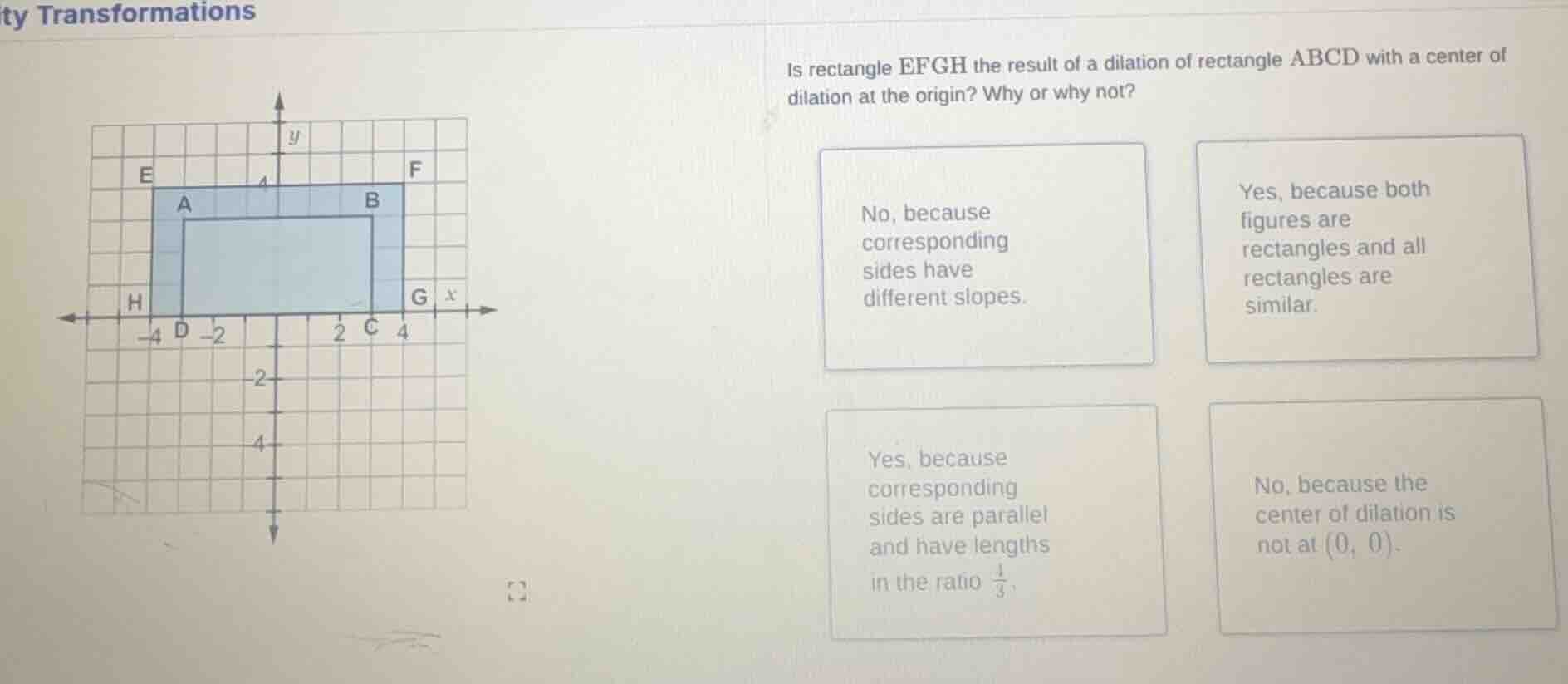
is rectangle efgh the result of a dilation of rectangle abcd with a center of dilation at the origin? why or why not?
no, because corresponding sides have different slopes.
yes, because both figures are rectangles and all rectangles are similar.
yes, because corresponding sides are parallel and have lengths in the ratio \\(\frac{4}{3}\\).
no, because the center of dilation is not at \\((0, 0)\\).
To determine if rectangle \( EFGH \) is a dilation of rectangle \( ABCD \) with center at the origin, we analyze dilation properties. Dilation preserves parallelism and scales lengths by a constant ratio.
- First, check parallelism: Sides of rectangles are horizontal/vertical, so corresponding sides (e.g., \( AB \parallel EF \), \( AD \parallel EH \)) are parallel.
- Next, check length ratio: Let’s find coordinates. For \( ABCD \), say \( A(-3,3) \), \( B(3,3) \), \( C(3,1) \), \( D(-3,1) \). Length \( AB = 6 \), \( AD = 2 \). For \( EFGH \), \( E(-4,4) \), \( F(4,4) \), \( G(4,1) \), \( H(-4,1) \). Length \( EF = 8 \), \( EH = 3 \)? Wait, no—wait, \( AD \) is from \( y=1 \) to \( y=3 \), so length \( 2 \); \( EH \) is from \( y=1 \) to \( y=4 \), length \( 3 \)? Wait, no, maybe better: \( AB \) length: \( ABCD \): from \( x=-3 \) to \( x=3 \), so \( 6 \); \( EFGH \): from \( x=-4 \) to \( x=4 \), so \( 8 \). Ratio \( \frac{8}{6} = \frac{4}{3} \). \( AD \): \( ABCD \) from \( y=1 \) to \( y=3 \), length \( 2 \); \( EH \): \( EFGH \) from \( y=1 \) to \( y=4 \), length \( 3 \). Ratio \( \frac{3}{2} \)? Wait, no, maybe I messed up coordinates. Wait, the grid: \( D \) is at \( (-3,0) \)? Wait, the x-axis is at \( y=0 \). So \( D(-3,0) \), \( C(3,0) \), \( B(3,3) \), \( A(-3,3) \)? Wait, the blue rectangle \( ABCD \): let's re-express. Let's take \( A(-3,3) \), \( B(3,3) \), \( C(3,1) \), \( D(-3,1) \). Then \( E(-4,4) \), \( F(4,4) \), \( G(4,1) \), \( H(-4,1) \). So \( AB \) length: \( 3 - (-3) = 6 \); \( EF \) length: \( 4 - (-4) = 8 \). Ratio \( \frac{EF}{AB} = \frac{8}{6} = \frac{4}{3} \). \( AD \) length: \( 3 - 1 = 2 \); \( EH \) length: \( 4 - 1 = 3 \). Wait, ratio \( \frac{EH}{AD} = \frac{3}{2} \)? No, that can't be. Wait, maybe \( ABCD \) has \( A(-3,3) \), \( B(3,3) \), \( C(3,0) \), \( D(-3,0) \)? Then \( AD \) length is \( 3 - 0 = 3 \), \( AB \) length \( 6 \). \( EFGH \): \( E(-4,4) \), \( F(4,4) \), \( G(4,0) \), \( H(-4,0) \). Then \( EF = 8 \), \( EH = 4 \). Ratio \( \frac{EF}{AB} = \frac{8}{6} = \frac{4}{3} \), \( EH/AD = \frac{4}{3} \). Ah, that makes sense. So corresponding sides are parallel (horizontal/vertical, so slopes 0 or undefined, parallel) and lengths are in ratio \( \frac{4}{3} \). Dilation from origin: scaling factor \( \frac{4}{3} \) would map \( ABCD \) to \( EFGH \) if center is origin. Wait, but the last option says "No, because the center of dilation is not at (0,0)"—but the question says center is origin. Wait, no, the options: let's check each:
- "No, because corresponding sides have different slopes": Sides of rectangles are horizontal/vertical, so slopes 0 (horizontal) or undefined (vertical), so corresponding sides have same slopes (parallel). So this is wrong.
- "Yes, because both figures are rectangles and all rectangles are similar": Not all rectangles are similar (e.g., 2x3 and 4x5 rectangles are not similar). Similarity requires proportional sides. So this is wrong.
- "Yes, because corresponding sides are parallel and have lengths in the ratio \( \frac{4}{3} \)": As we saw, if \( ABCD \) has sides 6 and 3 (wait, no, if \( AB = 6 \), \( AD = 3 \), then \( EFGH \) has \( EF = 8 \), \( EH = 4 \)? Wait, no, earlier mistake: if \( D \) is at \( (-3,0) \), \( A \) at \( (-3,3) \), so \( AD \) length 3; \( E \) at \( (-4,4) \), \( H \) at \( (-4,1) \), so \( EH \) length 3? No, \( y \)-coordinate of \( E \) is 4, \( H \) is 1, so length 3? Wait, no, \( E(-4,4) \), \( H(-4,1) \): vertical length is \( 4 - 1 = 3 \). \( A(-3,3) \), \( D(-3,0) \): vertical length \( 3 - 0 = 3 \). Wait, that's sam…

Snap & solve any problem in the app
Get step-by-step solutions on Sovi AI
Photo-based solutions with guided steps
Explore more problems and detailed explanations
Yes, because corresponding sides are parallel and have lengths in the ratio $\frac{4}{3}$ (the option with this explanation).