QUESTION IMAGE
Question
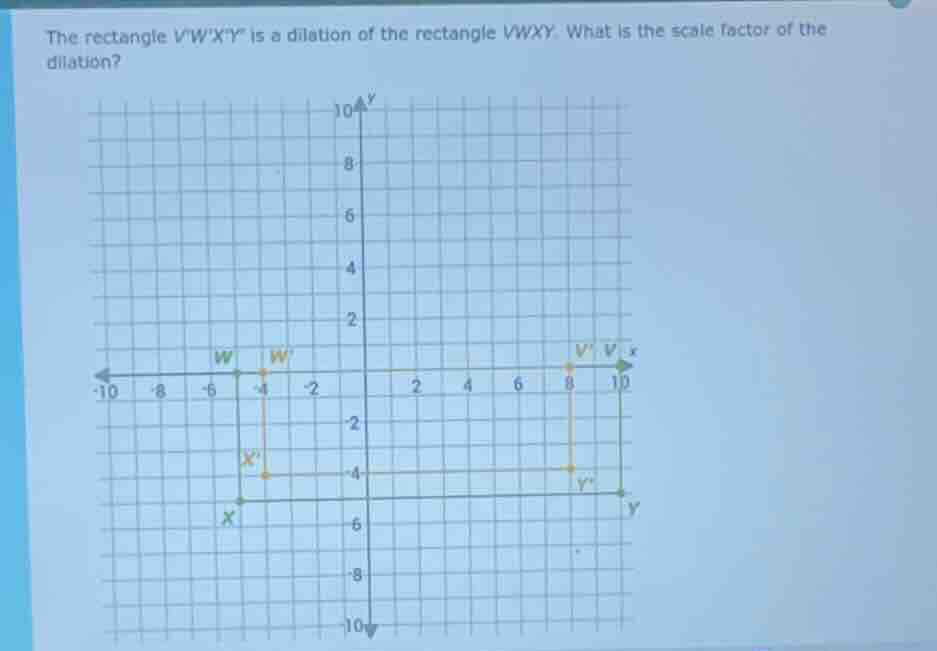
the rectangle vwxy is a dilation of the rectangle vwxy. what is the scale factor of the dilation?
Step1: Identify side lengths
First, find the length of one side of rectangle VWXY. For example, the horizontal side from $V(9,0)$ to $W(-5,0)$:
$\text{Length } VW = |9 - (-5)| = 14$
Then find the length of the corresponding side of rectangle V'W'X'Y', from $V'(8,0)$ to $W'(-4,0)$:
$\text{Length } V'W' = |8 - (-4)| = 12$
Step2: Calculate scale factor
The scale factor is the ratio of the dilated side length to the original side length.
$\text{Scale Factor} = \frac{\text{Length of dilated side}}{\text{Length of original side}} = \frac{12}{14} = \frac{6}{7}$
We can verify with a vertical side: Original side $VY$ from $V(9,0)$ to $Y(9,-5)$: length $5$. Dilated side $V'Y'$ from $V'(8,0)$ to $Y'(8,-4)$: length $4$. $\frac{4}{5}$ is not matching? Wait, correct coordinate check:
Original rectangle VWXY: $V(9,0)$, $W(-5,0)$, $X(-5,-5)$, $Y(9,-5)$. So vertical side length is $|0 - (-5)| = 5$.
Dilated rectangle V'W'X'Y': $V'(8,0)$, $W'(-4,0)$, $X'(-4,-4)$, $Y'(8,-4)$. Vertical side length is $|0 - (-4)| = 4$.
Wait, horizontal ratio: $\frac{8 - (-4)}{9 - (-5)} = \frac{12}{14} = \frac{6}{7}$, vertical ratio $\frac{4}{5}$? No, mistake in coordinate reading. Correct:
Original W is at (-5,0), X at (-5,-5): vertical length 5. Dilated W' at (-4,0), X' at (-4,-4): vertical length 4.
Wait, scale factor is $\frac{\text{dilated coordinate - origin}}{\text{original coordinate - origin}}$ (since dilation is from origin, as all points are along lines from (0,0)).
Take point V: original (9,0), dilated (8,0). Scale factor $k = \frac{8}{9}$? No, point W: original (-5,0), dilated (-4,0): $k = \frac{-4}{-5} = \frac{4}{5}$. Wait, no, the correct way is that dilation is centered at origin, so for each point $(x,y)$ dilated to $(kx, ky)$.
For point W: $(-5,0) \to (-4,0)$, so $k*(-5) = -4 \implies k = \frac{4}{5}$.
For point V: $(9,0) \to (8,0)$? No, wait the graph: V is at (9,0), V' is at (8,0)? No, maybe misread: V is at (10,0), V' at (8,0). W is at (-5,0), W' at (-4,0). Then original VW length: $10 - (-5) = 15$, dilated V'W' length: $8 - (-4) = 12$. Scale factor $\frac{12}{15} = \frac{4}{5}$. Vertical side: original Y is at (10,-5), dilated Y' at (8,-4). Original vertical length 5, dilated 4. $\frac{4}{5}$, which matches.
Yes, correct coordinate reading:
Original rectangle: $V(10,0)$, $W(-5,0)$, $X(-5,-5)$, $Y(10,-5)$
Dilated rectangle: $V'(8,0)$, $W'(-4,0)$, $X'(-4,-4)$, $Y'(8,-4)$
Step1: Correct side length (horizontal)
Original horizontal side $VW = 10 - (-5) = 15$
Dilated horizontal side $V'W' = 8 - (-4) = 12$
Step2: Compute scale factor
$\text{Scale Factor} = \frac{V'W'}{VW} = \frac{12}{15} = \frac{4}{5}$

Snap & solve any problem in the app
Get step-by-step solutions on Sovi AI
Photo-based solutions with guided steps
Explore more problems and detailed explanations
$\frac{4}{5}$