QUESTION IMAGE
Question
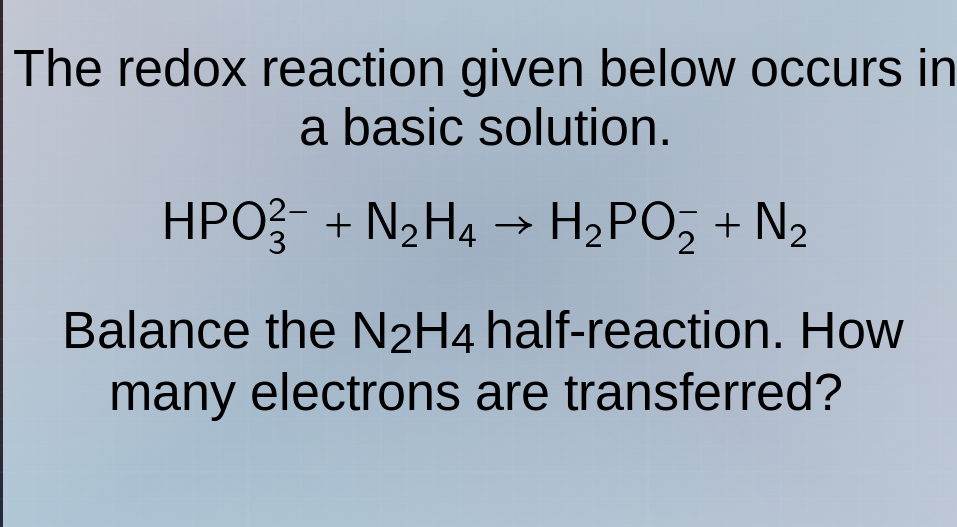
the redox reaction given below occurs in a basic solution. \\(\ce{hpo^{2-}_{3} + n_{2}h_{4} -> h_{2}po^{-}_{2} + n_{2}}\\) balance the \\(\ce{n_{2}h_{4}}\\) half - reaction. how many electrons are transferred?
Step1: Identify Oxidation State Changes
In \( \ce{N2H4} \), the oxidation state of \( \ce{N} \) is \(-2\) (since \( \ce{H} \) is \( +1 \), and \( 2x + 4(+1) = 0 \Rightarrow x = -2 \)). In \( \ce{N2} \), the oxidation state of \( \ce{N} \) is \( 0 \). Each \( \ce{N} \) atom loses \( 2 \) electrons (from \(-2\) to \( 0 \)), and there are \( 2 \) \( \ce{N} \) atoms in \( \ce{N2H4} \) and \( \ce{N2} \).
Step2: Write Unbalanced Half-Reaction
The oxidation half - reaction (since \( \ce{N} \) is oxidized) is: \( \ce{N2H4 -> N2} \)
Step3: Balance Atoms Other Than O and H
The number of \( \ce{N} \) atoms is already balanced (2 on each side).
Step4: Balance O (not needed here as no O atoms) and Balance H in Basic Solution
In basic solution, we add \( \ce{OH-} \) and \( \ce{H2O} \) to balance H. First, balance H by adding \( \ce{H2O} \) and \( \ce{OH-} \). The left - hand side has 4 H atoms. So we add \( 4\ce{OH-} \) to the right and \( 4\ce{H2O} \) to the left? Wait, no. The correct way: For the reaction \( \ce{N2H4 -> N2} \), to balance H, in basic solution, we can think of the reaction in terms of \( \ce{H2O} \) and \( \ce{OH-} \). The number of H atoms: left has 4 H. So we add \( 4\ce{H2O} \) to the right and \( 4\ce{OH-} \) to the left? Wait, no, the standard method for basic solution:
- Balance H by adding \( \ce{H2O} \) to the side with less H and \( \ce{OH-} \) to the other side. The half - reaction \( \ce{N2H4 -> N2} \) has 4 H on the left. So we add \( 4\ce{H2O} \) to the right and \( 4\ce{OH-} \) to the left? Wait, no, let's do it step by step.
The unbalanced half - reaction (oxidation): \( \ce{N2H4 -> N2} \)
Balance H: Add \( 4\ce{H2O} \) to the right and \( 4\ce{OH-} \) to the left? No, the correct approach is:
The number of H atoms: left has 4 H. So we can write:
\( \ce{N2H4 + 4OH- -> N2 + 4H2O} \)
Now check H: left: 4 H (from \( \ce{N2H4} \)) + 4 H (from \( 4\ce{OH-} \))? No, wait, \( \ce{OH-} \) has one H. Wait, I made a mistake. Let's use the standard method for balancing redox half - reactions in basic solution:
- Write the unbalanced half - reaction: \( \ce{N2H4 -> N2} \) (oxidation, since N is oxidized)
- Balance N: already balanced (2 N on each side)
- Balance H: There are 4 H on the left. In basic solution, we add \( \ce{H2O} \) to the side that needs H and \( \ce{OH-} \) to the other side. The formula for balancing H in basic solution is: if we have \( x \) H on the left, we can add \( x\ce{H2O} \) to the left and \( x\ce{OH-} \) to the right, or vice - versa. Wait, the correct way is:
For the reaction \( \ce{N2H4 -> N2} \), the number of H atoms: left has 4 H. So we add \( 4\ce{H2O} \) to the right and \( 4\ce{OH-} \) to the left? No, let's use the oxidation state to find the electrons.
From the oxidation state change: each N atom goes from - 2 to 0, so each N loses 2 electrons. There are 2 N atoms in \( \ce{N2H4} \), so total electrons lost: \( 2\times2 = 4 \) electrons.
Now, let's balance the half - reaction properly:
Oxidation half - reaction: \( \ce{N2H4 -> N2} \)
Balance H: Add \( 4\ce{H2O} \) to the right and \( 4\ce{OH-} \) to the left? Wait, no, let's do it by adding \( \ce{OH-} \) and \( \ce{H2O} \) correctly.
The number of H atoms: left has 4 H. So we can write:
\( \ce{N2H4 + 4OH- -> N2 + 4H2O} \)
Now check the charge:
Left - hand side charge: charge of \( \ce{N2H4} \) is 0, charge of \( 4\ce{OH-} \) is - 4, total charge: - 4.
Right - hand side charge: charge of \( \ce{N2} \) is 0, charge of \( 4\ce{H2O} \) is 0, total charge: 0. Wait, that's not balanced. We need to balance…

Snap & solve any problem in the app
Get step-by-step solutions on Sovi AI
Photo-based solutions with guided steps
Explore more problems and detailed explanations
The number of electrons transferred in the \( \ce{N2H4} \) half - reaction (oxidation half - reaction) is 4.