QUESTION IMAGE
Question
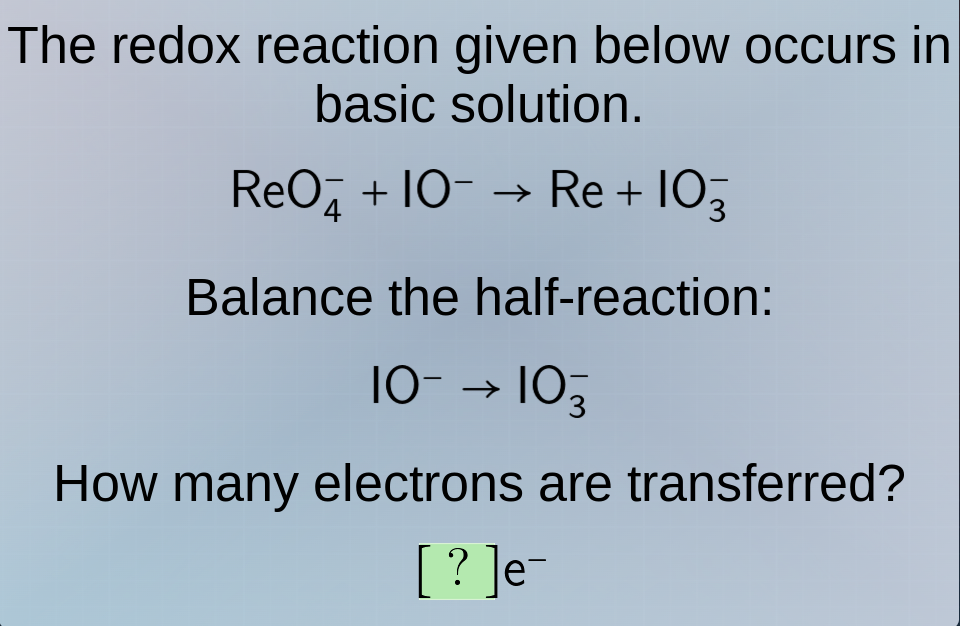
the redox reaction given below occurs in basic solution.
reo₄⁻ + io⁻ → re + io₃⁻
balance the half - reaction:
io⁻ → io₃⁻
how many electrons are transferred?
?e⁻
Step1: Balance O by adding H₂O
To balance the oxygen atoms, we see that there is 1 O in \( \text{IO}^- \) and 3 O in \( \text{IO}_3^- \). So we add 2 \( \text{H}_2\text{O} \) to the left side (reactant side) to balance O.
Step2: Balance H by adding H⁺
Now, balance the hydrogen atoms. There are 4 H in \( 2\text{H}_2\text{O} \), so we add 4 \( \text{H}^+ \) to the right side (product side).
Step3: Adjust for basic solution (add OH⁻)
Since the reaction is in basic solution, we add 4 \( \text{OH}^- \) to both sides to neutralize the \( \text{H}^+ \) (they combine to form \( \text{H}_2\text{O} \)).
Simplify the \( \text{H}^+ \) and \( \text{OH}^- \) to form \( \text{H}_2\text{O} \): \( 4\text{H}^+ + 4\text{OH}^- = 4\text{H}_2\text{O} \). So the equation becomes:
Step4: Balance charge (find electrons transferred)
Now, balance the charge. The charge on the left side: charge of \( \text{IO}^- \) is -1, charge of \( 4\text{OH}^- \) is -4, so total left charge is \( -1 + (-4) = -5 \).
The charge on the right side: charge of \( \text{IO}_3^- \) is -1, charge of \( 2\text{H}_2\text{O} \) is 0, so total right charge is -1.
The difference in charge is \( -1 - (-5) = +4 \), but since the oxidation state of I is increasing (oxidation), we need to lose electrons (negative charge is lost, so electrons are on the product side). Wait, let's calculate oxidation states.
Oxidation state of I in \( \text{IO}^- \): let x be oxidation state of I, \( x + (-2) + (-1) = 0 \)? Wait no, \( \text{IO}^- \): I + O = -1, O is -2, so \( x + (-2) = -1 \) → \( x = +1 \).
Oxidation state of I in \( \text{IO}_3^- \): \( x + 3(-2) = -1 \) → \( x - 6 = -1 \) → \( x = +5 \).
So the change in oxidation state of I is \( +5 - (+1) = +4 \). Since oxidation is loss of electrons, the number of electrons lost is 4 (because each I atom loses 4 electrons to go from +1 to +5). So we add 4 electrons to the product side to balance charge.
The charge on the left: -5, charge on the right: -1 + 0 + (-4) (from 4e⁻) = -5. So charge is balanced. The number of electrons transferred is 4.

Snap & solve any problem in the app
Get step-by-step solutions on Sovi AI
Photo-based solutions with guided steps
Explore more problems and detailed explanations
4