QUESTION IMAGE
Question
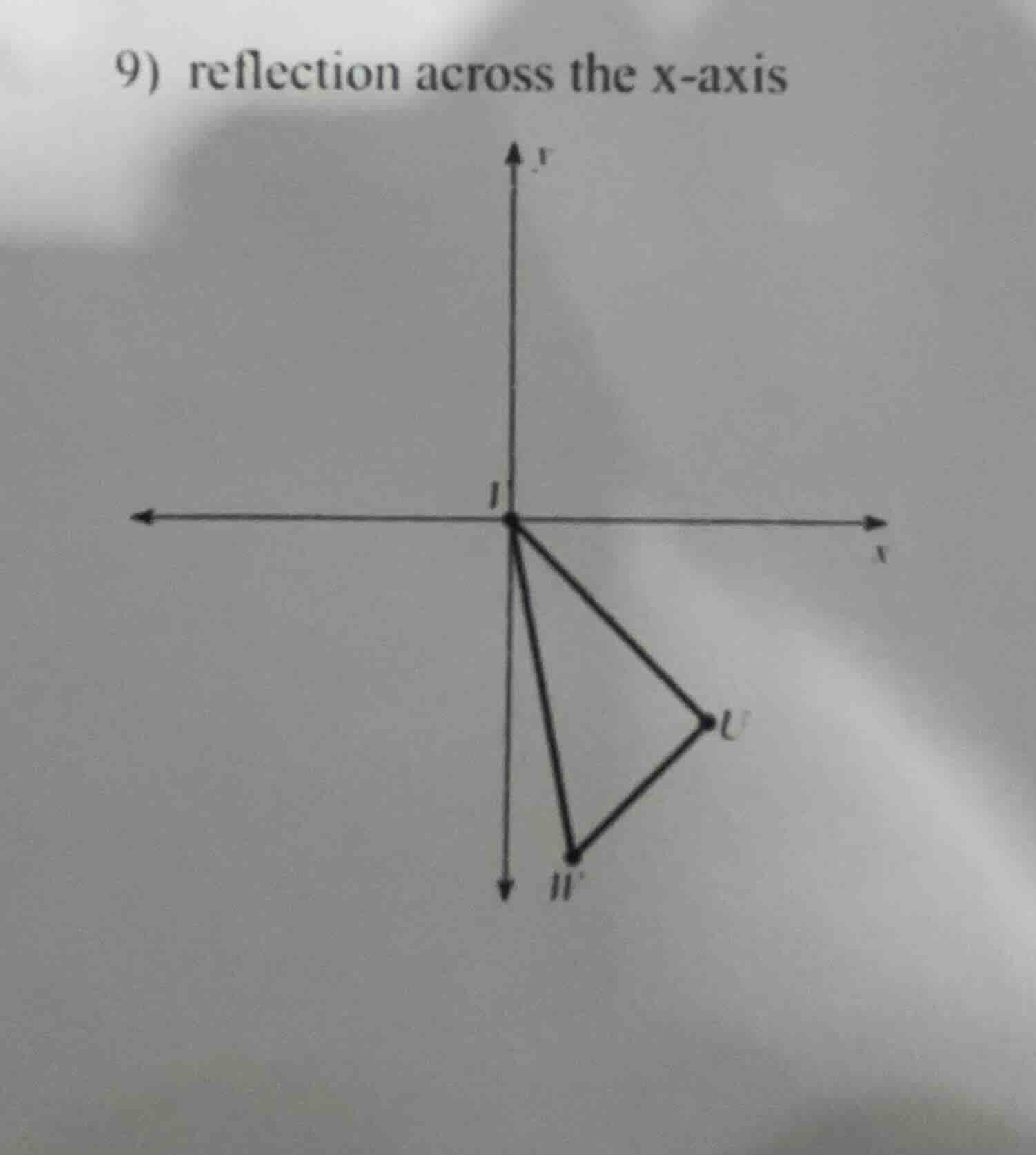
- reflection across the x - axis
To solve the reflection of the triangle across the \( x \)-axis, we use the rule for reflecting a point \((x, y)\) across the \( x \)-axis, which is \((x, -y)\). Let's assume the coordinates of the vertices:
- Let \( I \) be at \((0, 0)\) (since it's at the origin).
- Let \( W \) have coordinates \((a, b)\). After reflection across the \( x \)-axis, \( W' \) will be \((a, -b)\).
- Let \( U \) have coordinates \((c, d)\). After reflection across the \( x \)-axis, \( U' \) will be \((c, -d)\).
Step 1: Identify the coordinates of each vertex
- \( I \): \((0, 0)\)
- \( W \): Let's say \( W = (x_1, y_1) \)
- \( U \): Let's say \( U = (x_2, y_2) \)
Step 2: Apply the reflection rule across the \( x \)-axis
The reflection of a point \((x, y)\) across the \( x \)-axis is \((x, -y)\). So:
- Reflection of \( I(0, 0) \) is \( I'(0, 0) \) (since \( -0 = 0 \)).
- Reflection of \( W(x_1, y_1) \) is \( W'(x_1, -y_1) \).
- Reflection of \( U(x_2, y_2) \) is \( U'(x_2, -y_2) \).
Step 3: Plot the reflected points
Plot \( I'(0, 0) \), \( W'(x_1, -y_1) \), and \( U'(x_2, -y_2) \) on the coordinate plane. Connect these points to form the reflected triangle.
For example, if \( W = (1, -2) \) and \( U = (3, -1) \) (estimating from the graph):
- \( W' \) would be \( (1, 2) \)
- \( U' \) would be \( (3, 1) \)
Step 4: Draw the reflected triangle
Connect \( I'(0, 0) \), \( W'(1, 2) \), and \( U'(3, 1) \) to get the reflected triangle across the \( x \)-axis.
Final Answer
The reflected triangle will have vertices at \( I'(0, 0) \), \( W'(x_1, -y_1) \), and \( U'(x_2, -y_2) \) (where \( (x_1, y_1) \) and \( (x_2, y_2) \) are the original coordinates of \( W \) and \( U \)). The graph of the reflected triangle will be the mirror image of the original triangle across the \( x \)-axis.

Snap & solve any problem in the app
Get step-by-step solutions on Sovi AI
Photo-based solutions with guided steps
Explore more problems and detailed explanations
To solve the reflection of the triangle across the \( x \)-axis, we use the rule for reflecting a point \((x, y)\) across the \( x \)-axis, which is \((x, -y)\). Let's assume the coordinates of the vertices:
- Let \( I \) be at \((0, 0)\) (since it's at the origin).
- Let \( W \) have coordinates \((a, b)\). After reflection across the \( x \)-axis, \( W' \) will be \((a, -b)\).
- Let \( U \) have coordinates \((c, d)\). After reflection across the \( x \)-axis, \( U' \) will be \((c, -d)\).
Step 1: Identify the coordinates of each vertex
- \( I \): \((0, 0)\)
- \( W \): Let's say \( W = (x_1, y_1) \)
- \( U \): Let's say \( U = (x_2, y_2) \)
Step 2: Apply the reflection rule across the \( x \)-axis
The reflection of a point \((x, y)\) across the \( x \)-axis is \((x, -y)\). So:
- Reflection of \( I(0, 0) \) is \( I'(0, 0) \) (since \( -0 = 0 \)).
- Reflection of \( W(x_1, y_1) \) is \( W'(x_1, -y_1) \).
- Reflection of \( U(x_2, y_2) \) is \( U'(x_2, -y_2) \).
Step 3: Plot the reflected points
Plot \( I'(0, 0) \), \( W'(x_1, -y_1) \), and \( U'(x_2, -y_2) \) on the coordinate plane. Connect these points to form the reflected triangle.
For example, if \( W = (1, -2) \) and \( U = (3, -1) \) (estimating from the graph):
- \( W' \) would be \( (1, 2) \)
- \( U' \) would be \( (3, 1) \)
Step 4: Draw the reflected triangle
Connect \( I'(0, 0) \), \( W'(1, 2) \), and \( U'(3, 1) \) to get the reflected triangle across the \( x \)-axis.
Final Answer
The reflected triangle will have vertices at \( I'(0, 0) \), \( W'(x_1, -y_1) \), and \( U'(x_2, -y_2) \) (where \( (x_1, y_1) \) and \( (x_2, y_2) \) are the original coordinates of \( W \) and \( U \)). The graph of the reflected triangle will be the mirror image of the original triangle across the \( x \)-axis.