QUESTION IMAGE
Question
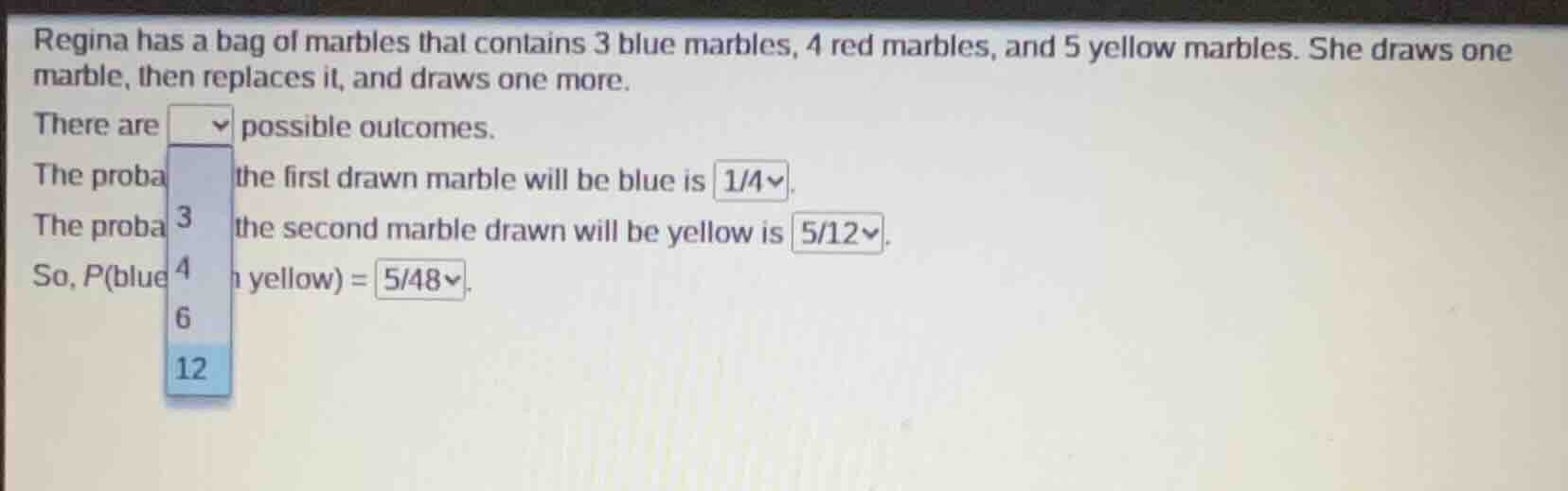
regina has a bag of marbles that contains 3 blue marbles, 4 red marbles, and 5 yellow marbles. she draws one marble, then replaces it, and draws one more. there are dropdown possible outcomes. the probability the first drawn marble will be blue is 1/4 dropdown. the probability the second marble drawn will be yellow is 5/12 dropdown. so, p(blue then yellow) = 5/48 dropdown.
Step1: Calculate total marbles
First, find the total number of marbles. There are 3 blue, 4 red, and 5 yellow marbles. So total marbles = \( 3 + 4 + 5 = 12 \).
Step2: Determine possible outcomes
Since she draws one marble, replaces it, and then draws another, for each draw there are 12 possible outcomes. So for two draws, the total number of possible outcomes is \( 12\times12 = 144 \)? Wait, no, wait. Wait, the first part: "There are [ ] possible outcomes." Wait, maybe it's the number of possible outcomes for each draw? Wait, no, the first dropdown: the total number of marbles is 12, so when drawing with replacement, each draw has 12 possibilities, but maybe the first question is the number of possible outcomes for a single draw? Wait, the problem says "She draws one marble, then replaces it, and draws one more." So for the first draw, number of possible outcomes is the total number of marbles, which is 12. So the first blank: 12.
Step3: Probability first marble blue
Probability of blue: number of blue marbles / total marbles = \( \frac{3}{12} = \frac{1}{4} \), which matches the given.
Step4: Probability second marble yellow
Probability of yellow: number of yellow marbles / total marbles = \( \frac{5}{12} \), which matches.
Step5: Probability blue then yellow
Since the draws are independent (with replacement), \( P(\text{blue then yellow}) = P(\text{blue}) \times P(\text{yellow}) = \frac{3}{12} \times \frac{5}{12} = \frac{15}{144} = \frac{5}{48} \), which matches.
Wait, but the first question: "There are [ ] possible outcomes." If it's the number of possible outcomes for the two - draw experiment with replacement, it's \( 12\times12 = 144 \), but the dropdown has 12. So maybe it's the number of possible outcomes for a single draw, which is 12. So the first blank is 12.

Snap & solve any problem in the app
Get step-by-step solutions on Sovi AI
Photo-based solutions with guided steps
Explore more problems and detailed explanations
For the first blank (possible outcomes): 12
For the probability of first blue: \( \frac{1}{4} \)
For the probability of second yellow: \( \frac{5}{12} \)
For \( P(\text{blue then yellow}) \): \( \frac{5}{48} \)
(If the first question was about the number of possible outcomes for a single draw, then 12 is correct. If it was for two draws, it's 144, but the dropdown has 12, so 12 is the intended answer here.)