QUESTION IMAGE
Question
- a regular hexagon is inscribed in a circle with a diameter of 32 units. find the area of the hexagon.
Step1: Find the side length and apothem
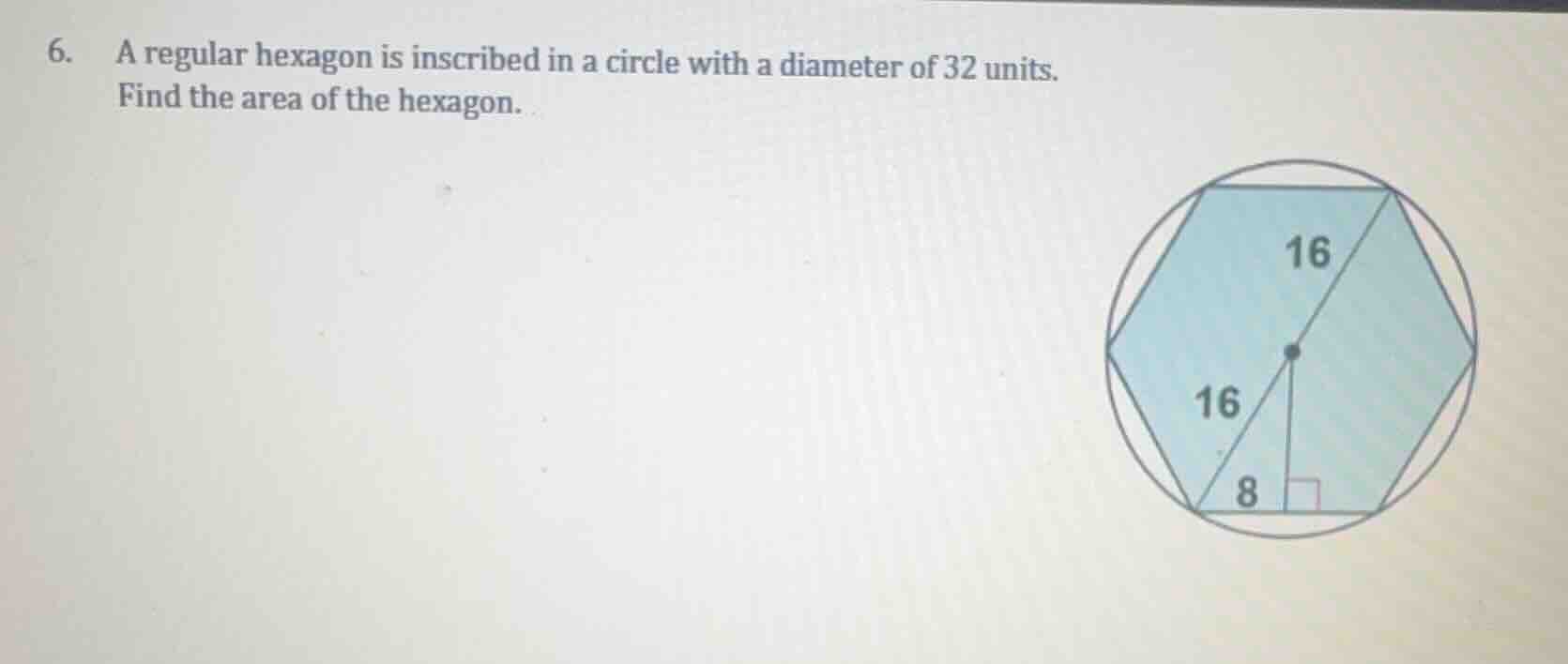
A regular hexagon inscribed in a circle has its side length equal to the radius of the circle. The diameter is 32, so the radius \( r = \frac{32}{2}=16 \) units. From the diagram, the apothem (distance from center to a side, height of the equilateral triangle's sub - triangle) can be related to the side. For an equilateral triangle (each triangle in the hexagon is equilateral) with side length \( s = 16 \), the height (apothem \( a \)) of the 30 - 60 - 90 triangle formed (half of the equilateral triangle) has the short leg \( \frac{s}{2}=8 \), and the long leg (apothem) \( a=\sqrt{16^{2}-8^{2}}=\sqrt{256 - 64}=\sqrt{192}=8\sqrt{3} \). But we can also use the formula for the area of a regular polygon \( A=\frac{1}{2}P\times a \), where \( P \) is the perimeter and \( a \) is the apothem. Alternatively, a regular hexagon can be divided into 6 equilateral triangles, each with side length equal to the radius of the circle.
Step2: Area of one equilateral triangle
The area of an equilateral triangle with side length \( s \) is \( A_{triangle}=\frac{\sqrt{3}}{4}s^{2} \). Here \( s = 16 \), so \( A_{triangle}=\frac{\sqrt{3}}{4}\times16^{2}=\frac{\sqrt{3}}{4}\times256 = 64\sqrt{3} \).
Step3: Area of the hexagon
Since the hexagon is made up of 6 such equilateral triangles, the area of the hexagon \( A = 6\times A_{triangle} \). Substituting the value of \( A_{triangle} \), we get \( A=6\times64\sqrt{3}=384\sqrt{3}\approx384\times1.732 = 665.088 \). But we can also use the formula for the area of a regular polygon \( A=\frac{1}{2}P\times a \). The perimeter \( P = 6\times16=96 \). The apothem \( a = 8\sqrt{3} \) (from the 30 - 60 - 90 triangle, since in a 30 - 60 - 90 triangle, the sides are in the ratio \( 1:\sqrt{3}:2 \), with hypotenuse 16, short leg 8, long leg \( 8\sqrt{3} \)). Then \( A=\frac{1}{2}\times96\times8\sqrt{3}=48\times8\sqrt{3}=384\sqrt{3}\approx665.1 \) square units.
Another way: From the diagram, the base of the right triangle is 8, hypotenuse 16, so height (apothem) is \( \sqrt{16^{2}-8^{2}} = 8\sqrt{3} \). The length of each side of the hexagon is 16 (radius). The hexagon can be thought of as 6 isosceles triangles with base 16 and height (apothem) \( 8\sqrt{3} \). Wait, no, actually each of the 6 triangles in the hexagon is equilateral, so the area of one equilateral triangle with side 16 is \( \frac{\sqrt{3}}{4}\times16^{2}=64\sqrt{3} \), and 6 of them give \( 6\times64\sqrt{3}=384\sqrt{3}\approx665.1 \).
Wait, let's check with the diagram. The diagram shows a right triangle with legs 8 and (let's say) \( h \), hypotenuse 16. So \( h=\sqrt{16^{2}-8^{2}}=\sqrt{256 - 64}=\sqrt{192}=8\sqrt{3} \). The side of the hexagon is 16, and the length of the base of the small triangle (half of the hexagon's side) is 8. The area of one of the 12 small right triangles (if we divide the hexagon into 12 30 - 60 - 90 triangles) is \( \frac{1}{2}\times8\times8\sqrt{3}=32\sqrt{3} \). Then the area of the hexagon is \( 12\times32\sqrt{3}=384\sqrt{3}\approx665.1 \).

Snap & solve any problem in the app
Get step-by-step solutions on Sovi AI
Photo-based solutions with guided steps
Explore more problems and detailed explanations
The area of the regular hexagon is \( 384\sqrt{3}\approx665.1 \) square units (exact form \( 384\sqrt{3} \) square units).