QUESTION IMAGE
Question
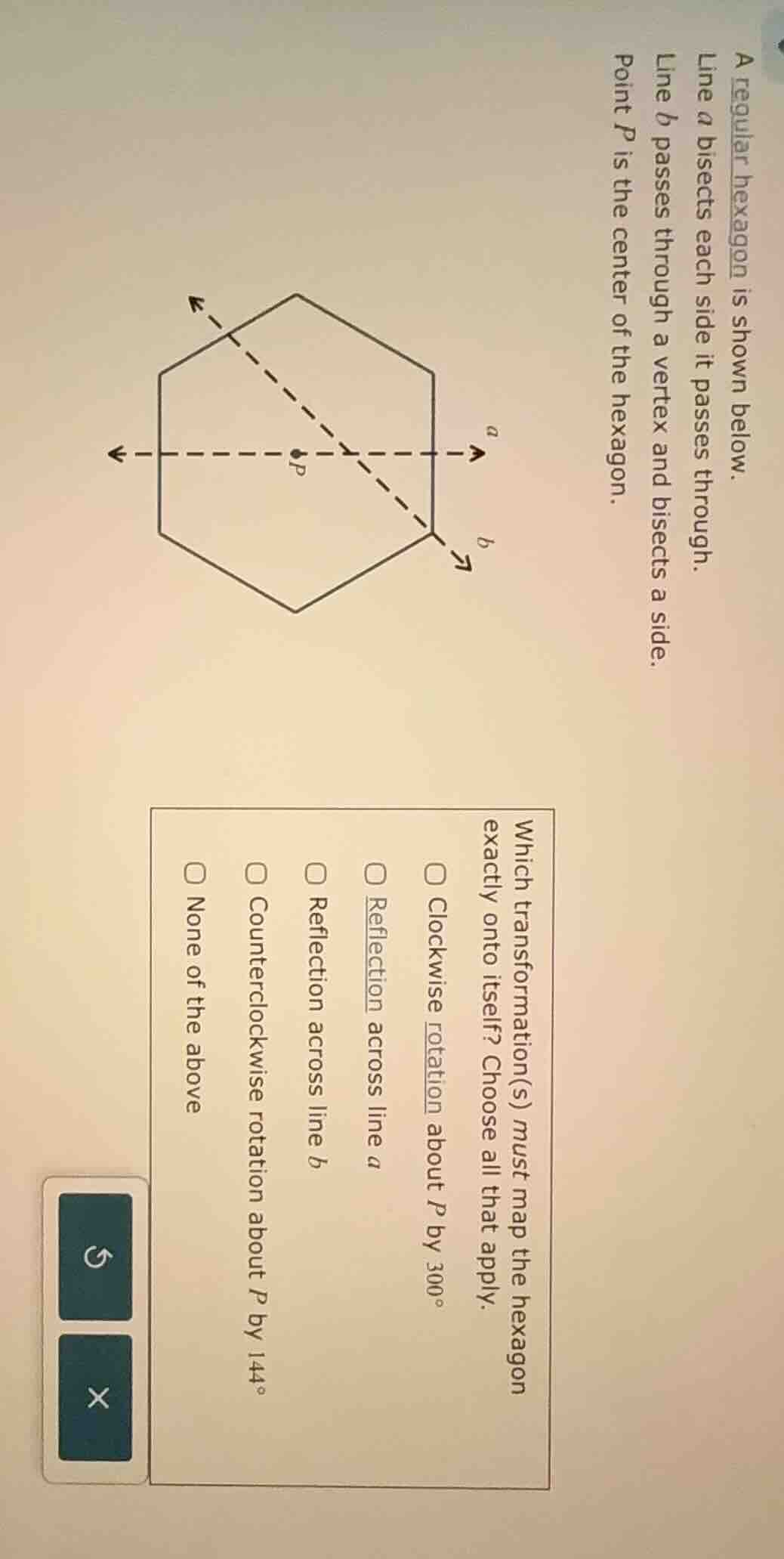
a regular hexagon is shown below.
line ( a ) bisects each side it passes through.
line ( b ) passes through a vertex and bisects a side.
point ( p ) is the center of the hexagon.
which transformation(s) must map the hexagon exactly onto itself? choose all that apply.
- clockwise rotation about ( p ) by ( 300^circ )
- reflection across line ( a )
- reflection across line ( b )
- counterclockwise rotation about ( p ) by ( 144^circ )
- none of the above
Brief Explanations
- Clockwise rotation about \( P \) by \( 300^\circ \): A regular hexagon has rotational symmetry of order 6, meaning the smallest angle of rotation that maps it onto itself is \( \frac{360^\circ}{6} = 60^\circ \). A \( 300^\circ \) clockwise rotation is equivalent to a \( 360^\circ - 300^\circ = 60^\circ \) counterclockwise rotation, which is a valid rotational symmetry. So this rotation maps the hexagon onto itself.
- Reflection across line \( a \): Line \( a \) bisects each side it passes through. In a regular hexagon, such a line (a line of symmetry through the midpoints of opposite sides) will reflect the hexagon onto itself, as the hexagon is symmetric with respect to this line.
- Reflection across line \( b \): Line \( b \) passes through a vertex and bisects a side. In a regular hexagon, a line through a vertex and the midpoint of the opposite side is also a line of symmetry, so reflecting across line \( b \) will map the hexagon onto itself.
- Counterclockwise rotation about \( P \) by \( 144^\circ \): The rotational symmetry angles for a regular hexagon are multiples of \( 60^\circ \) (\( 60^\circ, 120^\circ, 180^\circ, 240^\circ, 300^\circ \)). \( 144^\circ \) is not a multiple of \( 60^\circ \), so this rotation does not map the hexagon onto itself.

Snap & solve any problem in the app
Get step-by-step solutions on Sovi AI
Photo-based solutions with guided steps
Explore more problems and detailed explanations
- Clockwise rotation about \( P \) by \( 300^\circ \)
- Reflection across line \( a \)
- Reflection across line \( b \)