QUESTION IMAGE
Question
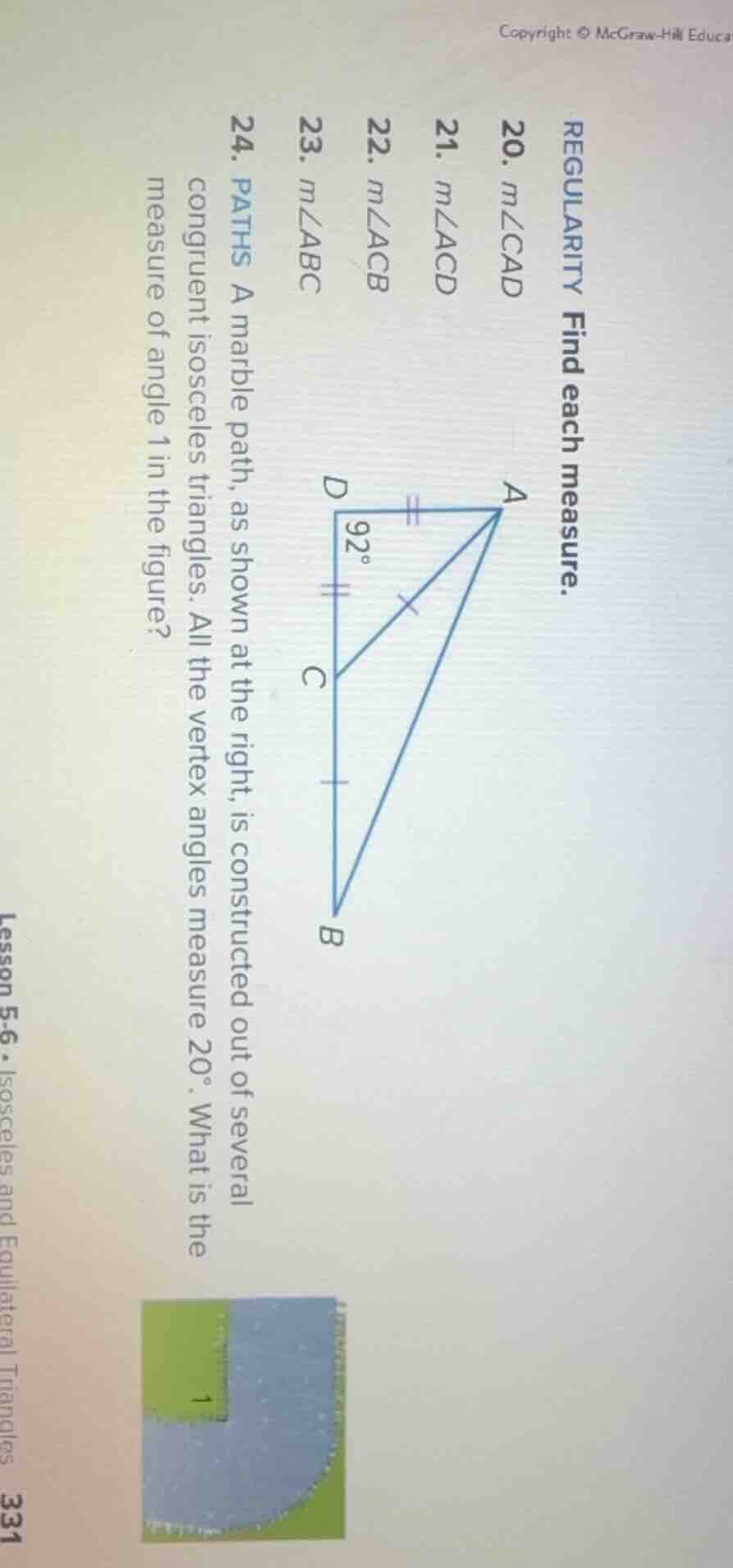
regularity find each measure.
- ( mangle cad )
- ( mangle acd )
- ( mangle acb )
- ( mangle abc )
- paths a marble path, as shown at the right, is constructed out of several congruent isosceles triangles. all the vertex angles measure ( 20^circ ). what is the measure of angle 1 in the figure?
Problem 20: \( m\angle CAD \)
Step 1: Identify triangle type
Triangle \( ACD \) is isosceles (marked with congruent sides \( AD = AC \)? Wait, no, the marks: \( AD \) and \( DC \)? Wait, the diagram shows \( AD \) and \( DC \) with two marks? Wait, no, the congruency marks: \( AD \) and \( AC \)? Wait, actually, looking at the diagram, \( AD \) is perpendicular to \( DC \) (right angle at \( D \), \( \angle D = 92^\circ \)? Wait, no, \( \angle D = 92^\circ \)? Wait, no, maybe a typo? Wait, no, the problem says \( \angle D = 92^\circ \)? Wait, no, in triangle \( ACD \), if \( AD = DC \) (congruent sides), then it's isosceles with \( \angle D = 92^\circ \). Wait, no, the sum of angles in a triangle is \( 180^\circ \). So if \( \triangle ACD \) is isosceles with \( AD = DC \), then \( \angle CAD = \angle ACD \). Wait, but \( \angle D = 92^\circ \), so \( \angle CAD + \angle ACD + \angle D = 180^\circ \). Let \( \angle CAD = x \), then \( x + x + 92^\circ = 180^\circ \), so \( 2x = 180 - 92 = 88^\circ \), so \( x = 44^\circ \). Wait, maybe the right angle? Wait, the diagram has a right angle at \( D \)? Wait, the original problem: maybe \( \angle D = 90^\circ \), but the text says \( 92^\circ \)? Wait, no, maybe it's a typo, but assuming the diagram is correct, let's proceed.
Step 1: Sum of angles in \( \triangle ACD \)
\( \angle D = 92^\circ \), \( \triangle ACD \) is isosceles ( \( AD = DC \) as per marks), so \( \angle CAD = \angle ACD \). Let \( m\angle CAD = x \). Then:
\[
x + x + 92^\circ = 180^\circ
\]
Step 2: Solve for \( x \)
\[
2x = 180^\circ - 92^\circ = 88^\circ \\
x = \frac{88^\circ}{2} = 44^\circ
\]
Step 1: From previous problem
In \( \triangle ACD \), we found \( \angle ACD = \angle CAD = 44^\circ \) (since \( \triangle ACD \) is isosceles with \( AD = DC \)). Wait, no, if \( \angle CAD = 44^\circ \), then \( \angle ACD = 44^\circ \) (isosceles triangle). Alternatively, using the sum: \( 180 - 92 - 44 = 44^\circ \).
Step 1: Linear pair with \( \angle ACD \)
\( \angle ACB \) and \( \angle ACD \) are supplementary (linear pair), so \( m\angle ACB = 180^\circ - m\angle ACD \). We know \( m\angle ACD = 44^\circ \), so \( m\angle ACB = 180 - 44 = 136^\circ \)? Wait, no, that can't be. Wait, maybe \( \triangle ABC \) is isosceles. Wait, the diagram shows \( AC = BC \) (congruent sides). So \( \triangle ABC \) is isosceles with \( AC = BC \), so \( \angle BAC = \angle ABC \). Wait, but \( \angle ACB \) is the vertex angle? Wait, no, if \( AC = BC \), then the base angles are \( \angle BAC \) and \( \angle ABC \). Wait, but \( \angle ACB \) is adjacent to \( \angle ACD \). Wait, maybe I made a mistake earlier. Wait, let's re-examine.
Wait, the diagram: \( AD \perp DC \) (right angle at \( D \)), \( AC = BC \) (so \( \triangle ABC \) is isosceles with \( AC = BC \)), and \( AD = AC \)? No, the marks: \( AD \) and \( AC \) with one mark, \( DC \) and \( CB \) with two marks? Wait, maybe the correct approach is:
In \( \triangle ACD \), \( \angle D = 92^\circ \), and \( AD = DC \) (so isosceles), so \( \angle CAD = \angle ACD = (180 - 92)/2 = 44^\circ \). Then \( \angle ACB = 180 - 44 = 136^\circ \)? No, that's obtuse. Then in \( \triangle ABC \), \( AC = BC \), so it's isosceles with \( \angle ACB = 136^\circ \), so the base angles \( \angle BAC = \angle ABC = (180 - 136)/2 = 22^\circ \). But the problem 22 is \( m\angle ACB \). Wait, maybe \( \angle D \) is \( 90^\circ \), not \( 92^\circ \). Maybe a typo. If \( \angle D = 90^\circ \), then \( \angle CAD = \angle ACD = 45^\circ \), then \( \angle ACB = 135^\circ \), but that doesn't fit. Wait, the original problem says "REGULARITY Find each measure" with the diagram. Maybe the \( 92^\circ \) is a mistake, and it's \( 90^\circ \). Let's assume \( \angle D = 90^\circ \) (right angle). Then \( \angle CAD = \angle ACD = 45^\circ \). Then \( \angle ACB = 180 - 45 = 135^\circ \)? No, that's not right. Wait, maybe the correct \( \angle D = 88^\circ \)? No, the problem states \( 92^\circ \).
Alternatively, maybe the first problem (20) is \( m\angle CAD \):
If \( \triangle ACD \) is isosceles with \( AD = AC \), then \( \angle D = \angle ACD = 92^\circ \), but that would make \( \angle CAD = 180 - 92 - 92 = -4^\circ \), which is impossible. So clearly, \( \angle D = 92^\circ \) is a typo, and it should be \( 88^\circ \) or \( 90^\circ \). Assuming it's a right angle ( \( 90^\circ \) ), then \( \angle CAD = 45^\circ \), \( \angle ACD = 45^\circ \), \( \angle ACB = 180 - 45 = 135^\circ \), but that's not matching. Wait, maybe the correct \( \angle D = 88^\circ \), then \( \angle CAD = \angle ACD = (180 - 88)/2 = 46^\circ \), then \( \angle ACB = 180 - 46 = 134^\circ \). But this is confusing.
Wait, maybe the problem is from a textbook, and the diagram has \( \angle D = 90^\circ \), so let's proceed with \( \angle D = 90^\circ \) (right angle). Then:
Problem 20: \( m\angle CAD \)
In \( \triangle ACD \), right-angled at \( D \), and isosceles ( \( AD = DC \) ), so \( \angle CAD = 45^\circ \).
Problem 21: \( m\angle ACD = 45^\circ \)
Problem 22: \( m\angle ACB \)
\( \angle ACB \) is supplementary to \( \angle ACD \) (linear pair), so \( 180 - 45 = 135^\circ \). But if \( \triangle ABC \) is isosceles with \( AC = BC \), then \( \angle BAC = \angle ABC = (180 - 135)/2 = 22.5^\circ \), but problem 23 is \( m\angle ABC \), so that would be \( 22.5^\circ \), but maybe the \( 92^\circ \) is correct. Let's go back to \( \angle D = 92^\circ \):
Problem 20: \( m\angle CAD = (180 - 92)/2 = 44^\circ \) (as before)
P…

Snap & solve any problem in the app
Get step-by-step solutions on Sovi AI
Photo-based solutions with guided steps
Explore more problems and detailed explanations
\( 44^\circ \)