QUESTION IMAGE
Question
- $f(x)=x^{3}+2x^{2}-x - 2$
rel. max: ____ rel. min: ____
abs. max: ____ abs. min: ____
inc: ____ dec: ____
domain: ____ range: ____
Step1: Find Relative Maximum
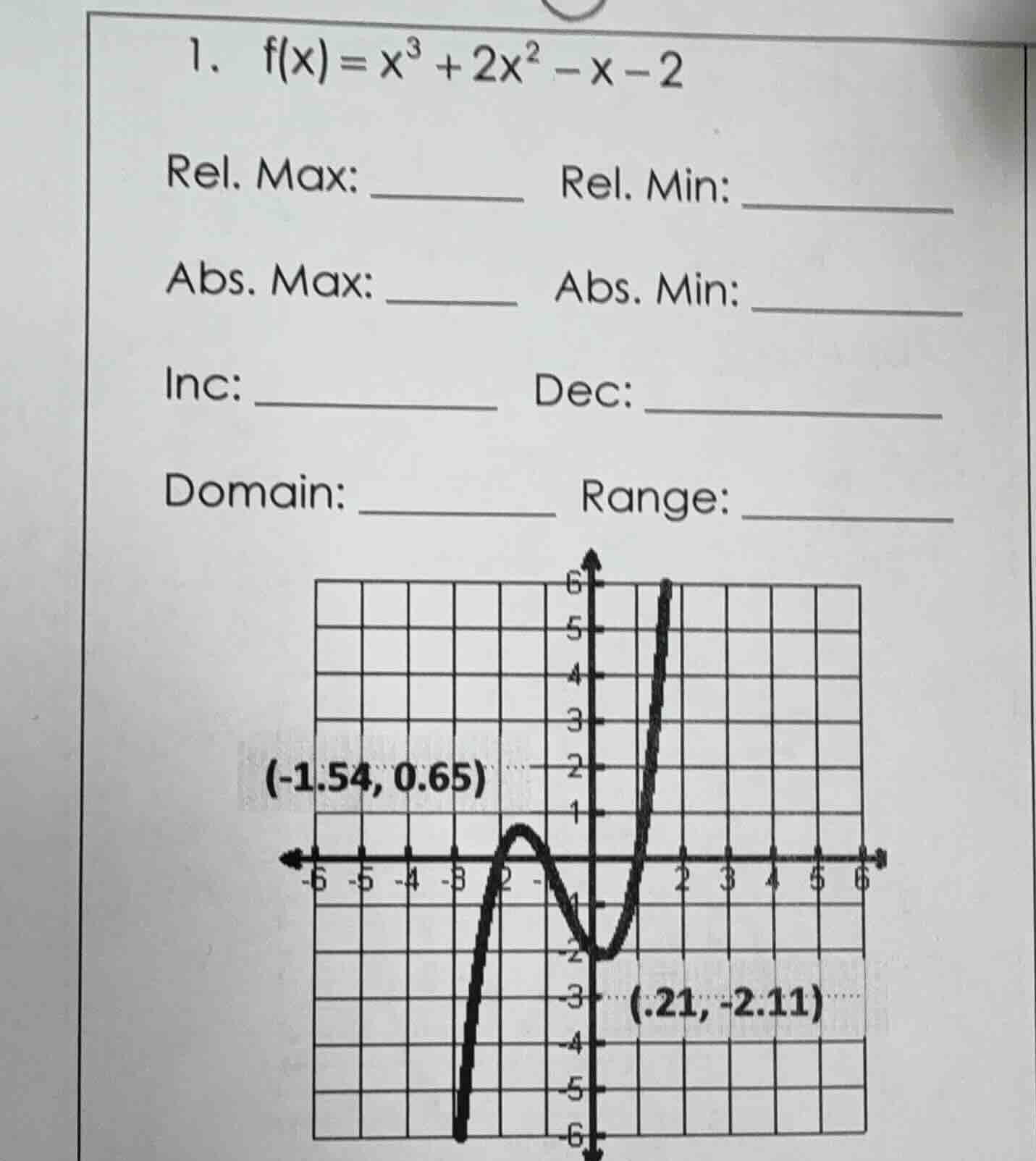
A relative maximum occurs at a point where the function changes from increasing to decreasing. From the graph, the point \((-1.54, 0.65)\) (or approximately \((- \frac{3}{2}, \frac{2}{3})\) but using the given graph's point) is a relative maximum. So the relative maximum (Rel. Max) is at \(x \approx -1.54\) with \(f(x) \approx 0.65\), so the point is \((-1.54, 0.65)\).
Step2: Find Relative Minimum
A relative minimum occurs at a point where the function changes from decreasing to increasing. From the graph, the point \((0.21, -2.11)\) (given as \((.21, -2.11)\)) is a relative minimum. So the relative minimum (Rel. Min) is \((0.21, -2.11)\).
Step3: Absolute Maximum and Minimum
For a cubic function \(f(x)=x^3 + 2x^2 - x - 2\), as \(x \to \infty\), \(f(x) \to \infty\) and as \(x \to -\infty\), \(f(x) \to -\infty\). So there is no absolute maximum (Abs. Max) and no absolute minimum (Abs. Min) (they are \(\pm \infty\)).
Step4: Intervals of Increase and Decrease
- Increase (Inc): The function increases when the derivative is positive. From the graph, we can see the function increases on \((-\infty, -1.54)\) and \((0.21, \infty)\) (since after the relative min at \(x \approx 0.21\), it goes to \(\infty\) and before the relative max at \(x \approx -1.54\), it was increasing from \(-\infty\) to \(-1.54\)).
- Decrease (Dec): The function decreases when the derivative is negative. From the graph, it decreases on \((-1.54, 0.21)\) (between the relative max and relative min).
Step5: Domain
The domain of a polynomial function (cubic) is all real numbers, so Domain: \((-\infty, \infty)\) or \(\mathbb{R}\).
Step6: Range
For a cubic function \(y = ax^3+bx^2 + cx + d\) with \(a>0\) (here \(a = 1>0\)), as \(x \to \infty\), \(y \to \infty\) and as \(x \to -\infty\), \(y \to -\infty\). So the range is all real numbers, Range: \((-\infty, \infty)\) or \(\mathbb{R}\).

Snap & solve any problem in the app
Get step-by-step solutions on Sovi AI
Photo-based solutions with guided steps
Explore more problems and detailed explanations
- Rel. Max: \((-1.54, 0.65)\)
- Rel. Min: \((0.21, -2.11)\)
- Abs. Max: None (or \(\infty\))
- Abs. Min: None (or \(-\infty\))
- Inc: \((-\infty, -1.54) \cup (0.21, \infty)\)
- Dec: \((-1.54, 0.21)\)
- Domain: \((-\infty, \infty)\)
- Range: \((-\infty, \infty)\)