QUESTION IMAGE
Question
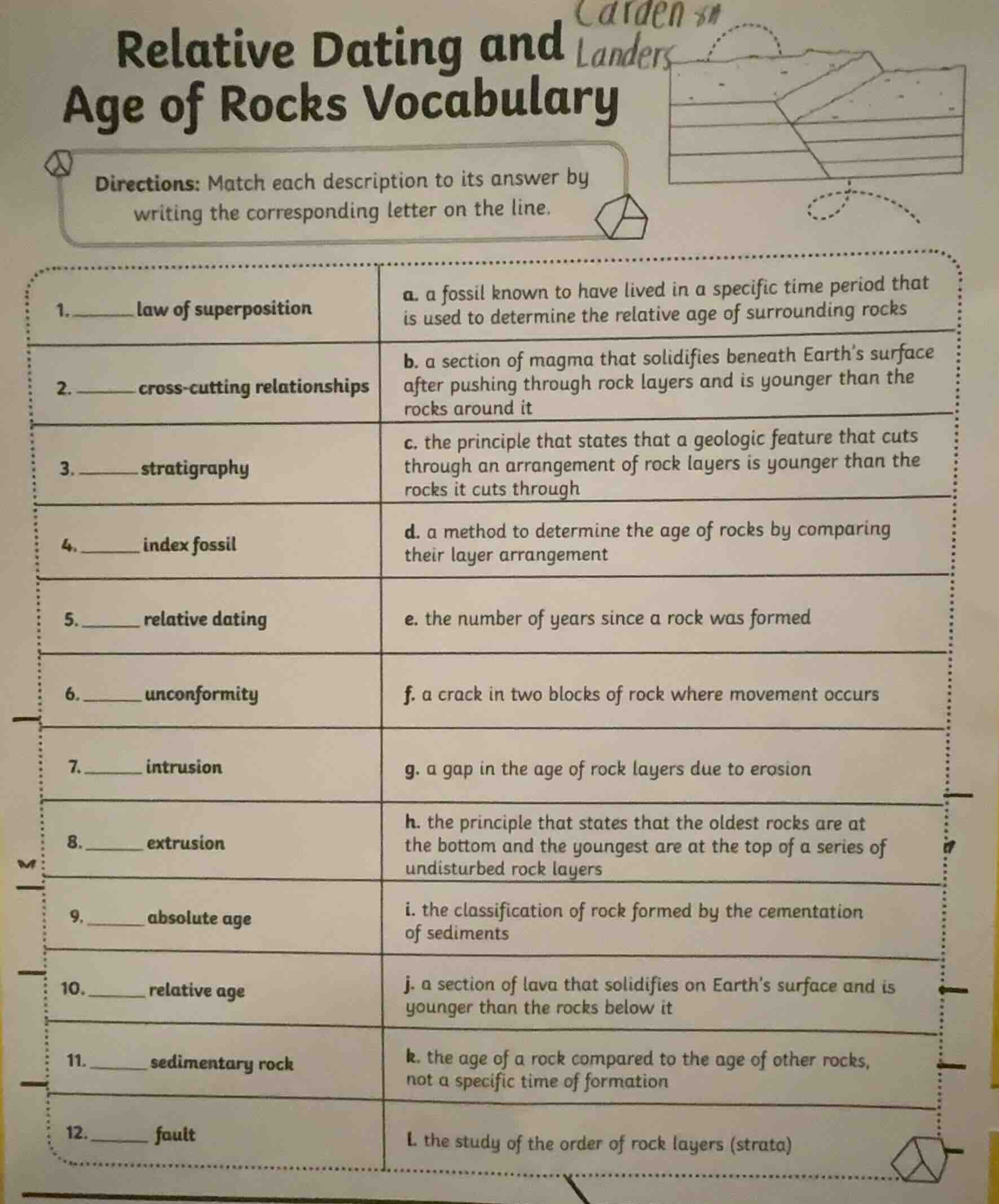
relative dating and age of rocks vocabulary
directions: match each description to its answer by writing the corresponding letter on the line.
- ______ law of superposition
a. a fossil known to have lived in a specific time period that is used to determine the relative age of surrounding rocks
- ______ cross - cutting relationships
b. a section of magma that solidifies beneath earth’s surface after pushing through rock layers and is younger than the rocks around it
- ______ stratigraphy
c. the principle that states that a geologic feature that cuts through an arrangement of rock layers is younger than the rocks it cuts through
- ______ index fossil
d. a method to determine the age of rocks by comparing their layer arrangement
- ______ relative dating
e. the number of years since a rock was formed
- ______ unconformity
f. a crack in two blocks of rock where movement occurs
- ______ intrusion
g. a gap in the age of rock layers due to erosion
- ______ extrusion
h. the principle that states that the oldest rocks are at the bottom and the youngest are at the top of a series of undisturbed rock layers
- ______ absolute age
i. the classification of rock formed by the cementation of sediments
- ______ relative age
j. a section of lava that solidifies on earth’s surface and is younger than the rocks below it
- ______ sedimentary rock
k. the age of a rock compared to the age of other rocks, not a specific time of formation
- ______ fault
l. the study of the order of rock layers (strata)
Each term is matched to its geologic definition based on core concepts of relative dating and rock formation:
- Law of superposition defines the age order of undisturbed rock layers.
- Cross-cutting relationships state cutting features are younger.
- Stratigraphy is the study of rock layer order.
- Index fossils are time-specific for dating rocks.
- Relative dating compares rock ages via layer arrangement.
- Unconformity is an erosion-caused age gap in layers.
- Intrusion is subsurface solidified magma.
- Extrusion is surface-solidified lava.
- Absolute age is the exact formation age in years.
- Relative age is a rock's age vs. other rocks.
- Sedimentary rock forms from cemented sediments.
- Fault is a moving crack between rock blocks.

Snap & solve any problem in the app
Get step-by-step solutions on Sovi AI
Photo-based solutions with guided steps
Explore more problems and detailed explanations
- h. the principle that states that the oldest rocks are at the bottom and the youngest are at the top of a series of undisturbed rock layers
- c. the principle that states that a geologic feature that cuts through an arrangement of rock layers is younger than the rocks it cuts through
- l. the study of the order of rock layers (strata)
- a. a fossil known to have lived in a specific time period that is used to determine the relative age of surrounding rocks
- d. a method to determine the age of rocks by comparing their layer arrangement
- g. a gap in the age of rock layers due to erosion
- b. a section of magma that solidifies beneath Earth's surface after pushing through rock layers and is younger than the rocks around it
- j. a section of lava that solidifies on Earth's surface and is younger than the rocks below it
- e. the number of years since a rock was formed
- k. the age of a rock compared to the age of other rocks, not a specific time of formation
- i. the classification of rock formed by the cementation of sediments
- f. a crack in two blocks of rock where movement occurs