QUESTION IMAGE
Question
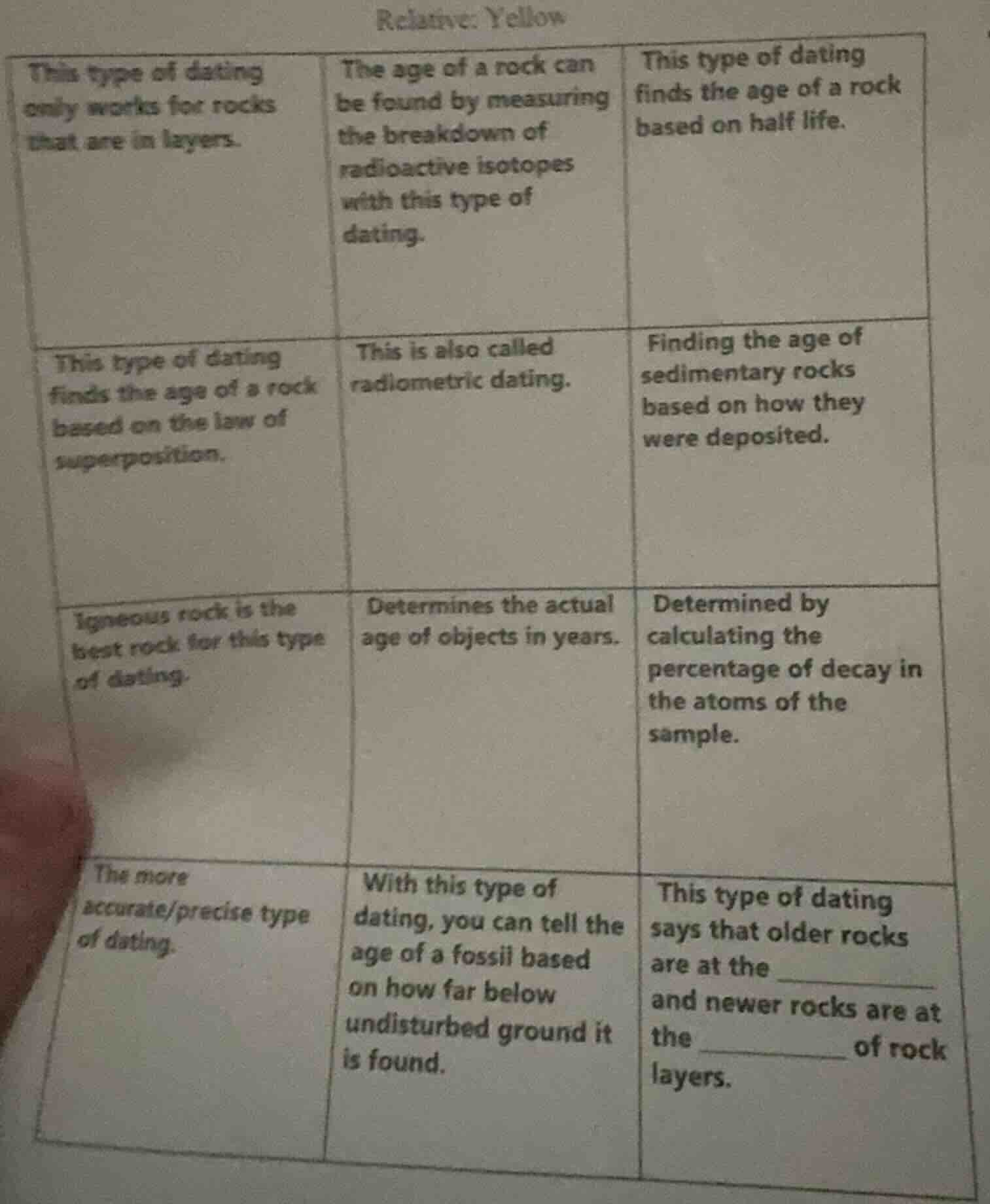
relative: yellow
this type of dating only works for rocks that are in layers. | the age of a rock can be found by measuring the breakdown of radioactive isotopes with this type of dating. | this type of dating finds the age of a rock based on half life.
this type of dating finds the age of a rock based on the law of superposition. | this is also called radiometric dating. | finding the age of sedimentary rocks based on how they were deposited.
igneous rock is the best rock for this type of dating. | determines the actual age of objects in years. | determined by calculating the percentage of decay in the atoms of the sample.
the more accurate/precise type of dating. | with this type of dating, you can tell the age of a fossil based on how far below undisturbed ground it is found. | this type of dating says that older rocks are at the ____ and newer rocks are at the ____ of rock layers.
These descriptions distinguish between relative dating (uses rock layers, superposition, sedimentary rock deposition, and states older rocks are at the bottom, newer at the top) and absolute (radiometric) dating (uses radioactive isotope half-lives, measures actual age in years, works best on igneous rocks, is more precise, and is called radiometric dating). We categorize each statement and fill the final blank:
- Column 1 (Relative Dating): Works for layered rocks; uses superposition; dates sedimentary rocks via deposition; older rocks at bottom, newer at top; fossil age via depth.
- Column 2 (Absolute/Radiometric Dating): Uses radioactive isotope breakdown; is radiometric dating; finds actual age in years; calculates decay percentage; works best on igneous rocks; more precise.

Snap & solve any problem in the app
Get step-by-step solutions on Sovi AI
Photo-based solutions with guided steps
Explore more problems and detailed explanations
First, categorize each box to Relative Dating or Absolute (Radiometric) Dating:
- Row 1, Column 1: Relative Dating
- Row 1, Column 2: Absolute (Radiometric) Dating
- Row 1, Column 3: Absolute (Radiometric) Dating
- Row 2, Column 1: Relative Dating
- Row 2, Column 2: Absolute (Radiometric) Dating
- Row 2, Column 3: Relative Dating
- Row 3, Column 1: Absolute (Radiometric) Dating
- Row 3, Column 2: Absolute (Radiometric) Dating
- Row 3, Column 3: Absolute (Radiometric) Dating
- Row 4, Column 1: Absolute (Radiometric) Dating
- Row 4, Column 2: Relative Dating
- Row 4, Column 3: Blank 1: bottom; Blank 2: top