QUESTION IMAGE
Question
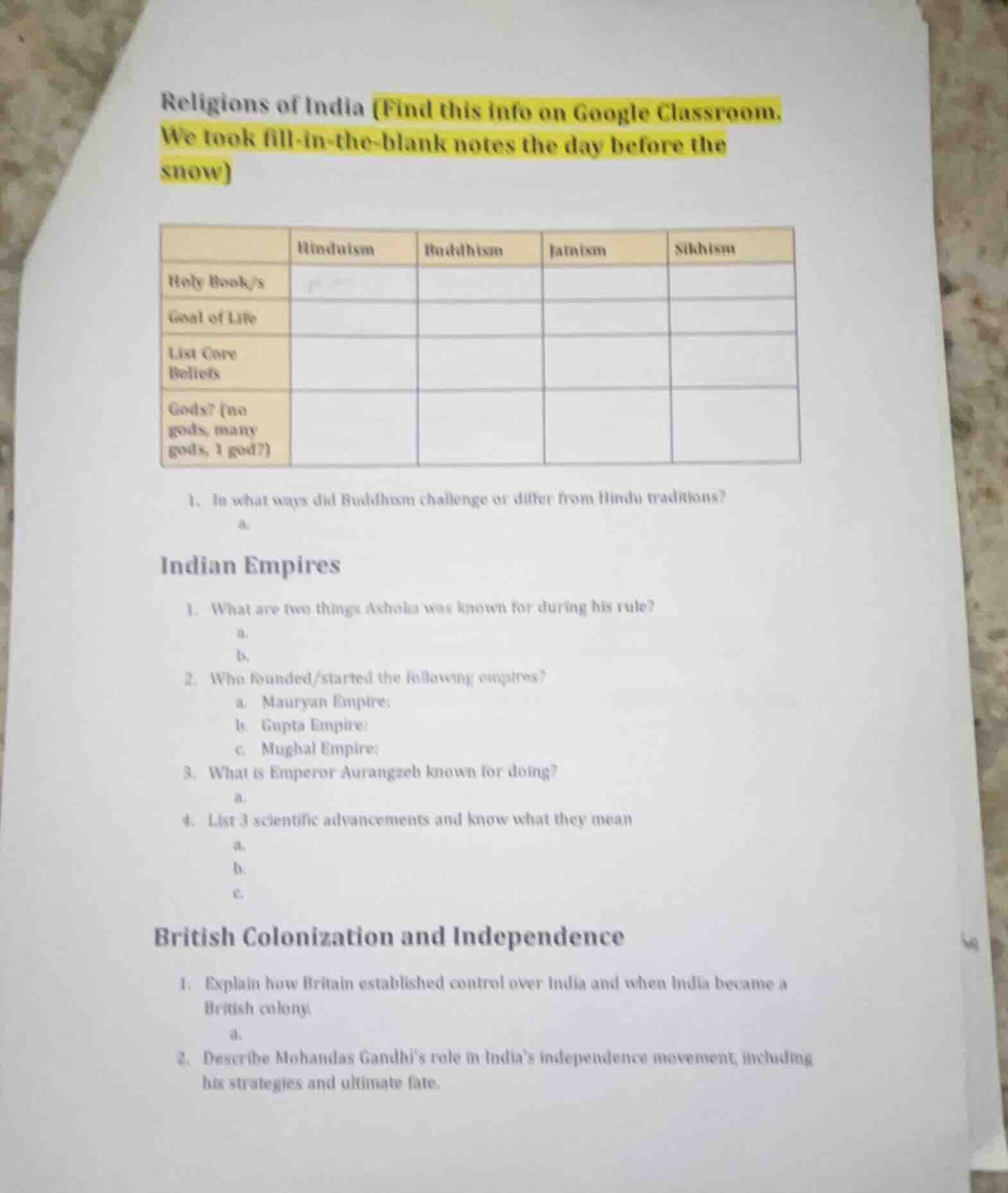
religions of india (find this info on google classroom. we took fill-in-the-blank notes the day before the snow)| | hinduism | buddhism | jainism | sikhism || ---- | ---- | ---- | ---- | ---- || holy book/s | | | | || goal of life | | | | || list core beliefs | | | | || gods? (no gods; many gods, 1 god?) | | | | |1. in what ways did buddhism challenge or differ from hindu traditions?a.indian empires1. what are two things ashoka was known for during his rule?a.b.2. who founded/started the following empires?a. mauryan empire:b. gupta empire:c. mughal empire:3. what is emperor aurangzeb known for doing?a.4. list 3 scientific advancements and know what they meana.b.c.british colonization and independence1. explain how britain established control over india and when india became a british colony.a.2. describe mohandas gandhis role in indias independence movement, including his strategies and ultimate fate.
Religions of India Table
- Holy Books:
- Hinduism: Vedas, Upanishads, Bhagavad Gita
- Buddhism: Tripitaka, Sutras
- Jainism: Agamas
- Sikhism: Guru Granth Sahib
- Goal of Life:
- Hinduism: Moksha (liberation from samsara)
- Buddhism: Nirvana (end of suffering and rebirth)
- Jainism: Moksha (liberation from karmic cycle)
- Sikhism: Union with Waheguru (God)
- Core Beliefs:
- Hinduism: Brahman, reincarnation, dharma, karma
- Buddhism: Four Noble Truths, Eightfold Path, reincarnation
- Jainism: Ahimsa, anekantavada, karma, reincarnation
- Sikhism: One God, equality, service to others, reincarnation
- Gods:
- Hinduism: Many gods (polytheistic, with Brahman as ultimate)
- Buddhism: No gods (non-theistic, focuses on self-liberation)
- Jainism: No supreme creator god (non-theistic)
- Sikhism: 1 god (monotheistic, Waheguru)
Buddhism vs Hinduism
Buddhism rejected Hinduism's caste system, did not require adherence to the Vedas, and offered a path to liberation accessible to all, not just Brahmin priests.
Indian Empires
- Ashoka:
a. Embracing Buddhism after the Kalinga War
b. Promoting non-violence (ahimsa) and building stone edicts across his empire
- Empire Founders:
a. Mauryan Empire: Chandragupta Maurya
b. Gupta Empire: Sri Gupta
c. Mughal Empire: Babur
- Aurangzeb: Expanding the Mughal Empire to its largest size, and enforcing strict Islamic law, which led to religious tensions.
- Scientific Advancements:
a. Decimal system (Gupta Empire): Created the base-10 number system, including the concept of zero, enabling advanced mathematics.
b. Ayurveda (ancient India): A holistic system of medicine focused on balancing the body, mind, and spirit.
c. Astronomy (Gupta Empire): Calculated the length of a solar year with high accuracy and identified planets in our solar system.
British Colonization and Independence
- Britain established control through the British East India Company, using military force and divide-and-rule tactics to take over regional kingdoms. India became a formal British colony in 1858, after the Sepoy Mutiny, when the British Crown took direct control from the East India Company.
- Gandhi was the leader of India's non-violent independence movement. He used strategies like civil disobedience (e.g., Salt March), non-cooperation with British authorities, and peaceful protests to unite Indians across religious and class lines. His ultimate fate was assassination in 1948 by a Hindu nationalist opposed to his efforts to reconcile Hindus and Muslims after India's partition.

Snap & solve any problem in the app
Get step-by-step solutions on Sovi AI
Photo-based solutions with guided steps
Explore more problems and detailed explanations
Religions of India Table
| Category | Hinduism | Buddhism | Jainism | Sikhism |
|---|---|---|---|---|
| Goal of Life | Moksha | Nirvana | Moksha | Union with Waheguru |
| Core Beliefs | Brahman, reincarnation, dharma, karma | Four Noble Truths, Eightfold Path, reincarnation | Ahimsa, anekantavada, karma, reincarnation | One God, equality, service, reincarnation |
| Gods? | Many gods | No gods | No supreme god | 1 god |
Buddhism vs Hinduism
Buddhism rejected the caste system and Vedic authority, offering liberation to all.
Indian Empires
- a. Embracing Buddhism post-Kalinga War
b. Building edicts promoting non-violence
- a. Chandragupta Maurya
b. Sri Gupta
c. Babur
- a. Expanding the Mughal Empire and enforcing strict Islamic law
- a. Decimal system: Base-10 counting with zero
b. Ayurveda: Holistic ancient Indian medicine
c. Gupta astronomy: Accurate solar year calculations
British Colonization and Independence
- a. Britain used the East India Company's military and divide-and-rule tactics to seize control; India became a British colony in 1858.
- a. Gandhi led non-violent civil disobedience (e.g., Salt March) to unite Indians for independence; he was assassinated in 1948.