QUESTION IMAGE
Question
represent and find the number of equal - sized parts
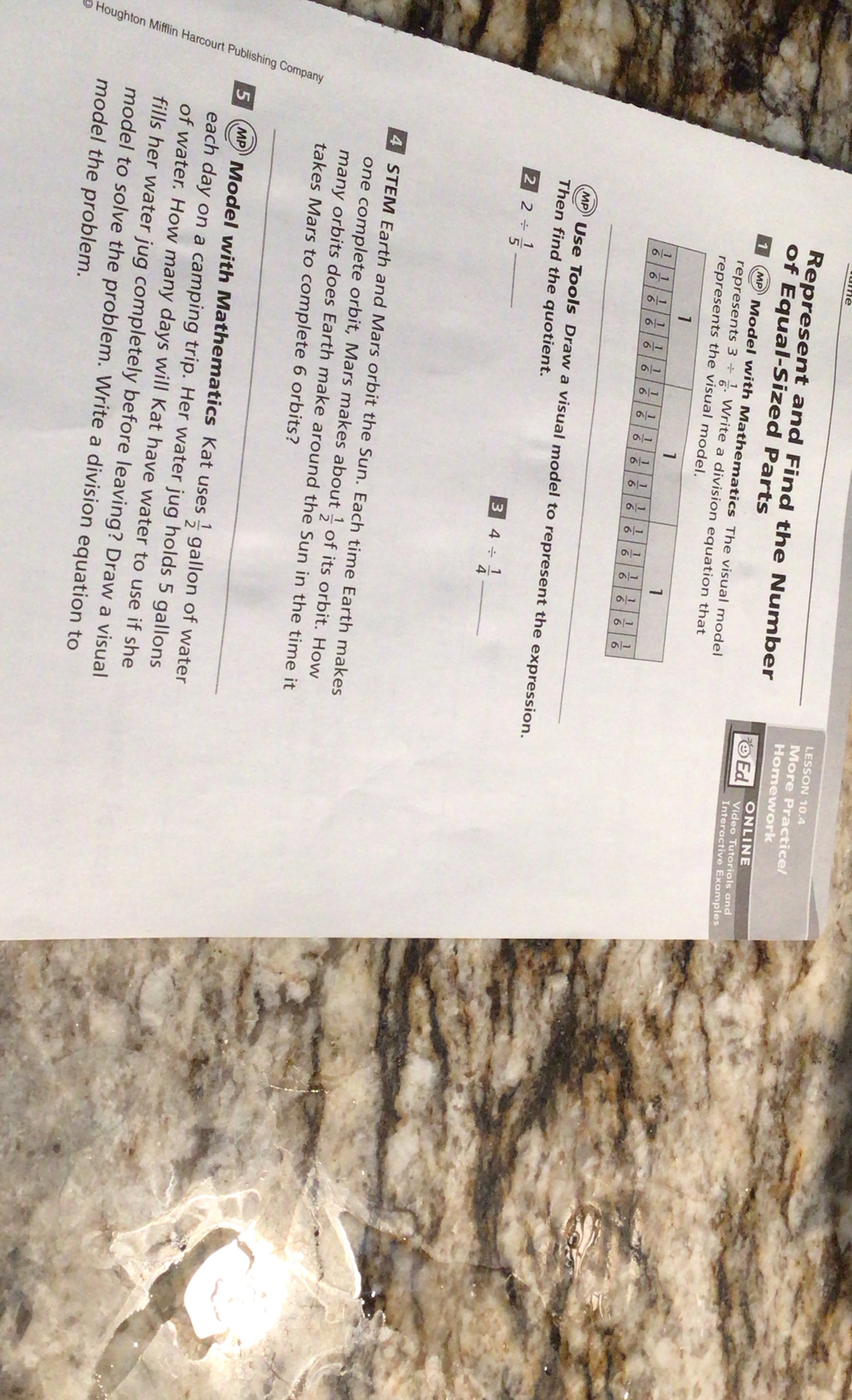
1 model with mathematics the visual model represents (3div\frac{1}{6}). write a division equation that represents the visual model.
2 use tools draw a visual model to represent the expression. then find the quotient. (2div\frac{1}{5})
3 (4div\frac{1}{4})
4 stem earth and mars orbit the sun. each time earth makes one complete orbit, mars makes about (\frac{1}{2}) of its orbit. how many orbits does earth make around the sun in the time it takes mars to complete 6 orbits?
5 model with mathematics kat uses (\frac{1}{2}) gallon of water each day on a camping trip. her water jug holds 5 gallons of water. how many days will kat have water to use if she fills her water jug completely before leaving? draw a visual model to solve the problem. write a division equation to model the problem.
© houghton mifflin harcourt publishing company
lesson 10.4
more practice/
homework
online
video tutorials and
interactive examples
Problem 2: \( 2 \div \frac{1}{5} \)
Step 1: Recall the rule for dividing by a fraction
Dividing by a fraction is the same as multiplying by its reciprocal. The reciprocal of \( \frac{1}{5} \) is \( 5 \). So, \( 2 \div \frac{1}{5}=2\times5 \).
Step 2: Perform the multiplication
\( 2\times5 = 10 \).
Step 1: Use the division - fraction rule
When dividing by a fraction \( \frac{a}{b} \), we multiply by \( \frac{b}{a} \). For \( 4\div\frac{1}{4} \), the reciprocal of \( \frac{1}{4} \) is \( 4 \), so \( 4\div\frac{1}{4}=4\times4 \).
Step 2: Calculate the product
\( 4\times4 = 16 \).
Step 1: Determine the number of Earth's orbits Mars makes
We know that Mars makes \( \frac{1}{2} \) of an Earth's orbit. Let the number of Earth's orbits Mars makes be \( x \). We want to find \( x \) when the total orbits (in terms of Mars' time) is 6. So we set up the equation \( x\times\frac{1}{2}=6 \) (or we can think of it as dividing 6 by \( \frac{1}{2} \) since we want to find how many \( \frac{1}{2} \) - orbits are in 6 orbits).
Step 2: Solve for \( x \)
Using the rule of dividing by a fraction, \( 6\div\frac{1}{2}=6\times2 \).
Step 3: Calculate the result
\( 6\times2 = 12 \). So Earth makes 12 orbits in the time Mars makes 6 orbits.

Snap & solve any problem in the app
Get step-by-step solutions on Sovi AI
Photo-based solutions with guided steps
Explore more problems and detailed explanations
\( 10 \)