QUESTION IMAGE
Question
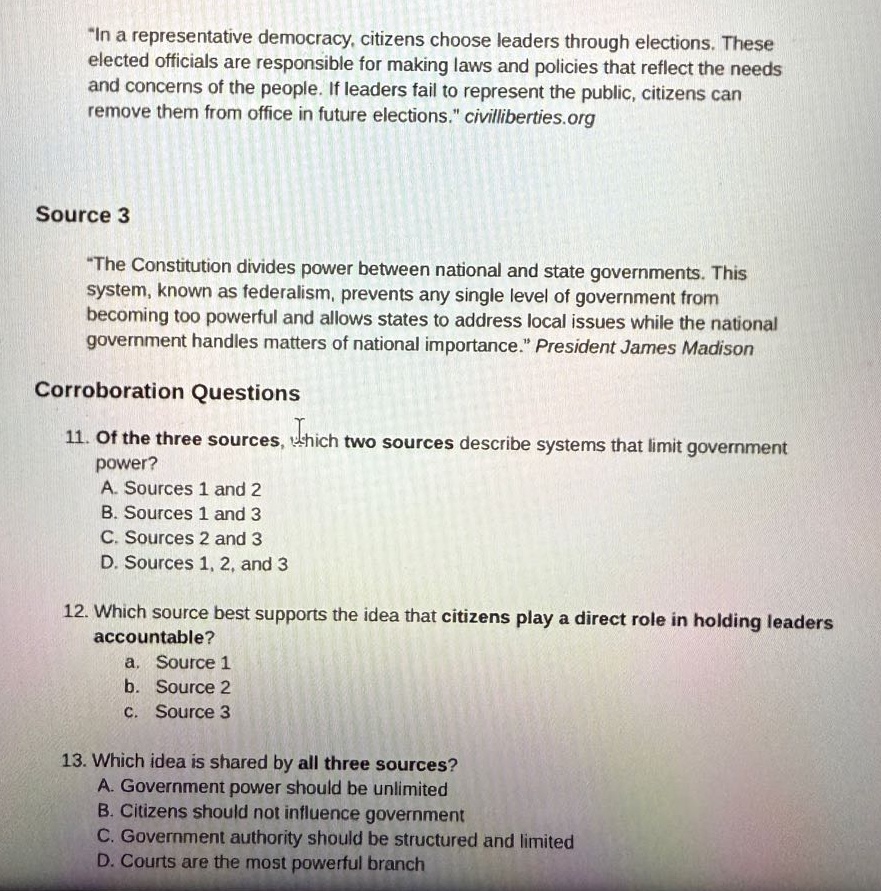
“in a representative democracy, citizens choose leaders through elections. these elected officials are responsible for making laws and policies that reflect the needs and concerns of the people. if leaders fail to represent the public, citizens can remove them from office in future elections.” civilliberties.org
source 3
“the constitution divides power between national and state governments. this system, known as federalism, prevents any single level of government from becoming too powerful and allows states to address local issues while the national government handles matters of national importance.” president james madison
corroboration questions
- of the three sources, which two sources describe systems that limit government power?
a. sources 1 and 2
b. sources 1 and 3
c. sources 2 and 3
d. sources 1, 2, and 3
- which source best supports the idea that citizens play a direct role in holding leaders accountable?
a. source 1
b. source 2
c. source 3
- which idea is shared by all three sources?
a. government power should be unlimited
b. citizens should not influence government
c. government authority should be structured and limited
d. courts are the most powerful branch
Question 11
- Source 1 (from civil liberties.org) describes representative democracy where citizens can remove leaders in elections, limiting government power by holding leaders accountable.
- Source 3 (from Madison) describes federalism, which divides power between national and state governments to limit any single level from being too powerful.
- We need to identify which two sources describe systems limiting government power. So Sources 1 and 3 (Option B) fit as Source 1 has electoral accountability and Source 3 has federalism for power division.
- Source 1 states that in representative democracy, citizens can remove leaders from office in future elections if they fail to represent the public. This shows citizens directly hold leaders accountable by voting them out.
- Source 2 (not fully shown but from context of the other sources, we focus on the given Source 1 description here) and Source 3 focus on federalism, not direct citizen accountability for leaders. So Source 1 best supports citizens' direct role in holding leaders accountable.
- Option A is wrong as the sources are about limiting government power, not unlimited power.
- Option B is wrong as Source 1 shows citizens influence government (via elections).
- Option C: Source 1 limits power via elections (leaders can be removed), Source 3 via federalism (power division), and the implied structure (like representative democracy and federalism) shows government authority is structured and limited.
- Option D: No source mentions courts being the most powerful branch. So Option C is correct.

Snap & solve any problem in the app
Get step-by-step solutions on Sovi AI
Photo-based solutions with guided steps
Explore more problems and detailed explanations
B. Sources 1 and 3