QUESTION IMAGE
Question
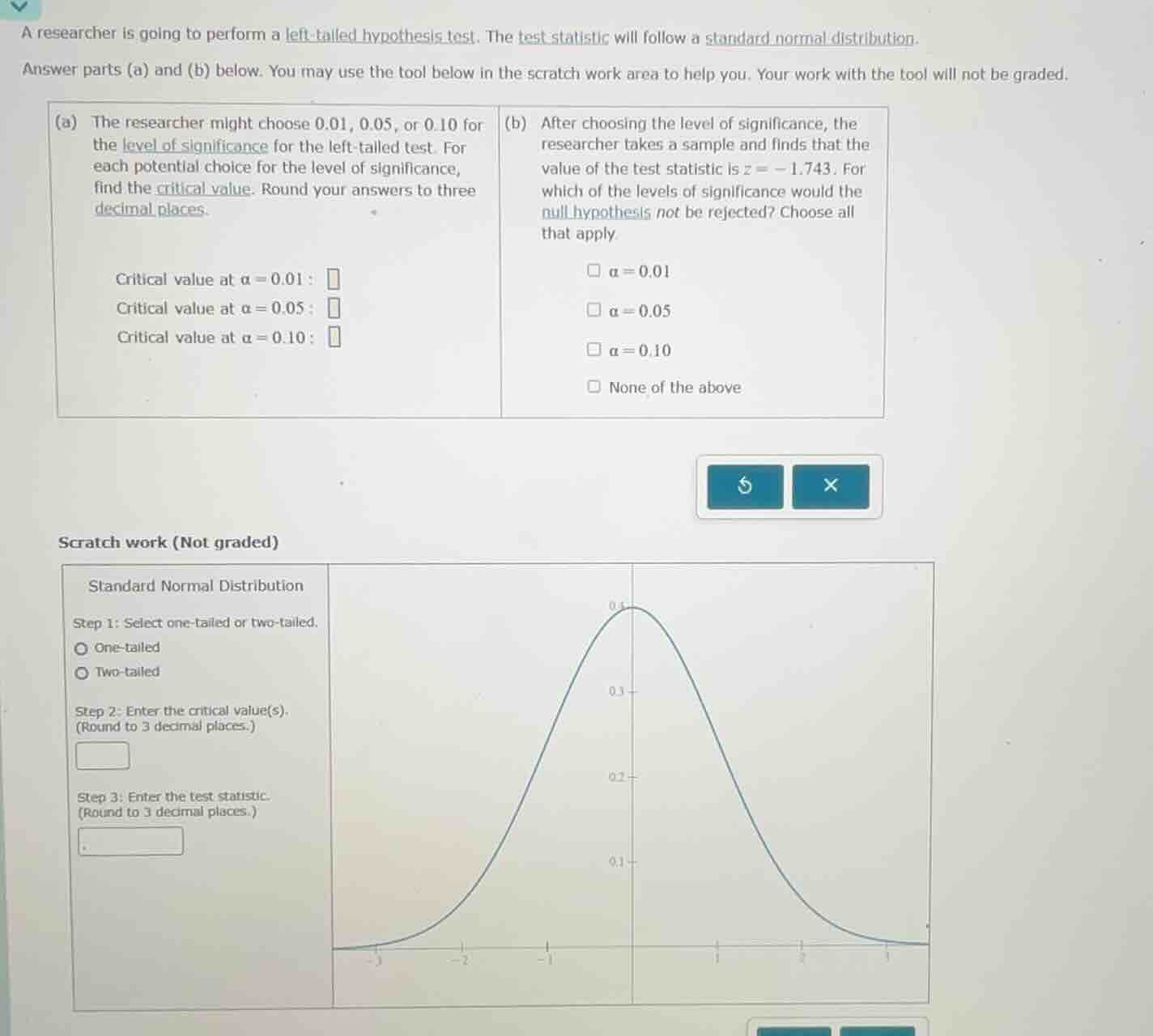
a researcher is going to perform a left - tailed hypothesis test. the test statistic will follow a standard normal distribution. answer parts (a) and (b) below. you may use the tool below in the scratch work area to help you. your work with the tool will not be graded. (a) the researcher might choose 0.01, 0.05, or 0.10 for the level of significance for the left - tailed test. for each potential choice for the level of significance, find the critical value. round your answers to three decimal places. critical value at α = 0.01: critical value at α = 0.05: critical value at α = 0.10: (b) after choosing the level of significance, the researcher takes a sample and finds that the value of the test statistic is z = - 1.743. for which of the levels of significance would the null hypothesis not be rejected? choose all that apply. □ α = 0.01 □ α = 0.05 □ α = 0.10 □ none of the above scratch work (not graded) standard normal distribution step 1: select one - tailed or two - tailed. ⚫ one - tailed ⚪ two - tailed step 2: enter the critical value(s). (round to 3 decimal places.) step 3: enter the test statistic. (round to 3 decimal places.)
Part (a)
For a left - tailed hypothesis test with a standard normal distribution, the critical value \(z_{\alpha}\) is the value such that \(P(Z < z_{\alpha})=\alpha\), where \(Z\) follows the standard normal distribution \(N(0,1)\). We can use the standard normal distribution table (or z - table) or a calculator with a normal - distribution inverse function (such as qnorm in R or the inverse normal function on a TI - 84 plus) to find the critical values.
Step 1: Critical value at \(\alpha = 0.01\)
We need to find \(z\) such that \(P(Z < z)=0.01\). Using the inverse of the standard normal distribution, \(z=\Phi^{- 1}(0.01)\), where \(\Phi\) is the cumulative distribution function of the standard normal distribution. From the standard normal table or a calculator, \(\Phi^{-1}(0.01)\approx - 2.326\) (because the area to the left of \(z=-2.326\) is approximately \(0.01\)).
Step 2: Critical value at \(\alpha = 0.05\)
We need to find \(z\) such that \(P(Z < z)=0.05\). Using the inverse of the standard normal distribution, \(z = \Phi^{-1}(0.05)\). From the standard normal table or a calculator, \(\Phi^{-1}(0.05)\approx - 1.645\) (because the area to the left of \(z = - 1.645\) is approximately \(0.05\)).
Step 3: Critical value at \(\alpha=0.10\)
We need to find \(z\) such that \(P(Z < z)=0.10\). Using the inverse of the standard normal distribution, \(z=\Phi^{-1}(0.10)\). From the standard normal table or a calculator, \(\Phi^{-1}(0.10)\approx - 1.282\) (because the area to the left of \(z=-1.282\) is approximately \(0.10\)).
Part (b)
In a left - tailed hypothesis test, we reject the null hypothesis if the test statistic \(z\) (in this case \(z=-1.743\)) is less than the critical value \(z_{\alpha}\) (i.e., \(z < z_{\alpha}\)). We do not reject the null hypothesis if \(z\geq z_{\alpha}\).
- For \(\alpha = 0.01\): The critical value \(z_{0.01}=-2.326\). Since \(-1.743>-2.326\) (i.e., the test statistic is greater than the critical value), we do not reject the null hypothesis.
- For \(\alpha = 0.05\): The critical value \(z_{0.05}=-1.645\). Since \(-1.743 < - 1.645\) (i.e., the test statistic is less than the critical value), we reject the null hypothesis.
- For \(\alpha=0.10\): The critical value \(z_{0.10}=-1.282\). Since \(-1.743 < - 1.282\) (i.e., the test statistic is less than the critical value), we reject the null hypothesis.
Part (a) Answers:
Critical value at \(\alpha = 0.01\): \(-2.326\)
Critical value at \(\alpha = 0.05\): \(-1.645\)
Critical value at \(\alpha = 0.10\): \(-1.282\)
Part (b) Answer:
The level of significance for which the null hypothesis is not rejected is \(\alpha = 0.01\) (i.e., the option \(\boldsymbol{\alpha = 0.01}\))

Snap & solve any problem in the app
Get step-by-step solutions on Sovi AI
Photo-based solutions with guided steps
Explore more problems and detailed explanations
In a left - tailed hypothesis test, we reject the null hypothesis if the test statistic \(z\) (in this case \(z=-1.743\)) is less than the critical value \(z_{\alpha}\) (i.e., \(z < z_{\alpha}\)). We do not reject the null hypothesis if \(z\geq z_{\alpha}\).
- For \(\alpha = 0.01\): The critical value \(z_{0.01}=-2.326\). Since \(-1.743>-2.326\) (i.e., the test statistic is greater than the critical value), we do not reject the null hypothesis.
- For \(\alpha = 0.05\): The critical value \(z_{0.05}=-1.645\). Since \(-1.743 < - 1.645\) (i.e., the test statistic is less than the critical value), we reject the null hypothesis.
- For \(\alpha=0.10\): The critical value \(z_{0.10}=-1.282\). Since \(-1.743 < - 1.282\) (i.e., the test statistic is less than the critical value), we reject the null hypothesis.
Part (a) Answers:
Critical value at \(\alpha = 0.01\): \(-2.326\)
Critical value at \(\alpha = 0.05\): \(-1.645\)
Critical value at \(\alpha = 0.10\): \(-1.282\)
Part (b) Answer:
The level of significance for which the null hypothesis is not rejected is \(\alpha = 0.01\) (i.e., the option \(\boldsymbol{\alpha = 0.01}\))