QUESTION IMAGE
Question
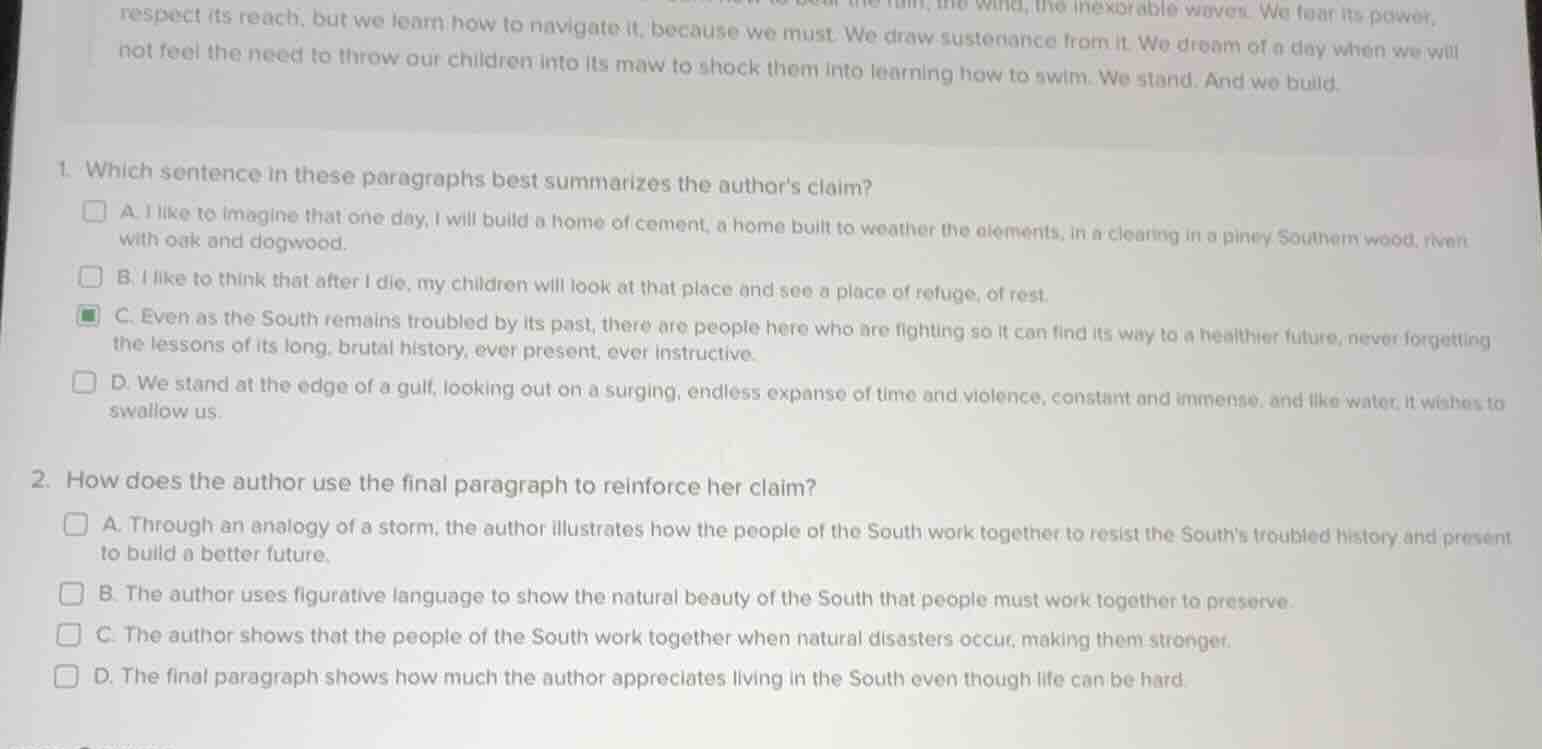
respect its reach, but we learn how to navigate it, because we must. we draw sustenance from it. we dream of a day when we will not feel the need to throw our children into its maw to shock them into learning how to swim. we stand. and we build.1. which sentence in these paragraphs best summarizes the authors claim?a. i like to imagine that one day, i will build a home of cement, a home built to weather the elements, in a clearing in a piney southern wood, river with oak and dogwood.b. i like to think that after i die, my children will look at that place and see a place of refuge, of rest.c. even as the south remains troubled by its past, there are people here who are fighting so it can find its way to a healthier future, never forgetting the lessons of its long, brutal history, ever present, ever instructive.d. we stand at the edge of a gulf, looking out on a surging, endless expanse of time and violence, constant and immense, and like water, it wishes to swallow us.2. how does the author use the final paragraph to reinforce her claim?a. through an analogy of a storm, the author illustrates how the people of the south work together to resist the souths troubled history and present to build a better future.b. the author uses figurative language to show the natural beauty of the south that people must work together to preserve.c. the author shows that the people of the south work together when natural disasters occur, making them stronger.d. the final paragraph shows how much the author appreciates living in the south even though life can be hard.
- For question 1: Option C directly states the core claim about the South's troubled past, people working toward a healthier future, and honoring historical lessons, which aligns with the reflective, forward-looking tone of the provided text about resilience and building. The other options focus on personal imagery (A, B) or only the threatening past (D), not the full claim of growth from struggle.
- For question 2: The final paragraph uses water/sea imagery (fear its power, navigate it, draw sustenance, stand and build) as an analogy for the South's difficult history and present. This figurative language frames people choosing to persist, learn, and build rather than be overwhelmed, which reinforces the claim of working toward a better future despite struggle, matching option A. Other options misinterpret the imagery's purpose (B focuses on beauty preservation, C on natural disasters, D on personal appreciation).

Snap & solve any problem in the app
Get step-by-step solutions on Sovi AI
Photo-based solutions with guided steps
Explore more problems and detailed explanations
- C. Even as the South remains troubled by its past, there are people here who are fighting so it can find its way to a healthier future, never forgetting the lessons of its long, brutal history, ever present, ever instructive.
- A. Through an analogy of a storm, the author illustrates how the people of the South work together to resist the South's troubled history and present to build a better future.