QUESTION IMAGE
Question
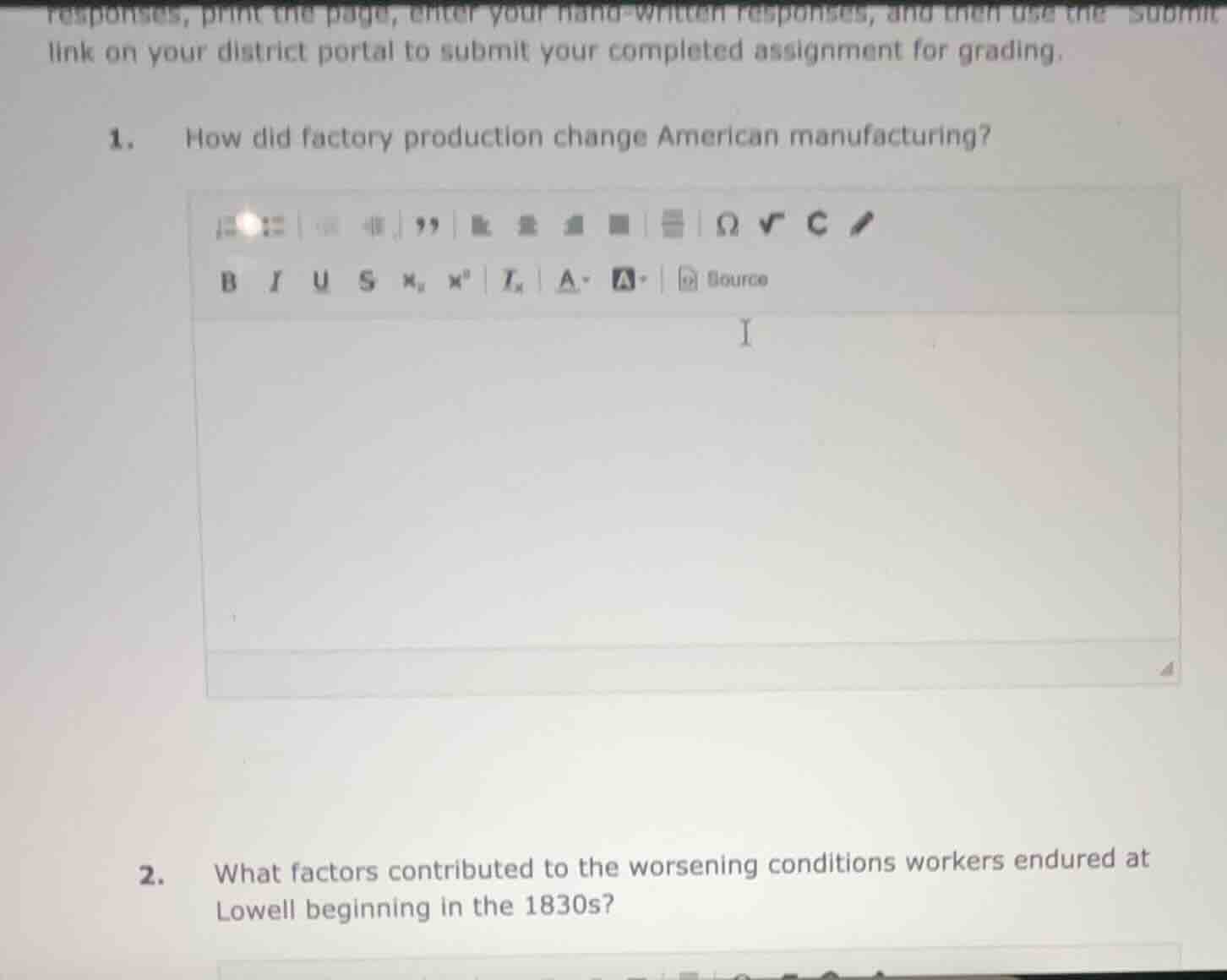
responses, print the page, enter your hand - written responses, and then use the submit link on your district portal to submit your completed assignment for grading.
- how did factory production change american manufacturing?
- what factors contributed to the worsening conditions workers endured at lowell beginning in the 1830s?
Brief Explanations
- For the first question: Factory production shifted American manufacturing from small, craft-based workshops to large-scale, centralized operations. It introduced division of labor, which increased output efficiency, standardized products, and allowed for mass production. This also led to the growth of urban industrial centers and a shift from skilled artisan work to unskilled or semi-skilled factory labor.
- For the second question: Several factors worsened Lowell workers' conditions in the 1830s. Increased competition among factory owners led to wage cuts and longer workdays. A surge in immigrant labor created a larger workforce, giving owners more leverage to reduce pay and benefits. Additionally, the demand for higher production volumes led to faster machine speeds and more strenuous work, while overcrowding in boarding houses (provided by mill owners) led to poor living conditions.

Snap & solve any problem in the app
Get step-by-step solutions on Sovi AI
Photo-based solutions with guided steps
Explore more problems and detailed explanations
- Factory production transformed American manufacturing by replacing small craft workshops with large, centralized facilities, introducing division of labor to boost efficiency and enable mass production, standardizing goods, and shifting the workforce from skilled artisans to mostly unskilled/semi-skilled factory labor, while spurring the growth of industrial urban centers.
- The factors worsening Lowell workers' conditions in the 1830s included: increased factory competition leading to wage cuts and longer workdays; a growing immigrant labor pool that gave owners leverage to reduce worker compensation and protections; higher production demands that increased machine speeds and work intensity; and overcrowded, poor-quality mill-owned boarding houses for workers.