QUESTION IMAGE
Question
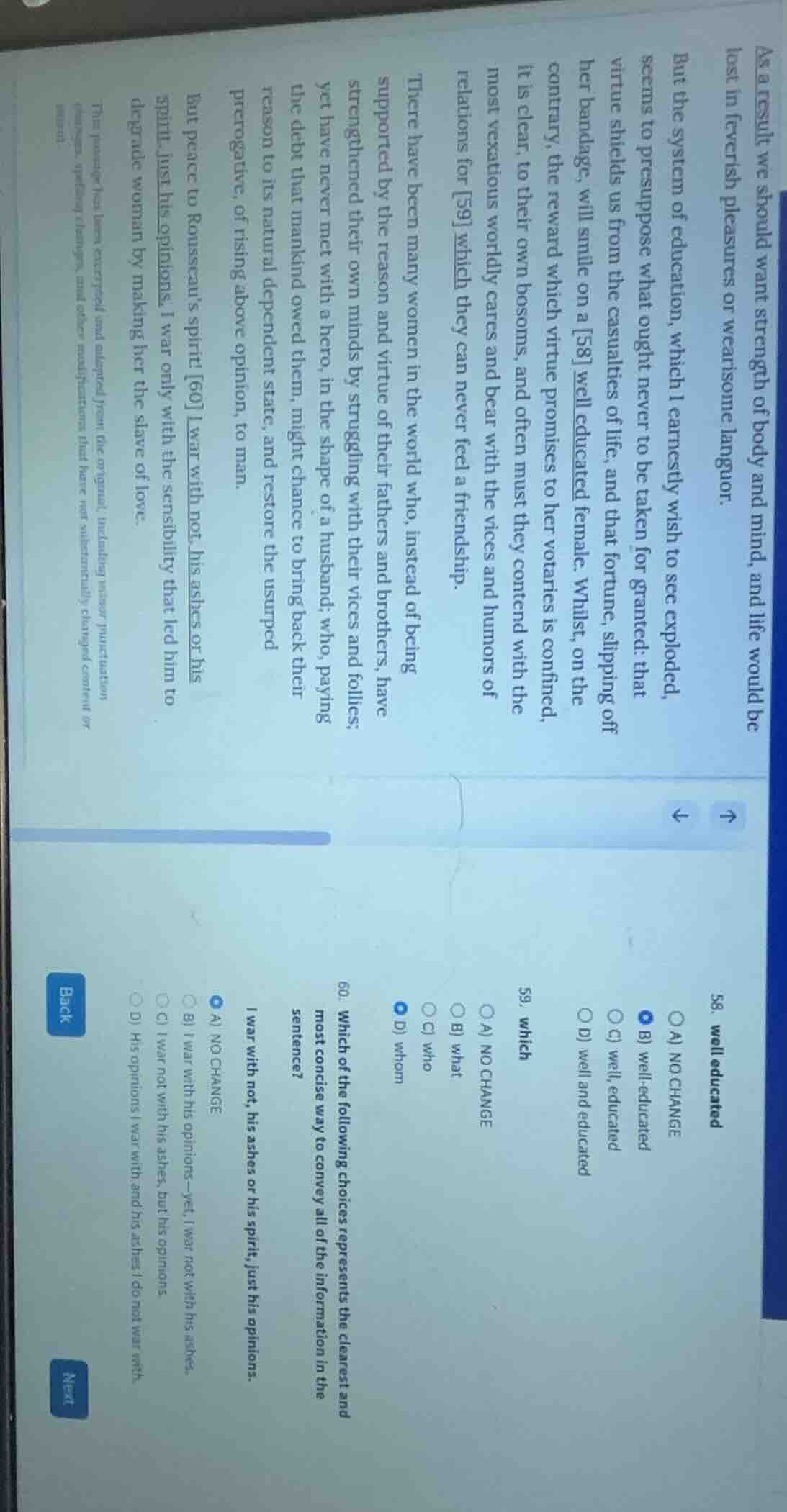
as a result we should want strength of body and mind, and life would be lost in feverish pleasures or wearisome languor. but the system of education, which i earnestly wish to see exploded, seems to presuppose what ought never to be taken for granted: that virtue shields us from the casualties of life, and that fortune, slipping off her bandage, will smile on a 58 well educated female. whilst, on the contrary, the reward which virtue promises to her votaries is confined, it is clear, to their own bosoms, and often must they contend with the most vexatious worldly cares and bear with the vices and humors of relations for 59 which they can never feel a friendship. there have been many women in the world who, instead of being supported by the reason and virtue of their fathers and brothers, have strengthened their own minds by struggling with their vices and follies; yet have never met with a hero, in the shape of a husband, who, paying the debt that mankind owed them, might chance to bring back their reason to its natural dependent state, and restore the usurped prerogative, of rising above opinion, to man. but peace to rousseau’s spirit! 60 i war with not his ashes or his spirit, just his opinions. i war only with the sensibility that led him to degrade woman by making her the slave of love. this passage has been excerpted and adapted from the original, including minor punctuation changes, spelling changes, and other modifications that have not substantially changed content or meaning. 58. well educated a) no change b) well - educated c) well, educated d) well and educated 59. which a) no change b) what c) who d) whom 60. which of the following choices represents the clearest and most concise way to convey all of the information in the sentence? i war with not, his ashes or his spirit, just his opinions. a) no change b) i war with his opinions—yet, i war not with his ashes. c) i war not with his ashes, but his opinions d) his opinions i war with and his ashes i do not war with
- When "well" modifies the past participle "educated" to form a compound adjective describing a noun ("female"), it requires a hyphen for clarity and grammatical correctness.
- The relative pronoun refers to "relations" (people), so we use "who" (subject pronoun) to introduce the clause about their lack of friendship. "Which" is for non-human nouns, "what" is not a relative pronoun here, and "whom" is an object pronoun, which does not fit the subject role in this clause.
- Option B clearly and concisely conveys the full meaning: the speaker opposes Rousseau's opinions but not his legacy ("ashes"), combining the ideas without redundancy. The original is wordy, option C splits the idea awkwardly, and option D is overly wordy.

Snap & solve any problem in the app
Get step-by-step solutions on Sovi AI
Photo-based solutions with guided steps
Explore more problems and detailed explanations
- B) well-educated
- C) who
- B) I war with his opinions—yet, I war not with his ashes.