QUESTION IMAGE
Question
- reteach this to a 5th grader....what was reconstruction? what and who made it successful?
optional word bank:
amendments, freedmens bureau, reconstruction acts, radical republicans
all persons born or naturalized in the united states, and subject to the jurisdiction thereof, are citizens of the united states and of the state wherein they reside. no state shall make or enforce any law which shall abridge the privileges or immunities of citizens of the united states; nor shall any state deprive any person of life, liberty, or property, without due process of law; nor deny to any person within its jurisdiction the equal protection of the laws.
14th amendment, section 1, united states constitution
- this amendment was adopted in 1868 primarily to
(1) protect the rights of formerly enslaved persons
(2) make it easier for immigrants to become citizens
(3) extend suffrage to settlers on the great plains
(4) require the federal government to pay the costs of reconstruction
- which of the following groups most directly advocated for this amendment?
(1) democrats 2. radical republicans 3. suffragists 4. progressives
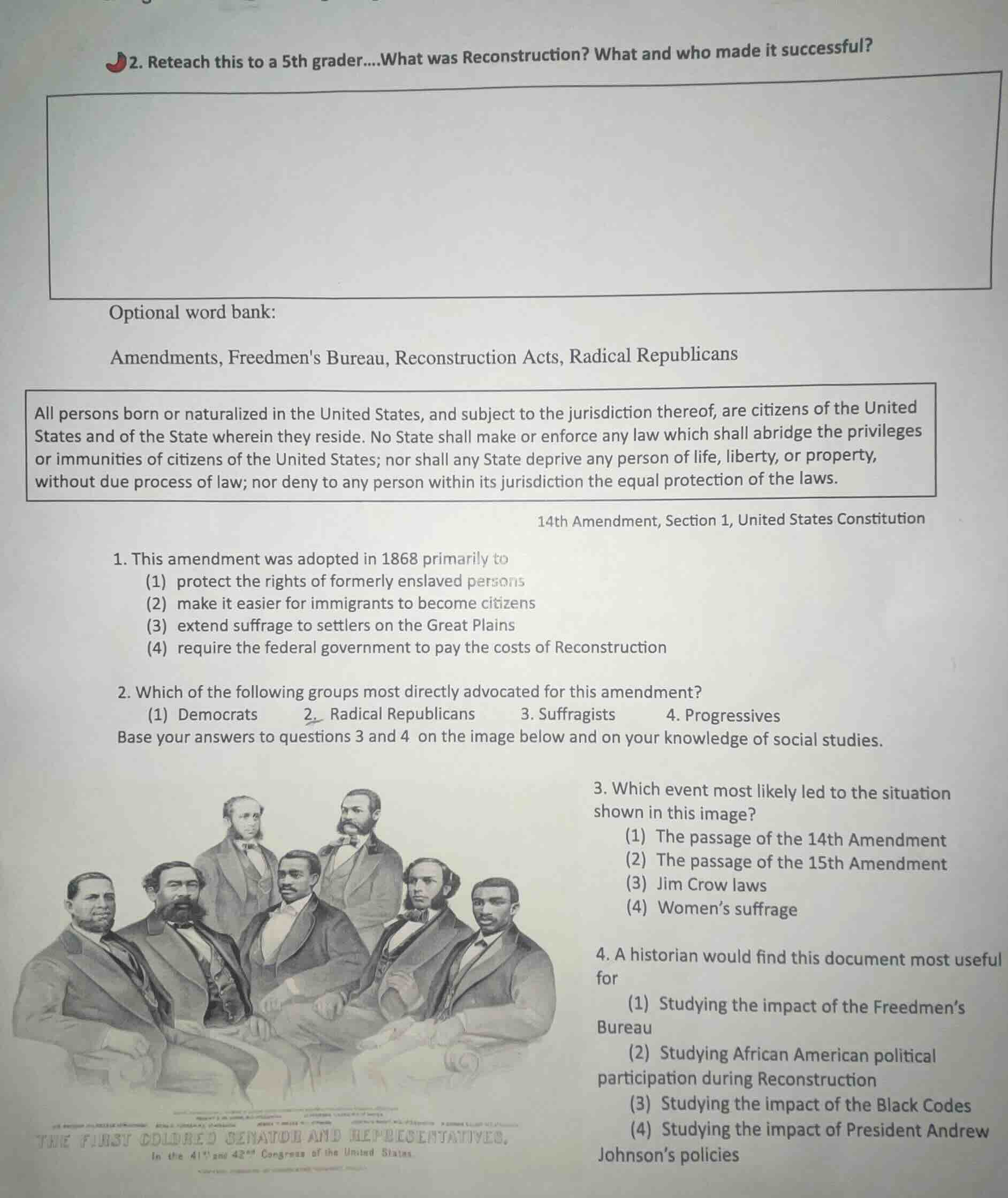
base your answers to questions 3 and 4 on the image below and on your knowledge of social studies.
- which event most likely led to the situation shown in this image?
(1) the passage of the 14th amendment
(2) the passage of the 15th amendment
(3) jim crow laws
(4) women’s suffrage
- a historian would find this document most useful for
(1) studying the impact of the freedmen’s bureau
(2) studying african american political participation during reconstruction
(3) studying the impact of the black codes
(4) studying the impact of president andrew johnson’s policies
Question 1
La 14e modification a été adoptée en 1868, après la Guerre Civile américaine, principalement pour protéger les droits des personnes anciennement esclavagées. Après l'abolition de l'esclavage par la 13e modification, il fallait garantir les droits civils des ex - esclaves. L'option (2) est incorrecte car la 14e modification n'avait pas pour but de faciliter la naturalisation des immigrants. L'option (3) est incorrecte car elle n'est pas liée au droit de vote des colons des Grandes Plaines. L'option (4) est incorrecte car la modification ne concerne pas le financement de la Reconstruction par le gouvernement fédéral.
Les Radicaux Républicains étaient un groupe politique qui réclamait des mesures pour protéger les droits des ex - esclaves et garantir l'égalité. Ils ont été les principaux défenseurs de la 14e modification. Les Démocrates à cette époque étaient souvent opposés à ces mesures. Les Suffragistes se concentraient sur le droit de vote des femmes et les Progressistes étaient un mouvement ultérieur.
La 15e modification a permis aux hommes noirs d'obtenir le droit de vote. L'image montre les premiers sénateurs et représentants noirs au Congrès, ce qui est lié à la participation politique des Afro - Américains après l'obtention du droit de vote grâce à la 15e modification. La 14e modification concernait la citoyenneté et les droits civils, pas directement le droit de vote. Les lois Jim Crow ont été des lois de ségrégation qui ont été mises en place plus tard. Le suffrage des femmes est un mouvement distinct.

Snap & solve any problem in the app
Get step-by-step solutions on Sovi AI
Photo-based solutions with guided steps
Explore more problems and detailed explanations
(1) protect the rights of formerly enslaved persons