QUESTION IMAGE
Question
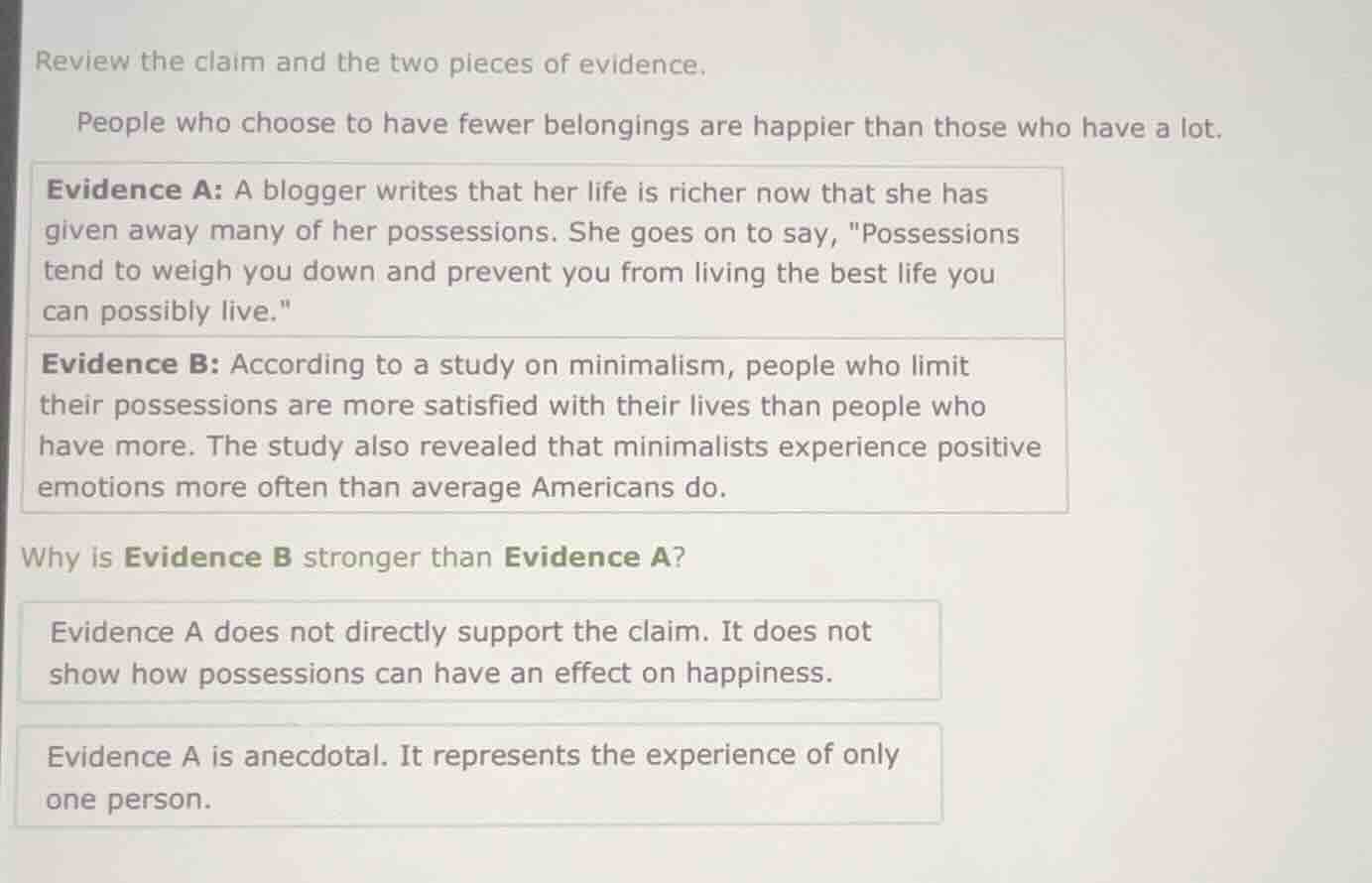
review the claim and the two pieces of evidence.
people who choose to have fewer belongings are happier than those who have a lot.
evidence a: a blogger writes that her life is richer now that she has given away many of her possessions. she goes on to say, \possessions tend to weigh you down and prevent you from living the best life you can possibly live.\
evidence b: according to a study on minimalism, people who limit their possessions are more satisfied with their lives than people who have more. the study also revealed that minimalists experience positive emotions more often than average americans do.
why is evidence b stronger than evidence a?
evidence a does not directly support the claim. it does not show how possessions can have an effect on happiness.
evidence a is anecdotal. it represents the experience of only one person.
To determine why Evidence B is stronger, we analyze the nature of each evidence. Evidence A is a single blogger's personal account (anecdotal), representing only one person's experience. Evidence B is from a study on minimalism, which likely involves a larger, more representative sample and systematic research, making it more reliable and generalizable. The first option's reasoning about Evidence A not directly supporting is incorrect because Evidence A does relate possessions to a "richer life" (implying happiness). The second option correctly identifies that Evidence A is anecdotal (one - person experience) while Evidence B is from a study (more rigorous, broader data).

Snap & solve any problem in the app
Get step-by-step solutions on Sovi AI
Photo-based solutions with guided steps
Explore more problems and detailed explanations
Evidence A is anecdotal. It represents the experience of only one person.