QUESTION IMAGE
Question
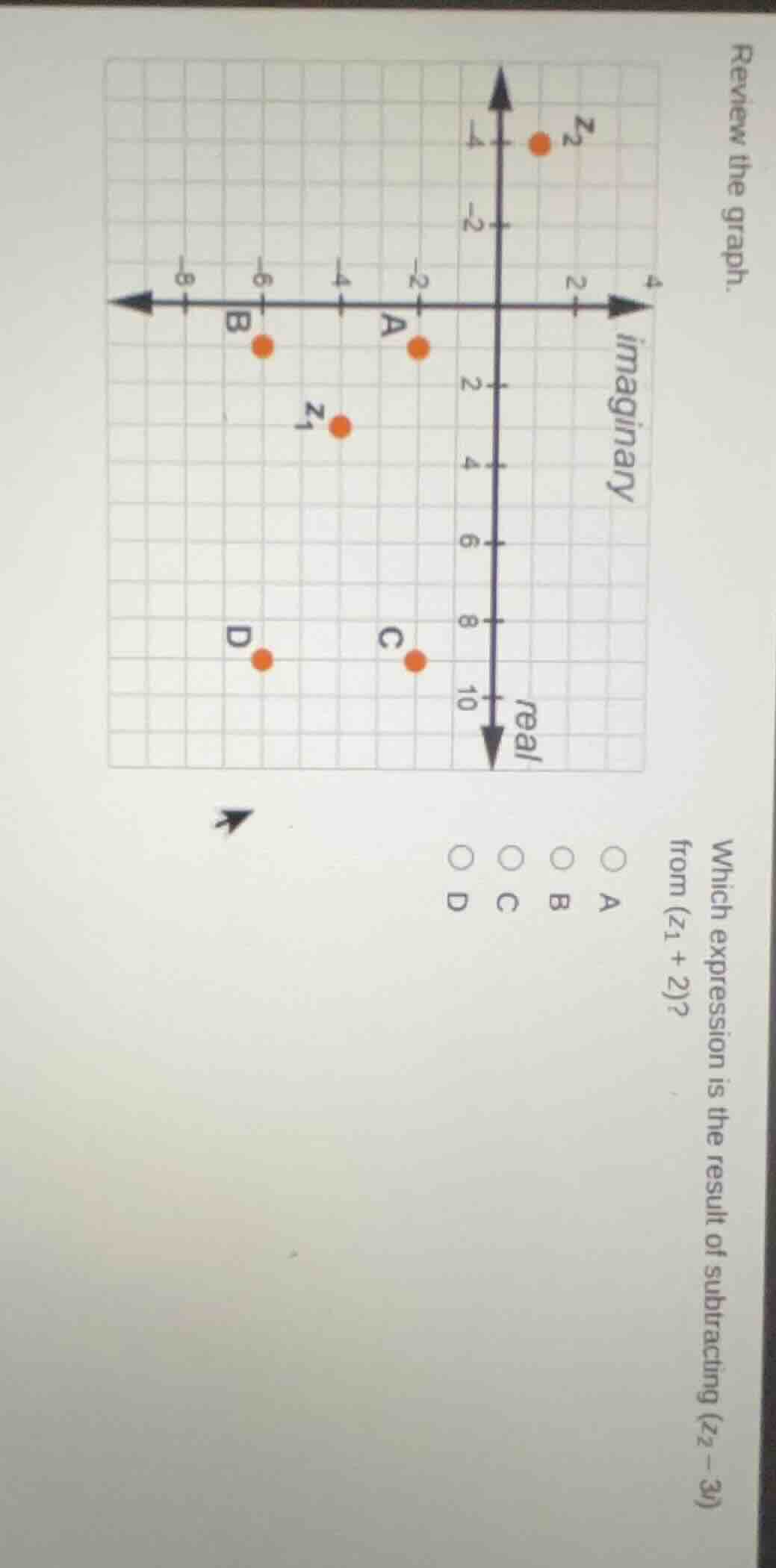
review the graph.
which expression is the result of subtracting (z₂ − 3i) from (z₁ + 2)?
a
b
c
d
Step1: Identify coordinates of \( z_1 \) and \( z_2 \)
From the graph, assume \( z_2 \) is at \( (1, -1) \) (real part 1, imaginary part -1, so \( z_2 = 1 - i \)), and \( z_1 \) is at \( (-4, 3) \) (real part -4, imaginary part 3, so \( z_1 = -4 + 3i \)). Wait, maybe better to read grid: Let's re - check. Wait, the real axis (vertical? Wait, no, in complex plane, real is horizontal, imaginary vertical? Wait, the graph has "real" arrow down at vertical axis? Wait, maybe labels: horizontal axis is imaginary? No, standard complex plane: horizontal is real, vertical is imaginary. But the graph has "imaginary" on horizontal and "real" on vertical? That's non - standard, but let's go by labels. So "imaginary" is horizontal (x - axis), "real" is vertical (y - axis). So a complex number \( a+bi \) has \( a \) (imaginary part) on x - axis, \( b \) (real part) on y - axis? Wait, no, standard is \( x \) (real), \( y \) (imaginary). But the graph labels: "imaginary" on horizontal (x), "real" on vertical (y). So \( z = \text{imaginary part}+i\times\text{real part} \). Let's find \( z_2 \): on "imaginary" (x) axis, it's at \( x = 1 \), "real" (y) axis at \( y=-1 \), so \( z_2=1 - i \). \( z_1 \): "imaginary" (x) at \( x=-4 \), "real" (y) at \( y = 3 \), so \( z_1=-4 + 3i \).
Step2: Compute \( (z_2 - 3i)-(z_1 + 2) \)
First, simplify the expression: \( (z_2-3i)-(z_1 + 2)=z_2-3i - z_1-2=(z_2 - z_1)-3i - 2 \)
Substitute \( z_2 = 1 - i \) and \( z_1=-4 + 3i \):
\( z_2 - z_1=(1 - i)-(-4 + 3i)=1 - i + 4-3i=5 - 4i \)
Then \( (5 - 4i)-3i - 2=(5 - 2)+(-4i-3i)=3 - 7i \)
Wait, maybe my coordinate reading is wrong. Let's try again. Let's assume standard complex plane (horizontal real, vertical imaginary). Then "imaginary" label is wrong, maybe a typo. Let's take horizontal as real (x), vertical as imaginary (y). Then \( z_2 \): x = 1, y=-1 (so \( z_2 = 1 - i \)), \( z_1 \): x=-4, y = 3 (so \( z_1=-4 + 3i \)). Now the expression: \( (z_2-3i)-(z_1 + 2)=(1 - i-3i)-(-4 + 3i+2)=(1 - 4i)-(-2 + 3i)=1 - 4i + 2-3i=3 - 7i \)
Now let's find the coordinates of the points:
- Point A: Let's see, on real (y) axis? No, let's look at the options. Wait, maybe the expression is \( (z_2 - 3i)-(z_1 + 2i) \)? Wait, the original question: "Which expression is the result of subtracting \( (z_2 - 3i) \) from \( (z_1 + 2) \)"? Wait, the user's question was cut, but from the options A, B, C, D. Let's re - express the correct operation: \( (z_1 + 2)-(z_2 - 3i)=z_1 + 2 - z_2+3i=(z_1 - z_2)+(2 + 3i) \)
If \( z_1=-4 + 3i \), \( z_2 = 1 - i \), then \( z_1 - z_2=(-4 + 3i)-(1 - i)=-4-1+3i + i=-5 + 4i \)
Then \( -5 + 4i+2 + 3i=-3 + 7i \)
Now let's find the coordinates of the points:
- Point A: Let's say on "imaginary" (x) = - 2, "real" (y)=1? No, let's count grid. Let's assume each grid is 1 unit.
If \( z_1=-4 + 3i \) (x=-4, y = 3), \( z_2=1 - i \) (x = 1, y=-1)
Compute \( (z_1 + 2)-(z_2 - 3i)=(-4 + 3i+2)-(1 - i-3i)=(-2 + 3i)-(1 - 4i)=-2-1+3i + 4i=-3 + 7i \)
Now, in the complex plane (with x as imaginary, y as real, as per graph labels), the number \( -3 + 7i \) has imaginary part (x) = - 3, real part (y)=7? No, that doesn't match. Wait, maybe the graph has real axis horizontal (x) and imaginary vertical (y), with labels swapped. So real is x, imaginary is y. Then \( -3 + 7i \) has x=-3, y = 7. Looking at the points:
- Point C: Let's see, x=-2, y = 9? No. Wait, maybe my initial coordinate reading is wrong. Let's try to find \( z_2 \) and \( z_1 \) correctly.
Looking at the graph: \( z_2 \) is at (1, - 1) (x = 1, y=-1) if real is y, imaginary is x. \( z_1 \) is at (-4, 3) (x=-4, y = 3).…

Snap & solve any problem in the app
Get step-by-step solutions on Sovi AI
Photo-based solutions with guided steps
Explore more problems and detailed explanations
C