QUESTION IMAGE
Question
review questions
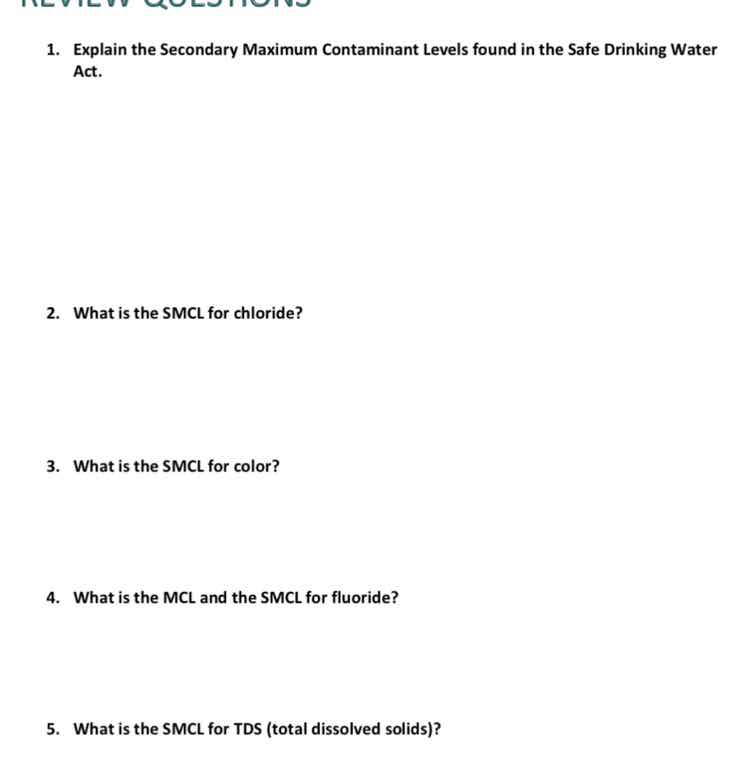
- explain the secondary maximum contaminant levels found in the safe drinking water act.
- what is the smcl for chloride?
- what is the smcl for color?
- what is the mcl and the smcl for fluoride?
- what is the smcl for tds (total dissolved solids)?
Brief Explanations
- Secondary Maximum Contaminant Levels (SMCLs) under the Safe Drinking Water Act are non-enforceable guidelines set by the EPA. They target contaminants that affect drinking water's aesthetic qualities (taste, odor, color) or cosmetic effects, not direct health risks. Water systems are encouraged to meet them to improve water acceptability for consumers.
- The EPA's SMCL for chloride is based on taste concerns in drinking water.
- The SMCL for color is defined in platinum-cobalt units, measuring water's visual discoloration.
- Maximum Contaminant Levels (MCLs) are enforceable health standards, while SMCLs are aesthetic/cosmetic guidelines. For fluoride, the MCL is a health-based limit to prevent overexposure, and the SMCL addresses cosmetic effects like dental fluorosis.
- The SMCL for total dissolved solids (TDS) targets taste and aesthetic issues from dissolved minerals in water.

Snap & solve any problem in the app
Get step-by-step solutions on Sovi AI
Photo-based solutions with guided steps
Explore more problems and detailed explanations
- Secondary Maximum Contaminant Levels (SMCLs) under the Safe Drinking Water Act are non-enforceable, EPA-recommended guidelines for contaminants that impact drinking water's aesthetic properties (taste, odor, color) or cause cosmetic effects (e.g., skin discoloration), rather than direct acute or chronic health risks. Public water systems are encouraged to meet SMCLs to enhance consumer acceptance of drinking water, but there are no legal penalties for non-compliance.
- 250 mg/L
- 15 color units (platinum-cobalt scale)
- MCL for fluoride: 4.0 mg/L (enforceable health limit to prevent severe skeletal fluorosis); SMCL for fluoride: 2.0 mg/L (guideline to reduce the risk of cosmetic dental fluorosis in children)
- 500 mg/L