QUESTION IMAGE
Question
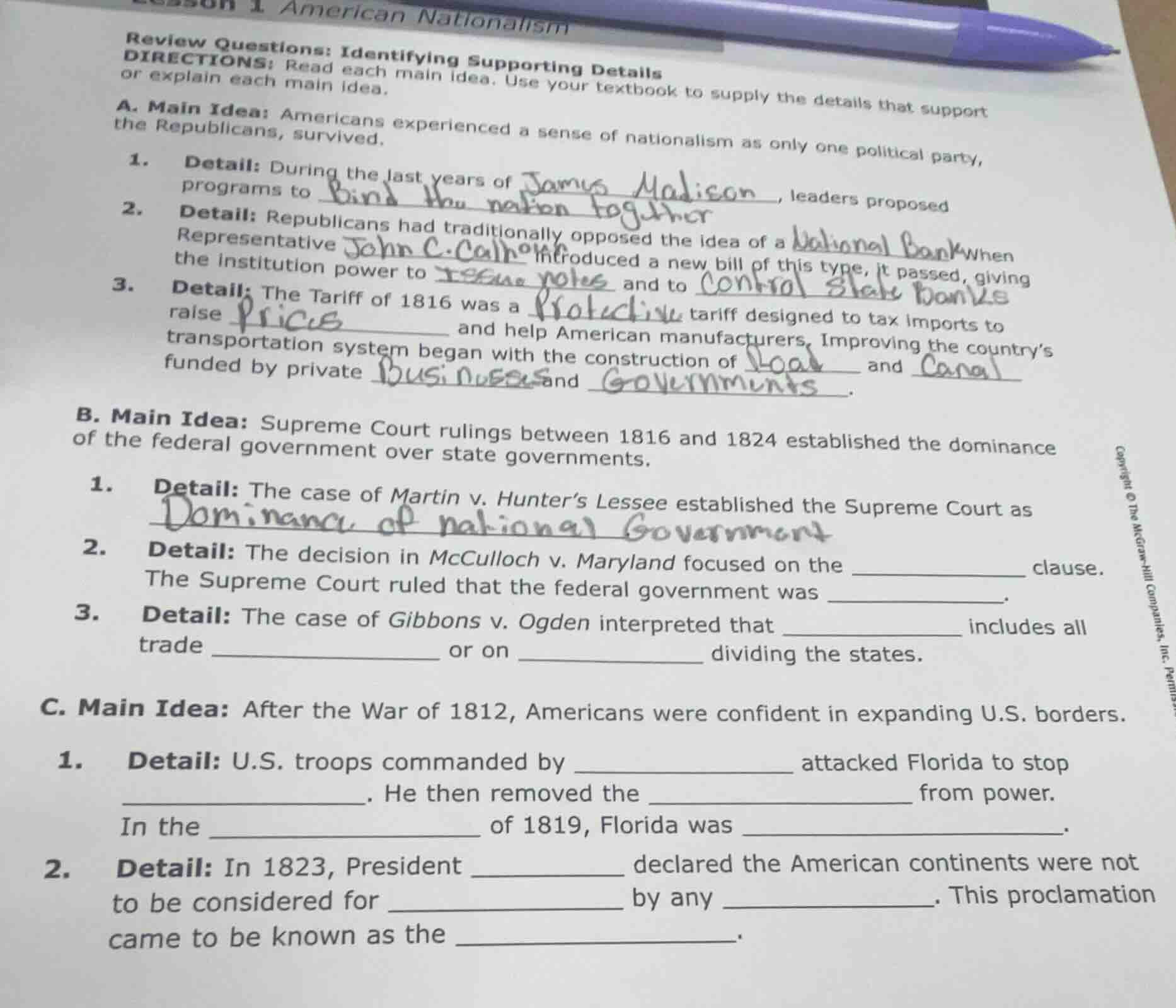
review questions: identifying supporting details
directions: read each main idea. use your textbook to supply the details that support or explain each main idea.
a. main idea: americans experienced a sense of nationalism as only one political party, the republicans, survived.
- detail: during the last years of ____, leaders proposed programs to ____
- detail: republicans had traditionally opposed the idea of a ____when representative __ introduced a new bill of this type, it passed, giving the institution power to __ and to ____
- detail: the tariff of 1816 was a ____ tariff designed to tax imports to raise __ and help american manufacturers. improving the country’s transportation system began with the construction of __ and __ funded by private __ and ____.
b. main idea: supreme court rulings between 1816 and 1824 established the dominance of the federal government over state governments.
- detail: the case of martin v. hunter’s lessee established the supreme court as ______
- detail: the decision in mcculloch v. maryland focused on the ____ clause. the supreme court ruled that the federal government was ____.
- detail: the case of gibbons v. ogden interpreted that ____ includes all trade __ or on ____ dividing the states.
c. main idea: after the war of 1812, americans were confident in expanding u.s. borders.
- detail: u.s. troops commanded by ____ attacked florida to stop __. he then removed the __ from power. in the __ of 1819, florida was ____.
- detail: in 1823, president ____ declared the american continents were not to be considered for __ by any __. this proclamation came to be known as the ____.
To solve these fill - in - the - blank questions about American nationalism, we need to recall relevant historical facts:
Part A
- Detail 1
- During the last years of James Madison's presidency, leaders proposed programs to bind the nation together.
- Detail 2
- Republicans had traditionally opposed the idea of a national bank. When Representative John C. Calhoun introduced a new bill of this type, it passed, giving the institution power to issue notes and to control state banks.
- Detail 3
- The Tariff of 1816 was a protective tariff designed to tax imports to raise prices and help American manufacturers. Improving the country's transportation system began with the construction of roads and canals funded by private businesses and governments.
Part B
- Detail 1
- The case of Martin v. Hunter’s Lessee established the Supreme Court as the final authority on constitutional questions.
- Detail 2
- The decision in McCulloch v. Maryland focused on the necessary and proper clause. The Supreme Court ruled that the federal government was supreme over the states in certain matters.
- Detail 3
- The case of Gibbons v. Ogden interpreted that interstate commerce includes all trade within a state or on waterways dividing the states.
Part C
- Detail 1
- U.S. troops commanded by Andrew Jackson attacked Florida to stop Seminole raids. He then removed the Spanish governor from power. In the treaty of 1819, Florida was ceded to the United States.
- Detail 2
- In 1823, President Monroe declared the American continents were not to be considered for colonization by any European power. This proclamation came to be known as the Monroe Doctrine.

Snap & solve any problem in the app
Get step-by-step solutions on Sovi AI
Photo-based solutions with guided steps
Explore more problems and detailed explanations
s:
Part A
- James Madison; bind the nation together
- national bank; issue notes; control state banks
- protective; prices; roads; canals; businesses; governments
Part B
- the final authority on constitutional questions
- necessary and proper; supreme over the states in certain matters
- interstate commerce; within a state; waterways
Part C
- Andrew Jackson; Seminole raids; Spanish governor; treaty; ceded to the United States
- Monroe; colonization; European power; Monroe Doctrine