QUESTION IMAGE
Question
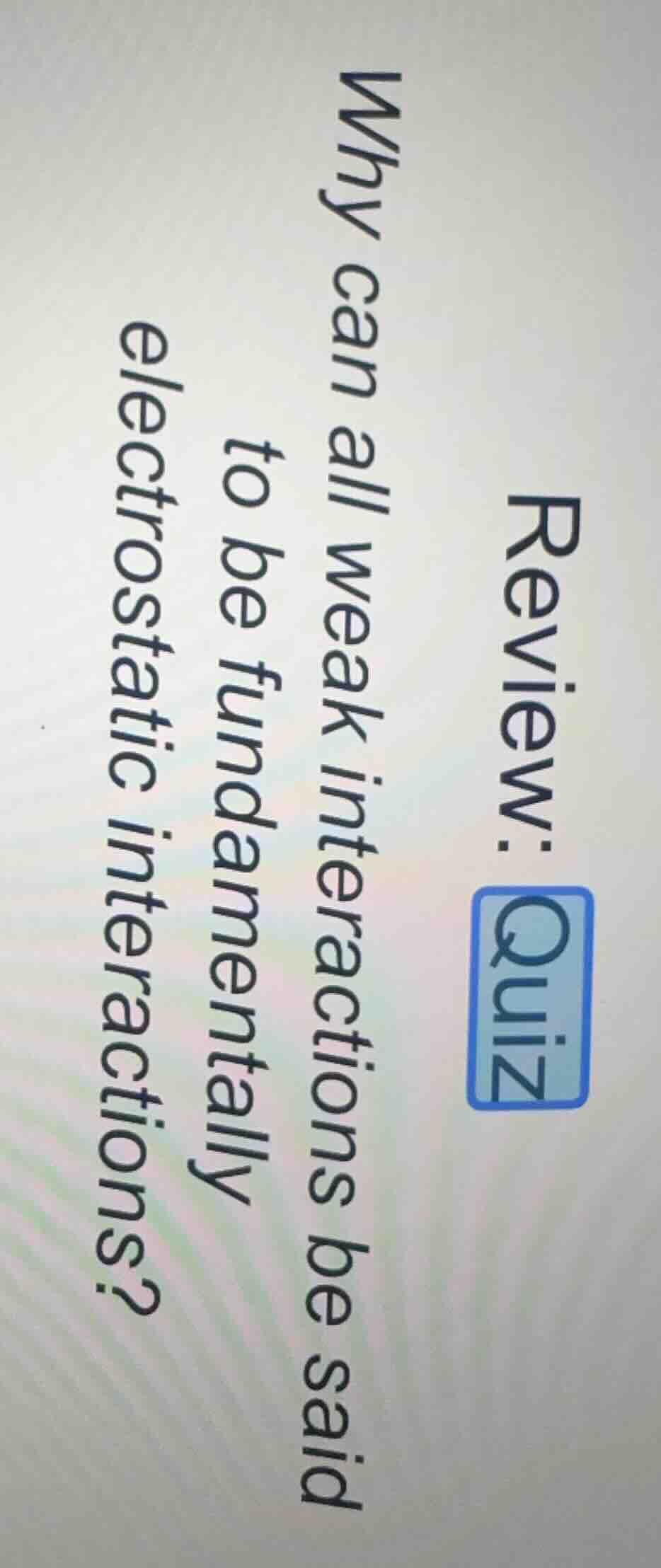
review: quiz why can all weak interactions be said to be fundamentally electrostatic interactions?
All weak interactions (like hydrogen bonds, van der Waals forces, hydrophobic interactions) arise from the attraction or repulsion between charged or partially charged particles. For example, hydrogen bonds form between a partially positive hydrogen (in a polar bond) and a partially negative atom; van der Waals forces stem from temporary dipoles that create electrostatic attractions. Even hydrophobic interactions are indirectly driven by the need to maximize favorable electrostatic interactions between polar water molecules. At their core, all these weak forces rely on electrostatic (charge-based) interactions.

Snap & solve any problem in the app
Get step-by-step solutions on Sovi AI
Photo-based solutions with guided steps
Explore more problems and detailed explanations
All weak interactions are fundamentally electrostatic because they all originate from the attractive or repulsive forces between charged, partially charged, or temporarily charged particles (such as dipoles, partial charges in polar molecules, or induced charges), with even indirect weak interactions like hydrophobic effects ultimately tied to optimizing electrostatic interactions in the system.