QUESTION IMAGE
Question
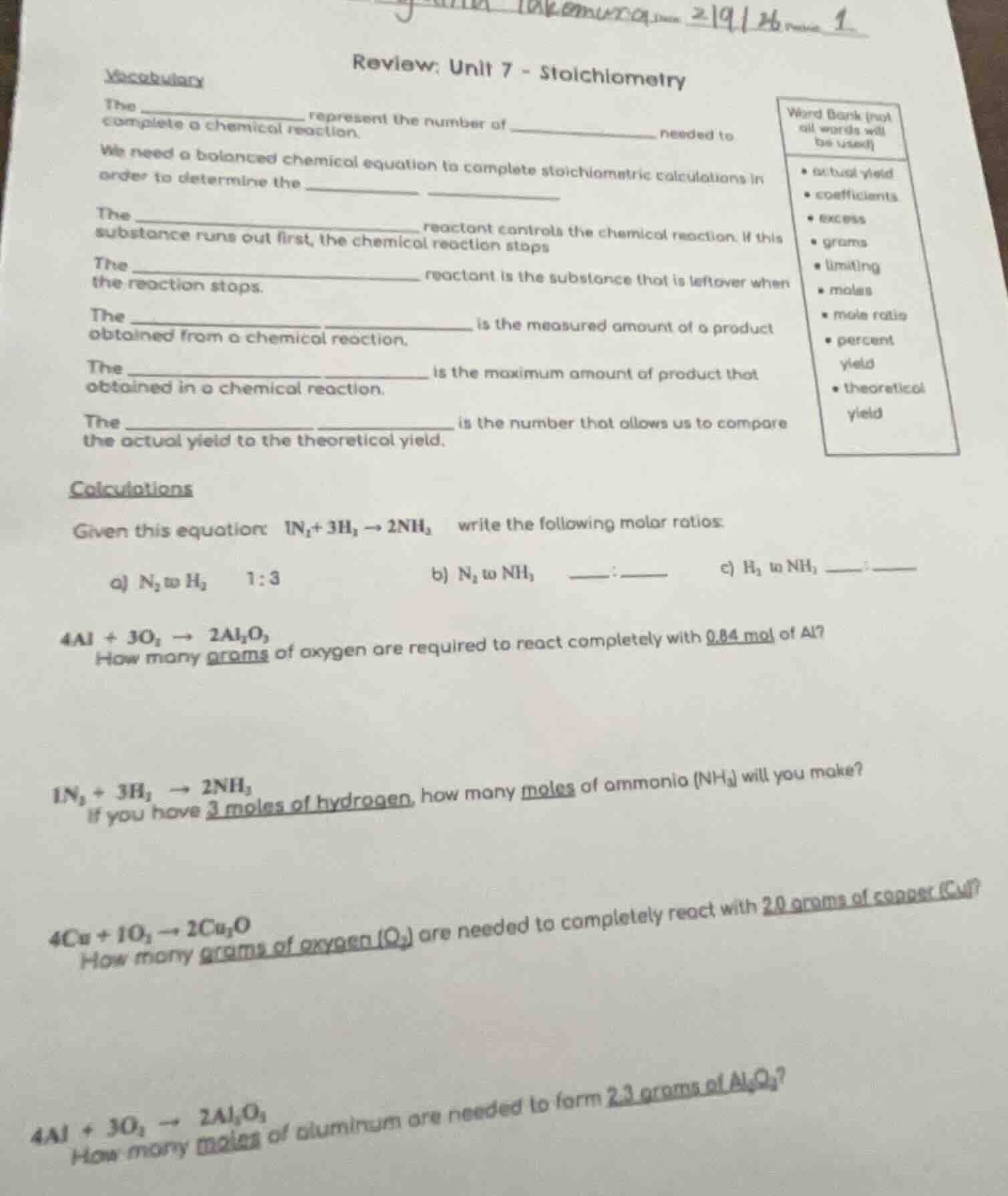
review: unit 7 - stoichiometryvocabularythe __________ represent the number of ________ needed to complete a chemical reaction.we need a balanced chemical equation to complete stoichiometric calculations in order to determine the ________ ________the ________ reactant controls the chemical reaction. if this substance runs out first, the chemical reaction stopsthe ________ reactant is the substance that is leftover when the reaction stops.the ________ ________ is the measured amount of a product obtained from a chemical reaction.the ________ ________ is the maximum amount of product that obtained in a chemical reaction.the ________ ________ is the number that allows us to compare the actual yield to the theoretical yield.word bank (not all words will be used)• actual yield• coefficients• excess• grams• limiting• moles• mole ratio• percent yield• theoretical yieldcalculationsgiven this equation: $ce{1n_{2}+3h_{2} -> 2nh_{3}}$ write the following molar ratios:a) $ce{n_{2}}$ to $ce{h_{2}}$ 1:3b) $ce{n_{2}}$ to $ce{nh_{3}}$ :c) $ce{h_{2}}$ to $ce{nh_{3}}$ :__$ce{4al + 3o_{2} -> 2al_{2}o_{3}}$how many grams of oxygen are required to react completely with 0.84 mol of al?$ce{1n_{2} + 3h_{2} -> 2nh_{3}}$if you have 3 moles of hydrogen, how many moles of ammonia ($ce{nh_{3}}$) will you make?$ce{4cu + 1o_{2} -> 2cu_{2}o}$how many grams of oxygen ($ce{o_{2}}$) are needed to completely react with 2.0 grams of copper (cu)?$ce{4al + 3o_{2} -> 2al_{2}o_{3}}$how many moles of aluminum are needed to form 2.3 grams of $ce{al_{2}o_{3}}$?
Vocabulary Section
Match terms to their definitions using the word bank, focusing on stoichiometry core concepts.
Step1: Extract mole ratios from equation
For $\ce{N2 + 3H2 -> 2NH3}$:
- b) Ratio of $\ce{N2}$ to $\ce{NH3}$: Use coefficients from the balanced equation.
- c) Ratio of $\ce{H2}$ to $\ce{NH3}$: Use coefficients from the balanced equation.
Step2: Moles of $\ce{O2}$ from $\ce{Al}$
Mole ratio $\ce{Al:O2} = 4:3$. Calculate moles of $\ce{O2}$:
$\text{Moles of } \ce{O2} = 0.84\ \text{mol Al} \times \frac{3\ \text{mol O2}}{4\ \text{mol Al}}$
Convert moles of $\ce{O2}$ to grams (molar mass $\ce{O2}=32.00\ \text{g/mol}$):
$\text{Mass of } \ce{O2} = \text{Moles of } \ce{O2} \times 32.00\ \text{g/mol}$
Step3: Moles of $\ce{NH3}$ from $\ce{H2}$
Mole ratio $\ce{H2:NH3} = 3:2$. Calculate moles of $\ce{NH3}$:
$\text{Moles of } \ce{NH3} = 3\ \text{mol H2} \times \frac{2\ \text{mol NH3}}{3\ \text{mol H2}}$
Step4: Mass of $\ce{O2}$ from $\ce{Cu}$
Molar mass of $\ce{Cu}=63.55\ \text{g/mol}$. Moles of $\ce{Cu}$:
$\text{Moles of } \ce{Cu} = \frac{2.0\ \text{g}}{63.55\ \text{g/mol}}$
Mole ratio $\ce{Cu:O2}=4:1$. Moles of $\ce{O2}$:
$\text{Moles of } \ce{O2} = \text{Moles of } \ce{Cu} \times \frac{1\ \text{mol O2}}{4\ \text{mol Cu}}$
Convert to grams:
$\text{Mass of } \ce{O2} = \text{Moles of } \ce{O2} \times 32.00\ \text{g/mol}$
Step5: Moles of $\ce{Al}$ from $\ce{Al2O3}$
Molar mass of $\ce{Al2O3}=101.96\ \text{g/mol}$. Moles of $\ce{Al2O3}$:
$\text{Moles of } \ce{Al2O3} = \frac{2.3\ \text{g}}{101.96\ \text{g/mol}}$
Mole ratio $\ce{Al:Al2O3}=4:2=2:1$. Moles of $\ce{Al}$:
$\text{Moles of } \ce{Al} = \text{Moles of } \ce{Al2O3} \times 2$

Snap & solve any problem in the app
Get step-by-step solutions on Sovi AI
Photo-based solutions with guided steps
Explore more problems and detailed explanations
- The coefficients represent the number of moles needed to complete a chemical reaction.
- We need a balanced chemical equation to complete stoichiometric calculations in order to determine the mole ratio.
- The limiting reactant controls the chemical reaction. If this substance runs out first, the chemical reaction stops.
- The excess reactant is the substance that is leftover when the reaction stops.
- The actual yield is the measured amount of a product obtained from a chemical reaction.
- The theoretical yield is the maximum amount of product that obtained in a chemical reaction.
- The percent yield is the number that allows us to compare the actual yield to the theoretical yield.
---