QUESTION IMAGE
Question
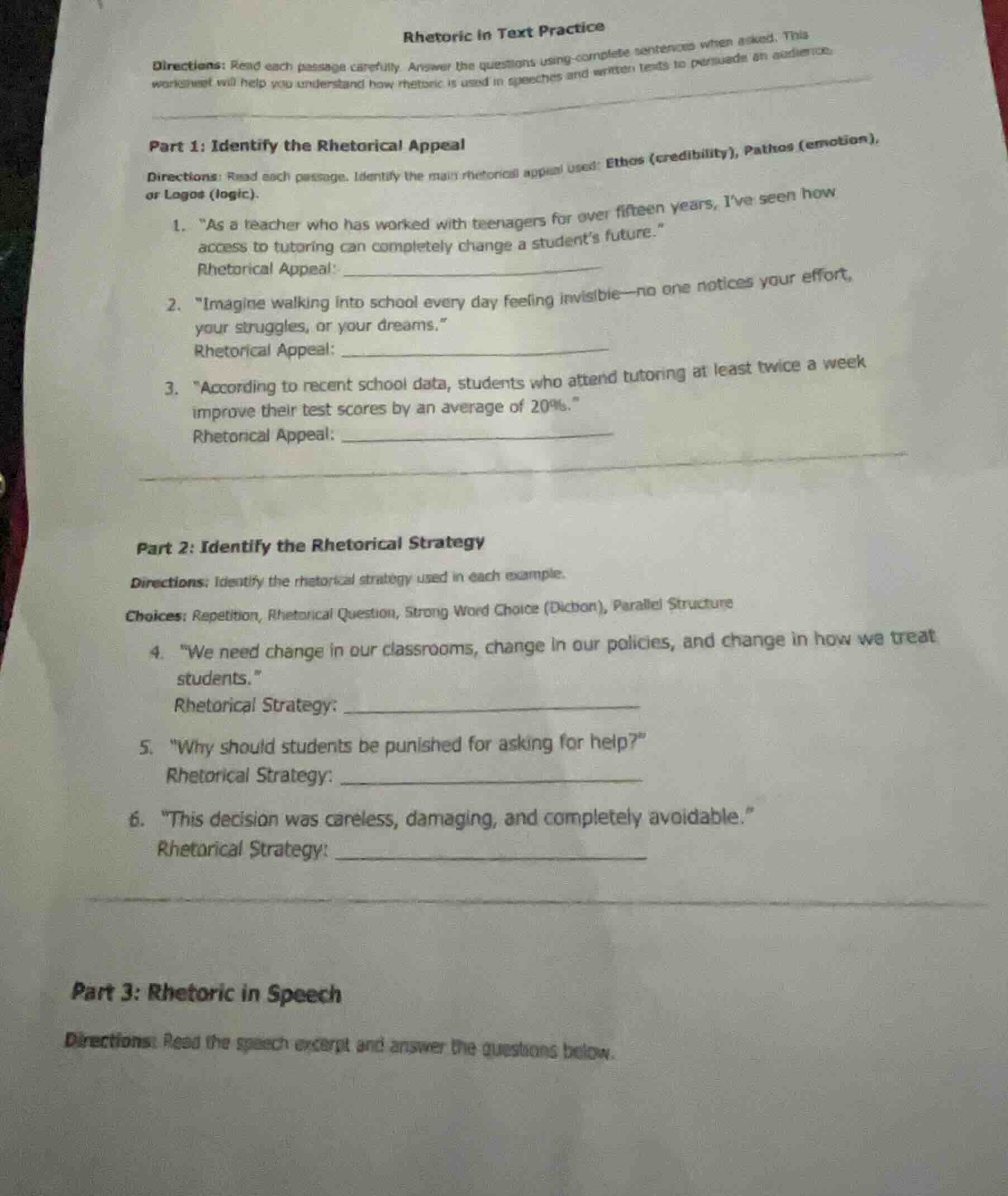
rhetoric in text practice
directions: read each passage carefully. answer the questions using complete sentences when asked. this
worksheet will help you understand how rhetoric is used in speeches and written texts to persuade an audience.
part 1: identify the rhetorical appeal
directions: read each passage. identify the main rhetorical appeal used: ethos (credibility), pathos (emotion),
or logos (logic).
- \as a teacher who has worked with teenagers for over fifteen years, ive seen how
access to tutoring can completely change a students future.\
rhetorical appeal: _________________________
- \imagine walking into school every day feeling invisible—no one notices your effort,
your struggles, or your dreams.\
rhetorical appeal: _________________________
- \according to recent school data, students who attend tutoring at least twice a week
improve their test scores by an average of 20%.\
rhetorical appeal: _________________________
part 2: identify the rhetorical strategy
directions: identify the rhetorical strategy used in each example.
choices: repetition, rhetorical question, strong word choice (diction), parallel structure
- \we need change in our classrooms, change in our policies, and change in how we treat
students.\
rhetorical strategy: _________________________
- \why should students be punished for asking for help?\
rhetorical strategy: _________________________
- \this decision was careless, damaging, and completely avoidable.\
rhetorical strategy: _________________________
part 3: rhetoric in speech
directions: read the speech excerpt and answer the questions below.
- The speaker cites their 15 years of experience as a teacher, which establishes their credibility on the topic of students and tutoring.
- The passage asks the reader to visualize a lonely, unrecognized experience, which targets emotional empathy.
- The passage uses specific school data and a percentage to make a logical, evidence-based claim about tutoring.
- The phrase "change in our..." is repeated three times to emphasize the need for change.
- The sentence is a question posed not to get an answer, but to challenge the audience and provoke thought.
- The sentence uses a series of descriptive, judgmental adjectives ("careless, damaging, and completely avoidable") to frame the decision negatively through deliberate impactful word choice.

Snap & solve any problem in the app
Get step-by-step solutions on Sovi AI
Photo-based solutions with guided steps
Explore more problems and detailed explanations
- Ethos
- Pathos
- Logos
- Repetition
- Rhetorical Question
- Strong Word Choice (Diction)