QUESTION IMAGE
Question
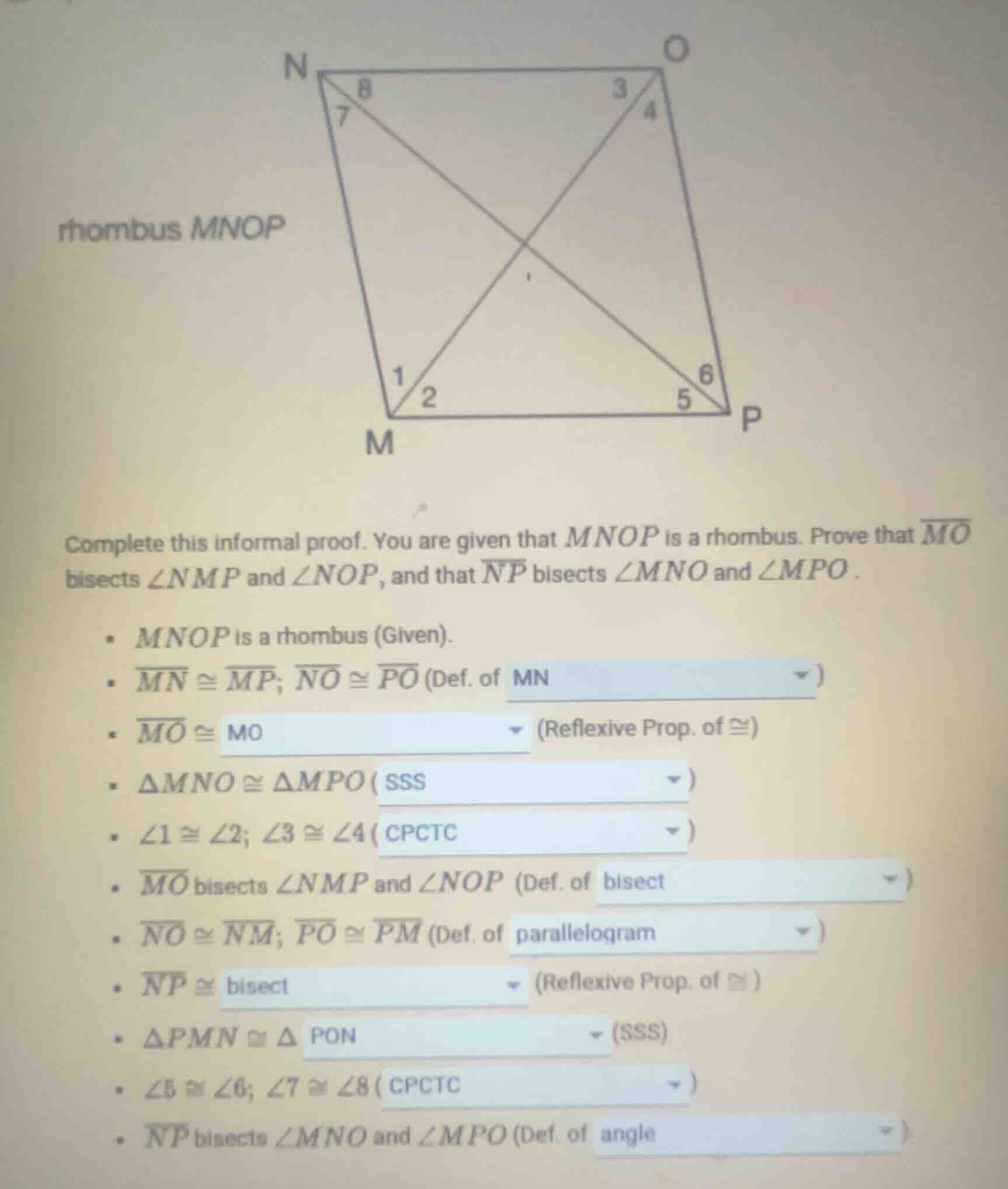
rhombus mnop
complete this informal proof. you are given that mnop is a rhombus. prove that \\(\overline{mo}\\) bisects \\(\angle nmp\\) and \\(\angle nop\\), and that \\(\overline{np}\\) bisects \\(\angle mno\\) and \\(\angle mpo\\).
- mnop is a rhombus (given).
- \\(\overline{mn} \cong \overline{mp}\\); \\(\overline{no} \cong \overline{po}\\) (def. of mn)
- \\(\overline{mo} \cong \\) mo (reflexive prop. of \\(\cong\\))
- \\(\triangle mno \cong \triangle mpo\\) ( sss )
- \\(\angle 1 \cong \angle 2\\); \\(\angle 3 \cong \angle 4\\) ( cpctc )
- \\(\overline{mo}\\) bisects \\(\angle nmp\\) and \\(\angle nop\\) (def. of bisect )
- \\(\overline{no} \cong \overline{nm}\\); \\(\overline{po} \cong \overline{pm}\\) (def. of parallelogram )
- \\(\overline{np} \cong \\) bisect (reflexive prop. of \\(\cong\\) )
- \\(\triangle pmn \cong \triangle \\) pon (sss)
- \\(\angle 5 \cong \angle 6\\); \\(\angle 7 \cong \angle 8\\) ( cpctc )
- \\(\overline{np}\\) bisects \\(\angle mno\\) and \\(\angle mpo\\) (def. of angle )
Step1: Recall Rhombus Properties
A rhombus has all sides equal, so \( \overline{MN} \cong \overline{MP} \), \( \overline{NO} \cong \overline{PO} \) (Def. of rhombus, since all sides of a rhombus are congruent). Also, \( \overline{NO} \cong \overline{NM} \), \( \overline{PO} \cong \overline{PM} \) (Def. of rhombus, all sides congruent).
Step2: Reflexive Property for \( \overline{MO} \)
\( \overline{MO} \cong \overline{MO} \) (Reflexive Prop. of \( \cong \), a segment is congruent to itself).
Step3: SSS Congruence for \( \triangle MNO \) and \( \triangle MPO \)
With \( \overline{MN} \cong \overline{MP} \), \( \overline{NO} \cong \overline{PO} \), \( \overline{MO} \cong \overline{MO} \), by SSS (Side - Side - Side) congruence criterion, \( \triangle MNO \cong \triangle MPO \).
Step4: CPCTC for Angles
By CPCTC (Corresponding Parts of Congruent Triangles are Congruent), \( \angle 1 \cong \angle 2 \), \( \angle 3 \cong \angle 4 \). This means \( \overline{MO} \) bisects \( \angle NMP \) (since \( \angle 1=\angle 2 \)) and \( \angle NOP \) (since \( \angle 3 = \angle 4 \)) (Def. of angle bisector: a ray that divides an angle into two congruent angles).
Step5: Rhombus Sides for \( \overline{NO},\overline{NM},\overline{PO},\overline{PM} \)
\( \overline{NO} \cong \overline{NM} \), \( \overline{PO} \cong \overline{PM} \) (Def. of rhombus, all sides congruent).
Step6: Reflexive Property for \( \overline{NP} \)
\( \overline{NP} \cong \overline{NP} \) (Reflexive Prop. of \( \cong \), a segment is congruent to itself).
Step7: SSS Congruence for \( \triangle PMN \) and \( \triangle PON \)
With \( \overline{NO} \cong \overline{NM} \), \( \overline{PO} \cong \overline{PM} \), \( \overline{NP} \cong \overline{NP} \), by SSS congruence criterion, \( \triangle PMN \cong \triangle PON \).
Step8: CPCTC for Angles
By CPCTC, \( \angle 5 \cong \angle 6 \), \( \angle 7 \cong \angle 8 \). This means \( \overline{NP} \) bisects \( \angle MNO \) (since \( \angle 7=\angle 8 \)) and \( \angle MPO \) (since \( \angle 5=\angle 6 \)) (Def. of angle bisector).
Filling the Blanks:
- \( \overline{MN} \cong \overline{MP};\overline{NO} \cong \overline{PO} \) (Def. of rhombus)
- \( \overline{MO} \cong \boldsymbol{\overline{MO}} \) (Reflexive Prop. of \( \cong \))
- \( \triangle MNO \cong \triangle MPO \) (SSS)
- \( \angle 1 \cong \angle 2;\angle 3 \cong \angle 4 \) (CPCTC)
- \( \overline{MO} \) bisects \( \angle NMP \) and \( \angle NOP \) (Def. of angle bisector)
- \( \overline{NO} \cong \overline{NM};\overline{PO} \cong \overline{PM} \) (Def. of rhombus)
- \( \overline{NP} \cong \boldsymbol{\overline{NP}} \) (Reflexive Prop. of \( \cong \))
- \( \triangle PMN \cong \triangle \boldsymbol{PON} \) (SSS)
- \( \angle 5 \cong \angle 6;\angle 7 \cong \angle 8 \) (CPCTC)
- \( \overline{NP} \) bisects \( \angle MNO \) and \( \angle MPO \) (Def. of angle bisector)

Snap & solve any problem in the app
Get step-by-step solutions on Sovi AI
Photo-based solutions with guided steps
Explore more problems and detailed explanations
- \( \overline{MN} \cong \overline{MP};\overline{NO} \cong \overline{PO} \) (Def. of rhombus)
- \( \overline{MO} \cong \overline{MO} \) (Reflexive Prop. of \( \cong \))
- \( \triangle MNO \cong \triangle MPO \) (SSS)
- \( \angle 1 \cong \angle 2;\angle 3 \cong \angle 4 \) (CPCTC)
- \( \overline{MO} \) bisects \( \angle NMP \) and \( \angle NOP \) (Def. of angle bisector)
- \( \overline{NO} \cong \overline{NM};\overline{PO} \cong \overline{PM} \) (Def. of rhombus)
- \( \overline{NP} \cong \overline{NP} \) (Reflexive Prop. of \( \cong \))
- \( \triangle PMN \cong \triangle PON \) (SSS)
- \( \angle 5 \cong \angle 6;\angle 7 \cong \angle 8 \) (CPCTC)
- \( \overline{NP} \) bisects \( \angle MNO \) and \( \angle MPO \) (Def. of angle bisector)