QUESTION IMAGE
Question
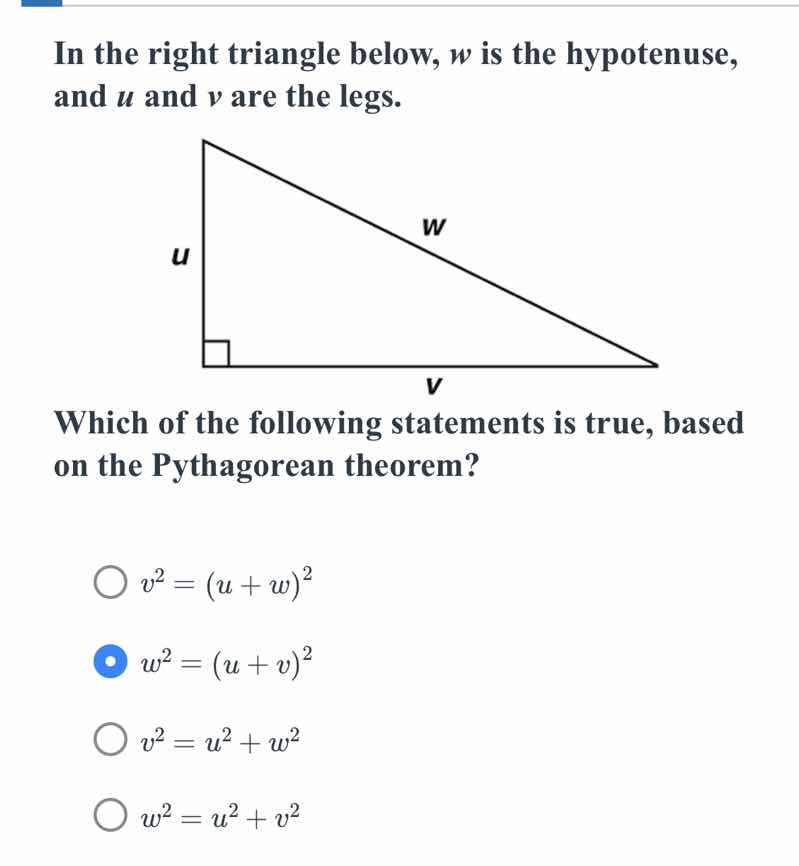
in the right triangle below, w is the hypotenuse, and u and v are the legs.
which of the following statements is true, based on the pythagorean theorem?
\\( v^2 = (u + w)^2 \\)
\\( w^2 = (u + v)^2 \\)
\\( v^2 = u^2 + w^2 \\)
\\( w^2 = u^2 + v^2 \\)
Step1: Recall Pythagorean Theorem
The Pythagorean theorem states that in a right triangle, the square of the hypotenuse (the side opposite the right angle) is equal to the sum of the squares of the other two sides (the legs). For a right triangle with legs \( u \) and \( v \), and hypotenuse \( w \), the formula is \( w^2 = u^2 + v^2 \).
Step2: Analyze Each Option
- Option 1: \( v^2=(u + w)^2 \). Expanding the right side gives \( u^2 + 2uw+w^2 \), which is not equal to \( v^2 \) (since \( w \) is the hypotenuse, \( w>v \), so this is false).
- Option 2: \( w^2=(u + v)^2 \). Expanding the right side gives \( u^2 + 2uv+v^2 \), which is not equal to \( w^2 \) (as per the Pythagorean theorem, it should be \( u^2 + v^2 \), not with the \( 2uv \) term), so this is false.
- Option 3: \( v^2=u^2 + w^2 \). Since \( w \) is the hypotenuse, \( w>v \), so \( u^2 + w^2 \) would be greater than \( v^2 \), and this contradicts the Pythagorean theorem, so this is false.
- Option 4: \( w^2=u^2 + v^2 \). This matches the Pythagorean theorem for a right triangle with legs \( u, v \) and hypotenuse \( w \), so this is true.

Snap & solve any problem in the app
Get step-by-step solutions on Sovi AI
Photo-based solutions with guided steps
Explore more problems and detailed explanations
D. \( w^2 = u^2 + v^2 \) (assuming the last option is D, as per the standard Pythagorean theorem statement for this triangle)