QUESTION IMAGE
Question
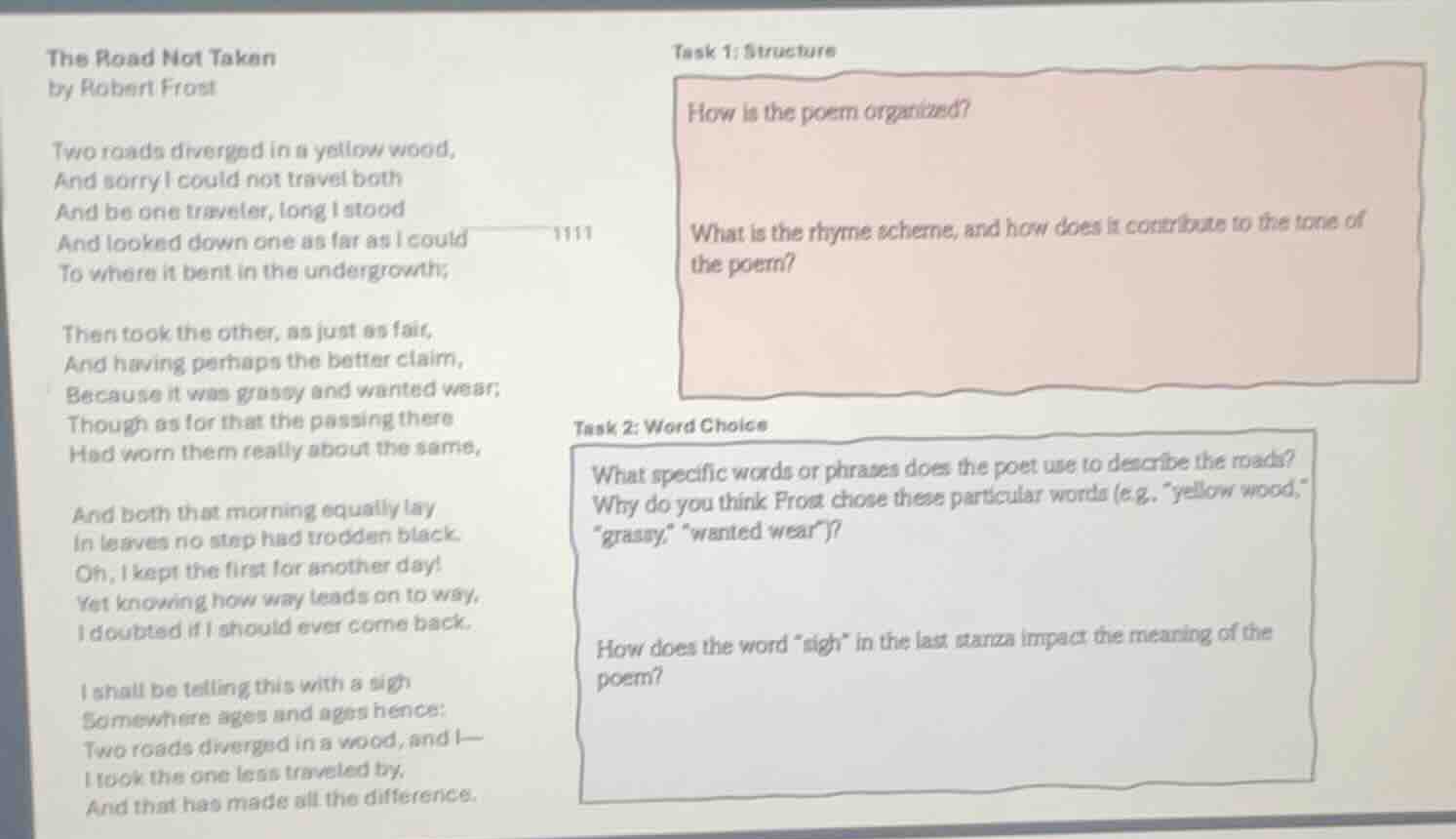
the road not taken by robert frost two roads diverged in a yellow wood, and sorry i could not travel both and be one traveler, long i stood and looked down one as far as i could to where it bent in the undergrowth; then took the other, as just as fair, and having perhaps the better claim, because it was grassy and wanted wear; though as for that the passing there had worn them really about the same, and both that morning equally lay in leaves no step had trodden black. oh, i kept the first for another day! yet knowing how way leads on to way, i doubted if i should ever come back. i shall be telling this with a sigh somewhere ages and ages hence: two roads diverged in a wood, and i— i took the one less traveled by, and that has made all the difference. task 1: structure how is the poem organized? what is the rhyme scheme, and how does it contribute to the tone of the poem? task 2: word choice what specific words or phrases does the poet use to describe the roads? why do you think frost chose these particular words (e.g., “yellow wood,” “grassy,” “wanted wear”)? how does the word “sigh” in the last stanza impact the meaning of the poem?
For Task 1: Structure
- Organization: The poem is organized into 4 stanzas of 5 lines each, following a narrative arc: the speaker's moment of choice, reflection on the choice, doubt about revisiting, and a retrospective framing of the choice.
- Rhyme Scheme: The poem uses an ABAAB rhyme scheme (e.g., Stanza 1: wood/stood/could (A), both/undergrowth (B)). This consistent, folksy scheme creates a calm, reflective tone, mirroring the speaker's thoughtful, nostalgic framing of their past choice rather than a frantic one.
For Task 2: Word Choice
- Road Descriptions: Frost uses phrases like "yellow wood", "grassy and wanted wear", "no step had trodden black". "Yellow wood" signals an autumnal, transitional moment, emphasizing a pivotal choice. "Grassy and wanted wear" frames the road as less traveled, while "no step had trodden black" shows both roads were similarly fresh that morning, highlighting the speaker's later romanticization of the choice.
- Impact of "sigh": The word "sigh" carries ambiguous, bittersweet weight—it can signal regret over the road not taken, quiet satisfaction with the chosen path, or the weariness of looking back on a life-defining choice, adding nuance to the poem's theme of life's irreversible decisions.

Snap & solve any problem in the app
Get step-by-step solutions on Sovi AI
Photo-based solutions with guided steps
Explore more problems and detailed explanations
Task 1: Structure
- The poem is split into 4 5-line stanzas, following a narrative of choice, reflection, doubt, and retrospective storytelling.
- The rhyme scheme is ABAAB; its consistent, gentle rhythm fosters a calm, nostalgic, reflective tone that matches the speaker's thoughtful look back on their choice.
Task 2: Word Choice
- Specific phrases: "yellow wood", "grassy and wanted wear", "no step had trodden black". "Yellow wood" sets a transitional, pivotal scene; "grassy and wanted wear" implies a less-traveled road; "no step had trodden black" reveals the roads were nearly identical, underscoring the speaker's later romanticization of their choice.
- The "sigh" adds ambiguous, bittersweet depth—it can convey regret, quiet satisfaction, or the weariness of reflecting on a life-altering, irreversible decision, enriching the poem's theme of life's choices.