QUESTION IMAGE
Question
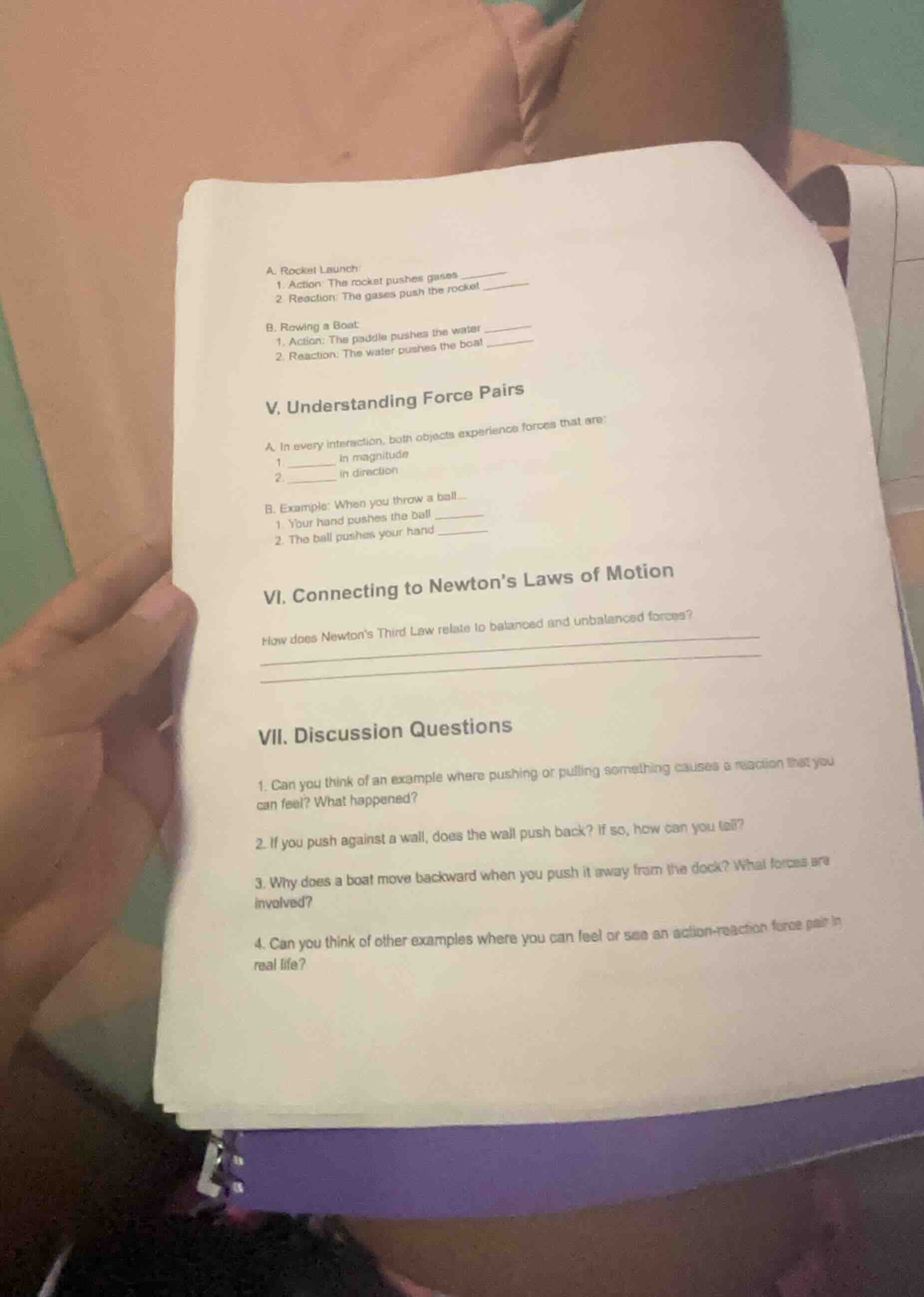
a. rocket launch
- action: the rocket pushes gases ______
- reaction: the gases push the rocket ______
b. rowing a boat
- action: the paddle pushes the water ______
- reaction: the water pushes the boat ______
v. understanding force pairs
a. in every interaction, both objects experience forces that are:
- ______ in magnitude
- ______ in direction
b. example: when you throw a ball...
- your hand pushes the ball ______
- the ball pushes your hand ______
vi. connecting to newton’s laws of motion
how does newton’s third law relate to balanced and unbalanced forces?
_____________________________________________________
_____________________________________________________
vii. discussion questions
- can you think of an example where pushing or pulling something causes a reaction that you can feel? what happened?
- if you push against a wall, does the wall push back? if so, how can you tell?
- why does a boat move backward when you push it away from the dock? what forces are involved?
- can you think of other examples where you can feel or see an action - reaction force pair in real life?
Step1: Fill rocket action/reaction
A. Rocket Launch:
- Action: The rocket pushes gases downward
- Reaction: The gases push the rocket upward
Step2: Fill rowing action/reaction
B. Rowing a Boat:
- Action: The paddle pushes the water backward
- Reaction: The water pushes the boat forward
Step3: Fill force pair properties
V. Understanding Force Pairs
A. In every interaction, both objects experience forces that are:
- equal in magnitude
- opposite in direction
Step4: Fill ball throw action/reaction
B. Example: When you throw a ball...
- Your hand pushes the ball forward
- The ball pushes your hand backward
Step5: Answer Newton's 3rd Law question
VI. Connecting to Newton's Laws of Motion
Newton's Third Law describes action-reaction force pairs that are always equal in magnitude and opposite in direction. These pairs act on different objects, so they do not cancel each other out (they are not balanced forces). Balanced forces act on the same object and result in no acceleration; unbalanced forces (a single net force on one object) cause acceleration, while the reaction force acts on a separate object.
Step6: Answer discussion questions
VII. Discussion Questions
- Example: When you jump off a small stool. You push down on the stool, and you feel the stool push up on your feet, launching you into the air.
- Yes, the wall pushes back. You can tell because you feel a pressure on your hands, and your body does not move through the wall (the force from the wall opposes your push).
- This is due to Newton's Third Law: when you push the boat away from the dock (action force: you push the boat backward), the boat exerts an equal and opposite reaction force on you, pushing you backward (making the boat move away from the dock relative to you). The forces involved are your push on the boat and the boat's push on you.
- Example: When you fire a gun: the gun pushes the bullet forward, and the bullet pushes the gun backward (recoil that you feel in your shoulder). Another example: swimming: you push water backward with your arms/legs, and the water pushes you forward.

Snap & solve any problem in the app
Get step-by-step solutions on Sovi AI
Photo-based solutions with guided steps
Explore more problems and detailed explanations
A. Rocket Launch:
- Action: The rocket pushes gases downward
- Reaction: The gases push the rocket upward
B. Rowing a Boat:
- Action: The paddle pushes the water backward
- Reaction: The water pushes the boat forward
V. Understanding Force Pairs
A.
- equal
- opposite
B.
- forward
- backward
VI. Connecting to Newton's Laws of Motion
Newton's Third Law describes action-reaction force pairs (equal, opposite, acting on different objects). These pairs are not balanced forces (balanced forces act on the same object). Unbalanced forces (net force on one object) cause acceleration, while the reaction force acts on a second object.
VII. Discussion Questions
- Example: Jumping off a stool. You push down on the stool, and the stool pushes up on your feet, lifting you.
- Yes, the wall pushes back. You feel pressure on your hands, and your body cannot move through the wall, proving the opposing force exists.
- It follows Newton's Third Law: when you push the boat away (action), the boat exerts an equal opposite force on you, making the boat move backward relative to the dock. The forces are your push on the boat and the boat's push on you.
- Example: Firing a gun: the gun pushes the bullet forward, and the bullet causes the gun to recoil backward (felt as a push on your shoulder). Another example: Walking: you push the ground backward, and the ground pushes you forward.